My Forking Life

  • Air Fryer
  • Jamaican
  • Entree
  • Browse Recipes
  • Breakfast
  • Side Dishes
  • About
menu icon
go to homepage
  • Air Fryer
  • Jamaican
  • Entree
  • Browse Recipes
  • Breakfast
  • Side Dishes
  • About
search icon
Homepage link
  • Air Fryer
  • Jamaican
  • Entree
  • Browse Recipes
  • Breakfast
  • Side Dishes
  • About
×
Home » Recipe Index

Southern Smothered Potatoes Recipe

August 15, 2026 by Tanya Harris 13 Comments

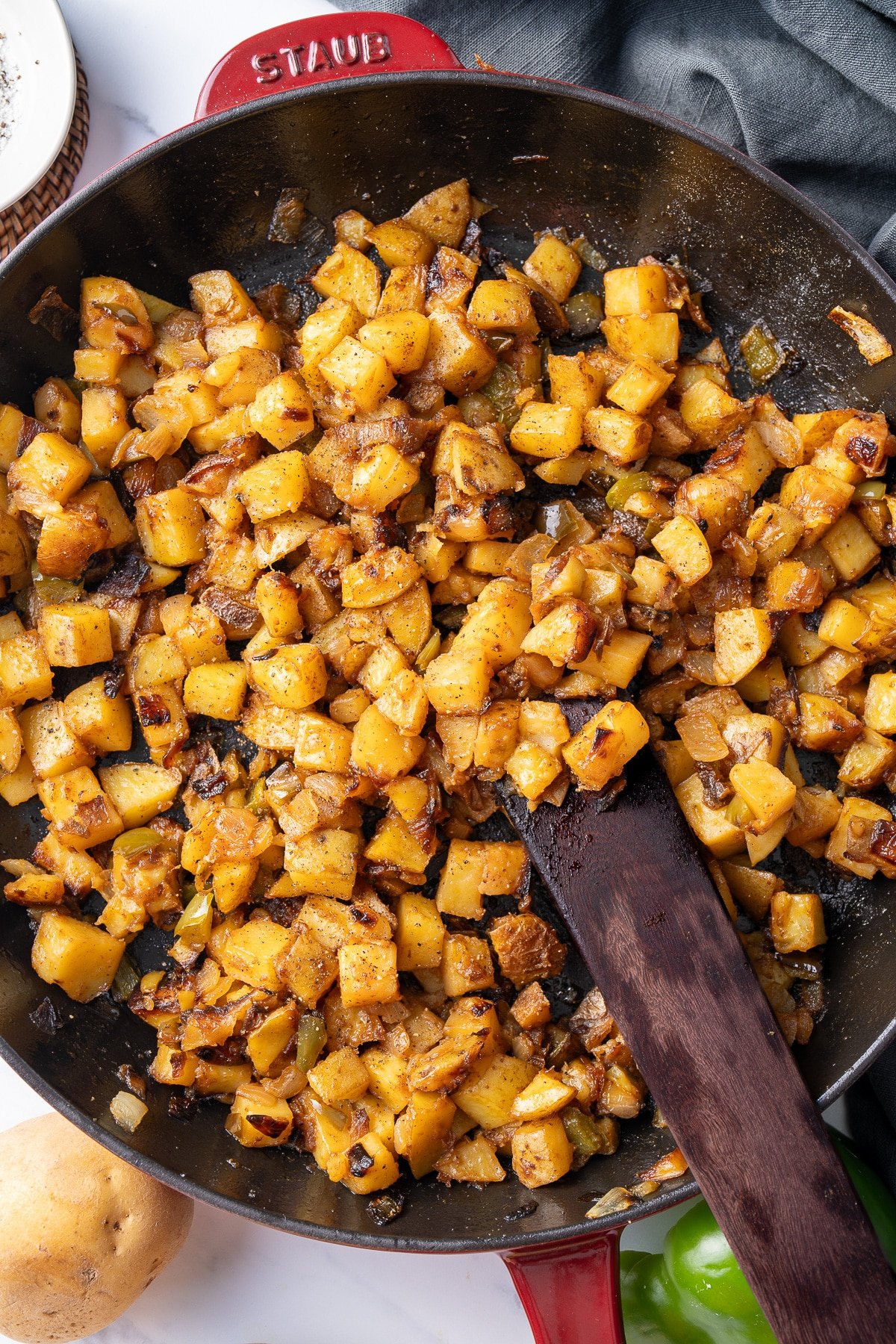
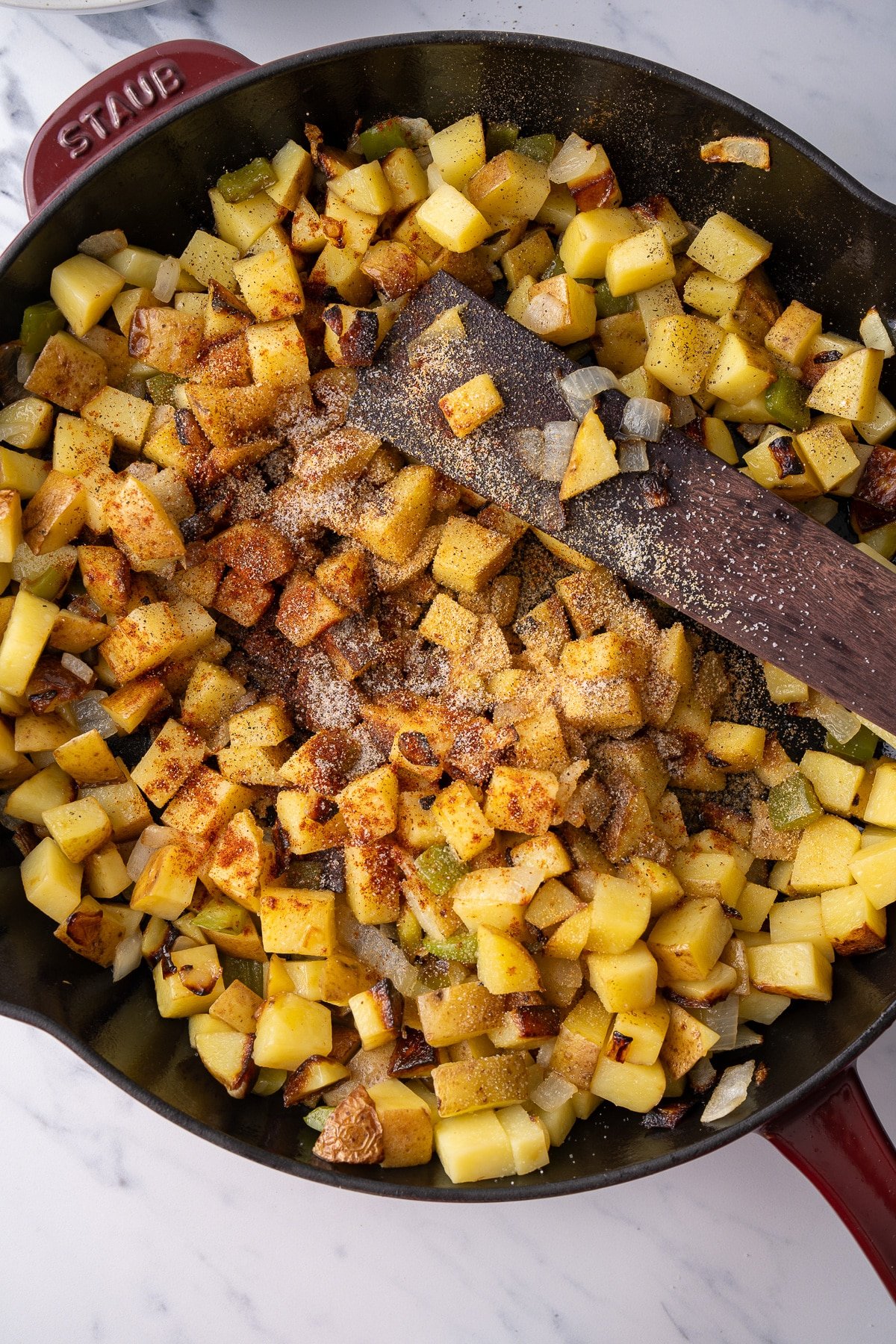
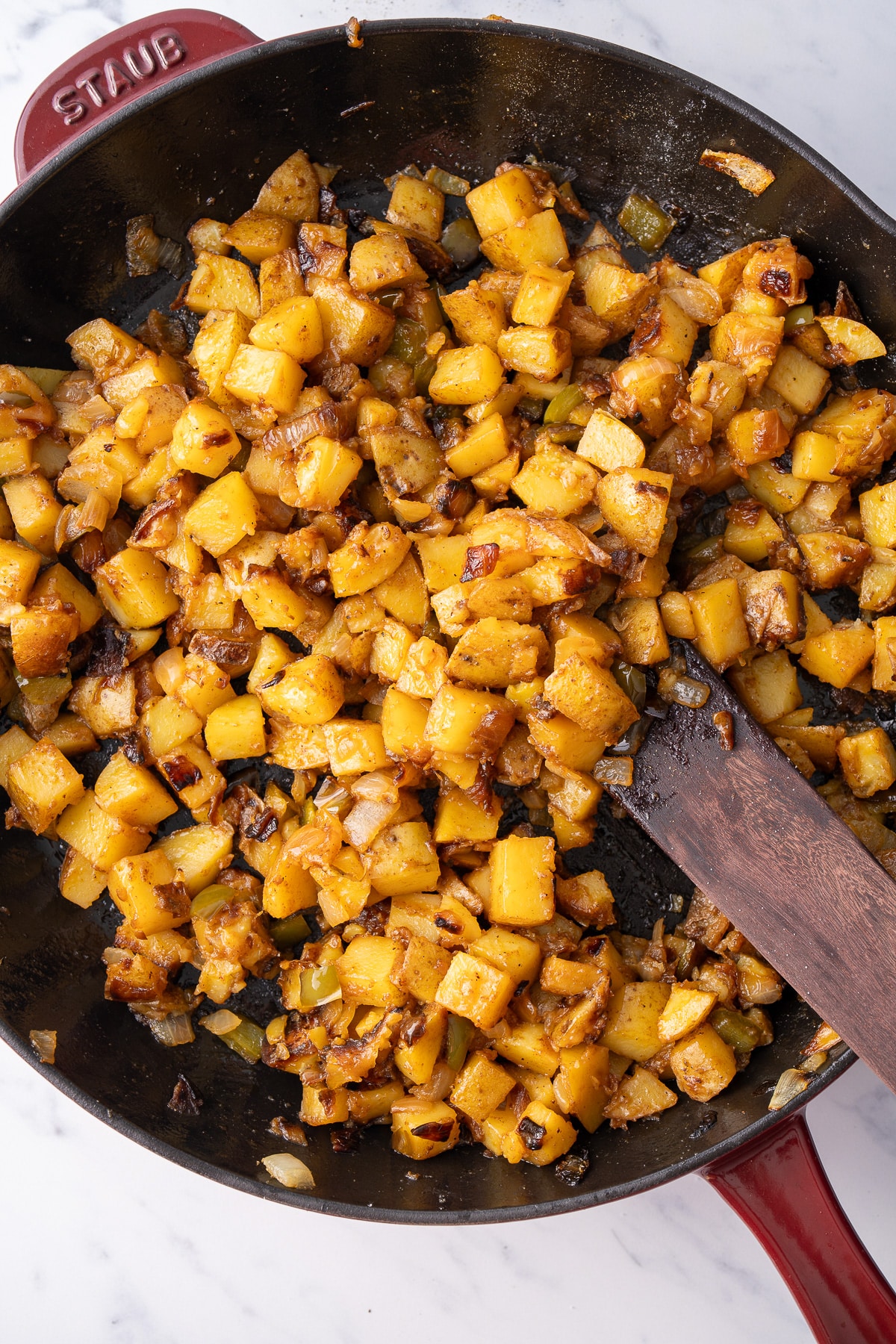
smothered potatoes in cast iron skillet with wooden spatula sticking out

These Smothered Potatoes are the ultimate side dish. This classic Southern dish features tender potatoes, sautéed peppers, and delicious seasonings, creating a comforting meal.

smothered potatoes in cast iron skillet with wooden spatula sticking out

You’ll find the full recipe with ingredient amounts and instructions in the recipe card at the bottom of this post. Be sure to check out the blog post itself for extra tips and tricks!
This side dish is a staple in our house because it is quick, delicious, and can be served during multiple meals. Whether for breakfast, lunch, or dinner, these smothered potatoes pair well with almost any meal.

Smothered potatoes are a classic dish from the Southern United States, particularly Louisiana. To "smother" vegetables means to cook them slowly at a low temperature until they are tender and flavorful. Some cooks add meats like bacon or sausage to the dish.

If you like smothered dishes, try my smothered green beans or smothered chicken.

5 Star Review

⭐⭐⭐⭐⭐

Karen H. says, "Wonderfully delicious! I have used buttermilk for years, but love the chicken broth flavor."

Ingredient Notes

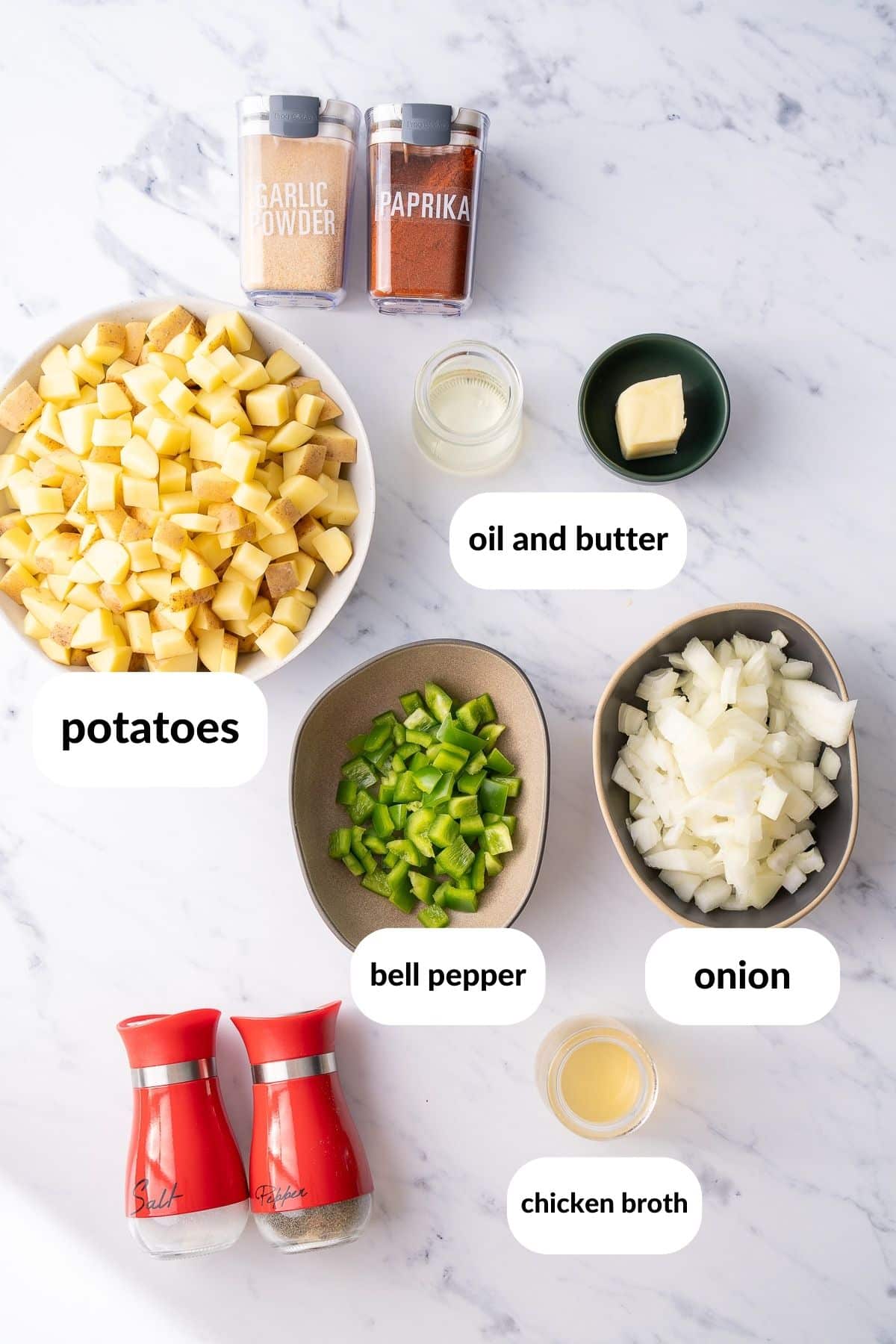
Ingredient amounts and full recipe instructions are on the printable recipe card at the bottom of the post.

  • Potatoes: The star of this dish. Choose starchy potatoes like Russet or Yukon Gold for the best results.
  • Oil and Butter: To brown the potatoes and add that rich, buttery flavor.
  • Onion and Bell Pepper: These aromatic vegetables add flavor.
  • Seasonings: Paprika, garlic powder, salt, and black pepper. You can also use about one teaspoon of an all-purpose seasoning blend if you prefer.
  • Broth: Chicken broth. You could also use vegetable broth, beef broth, or water.
ingredients for smothered potatoes

Tools Needed

  • Large skillet or cast-iron pan
  • Spatula
  • Knife
  • Cutting board
  • Measuring spoons

How to Make Southern Smothered Potatoes

Please see the recipe card below for the full printable recipe, ingredients, and instructions. Here you will find step-by-step photos of how to make this recipe.

Step 1: Prep the Ingredients

Peel and cube the potatoes. You can also skip the peeling of the potatoes if you prefer. Chop the onion and green bell pepper.

Step 2: Heat the Pan and cook the peppers and onions

Heat the oil and butter in a large skillet over medium heat. Add the chopped onions and green bell pepper to the skillet. Cook, stirring occasionally, until they soften and become aromatic, about 5-7 minutes.

Step 3: Add Potatoes

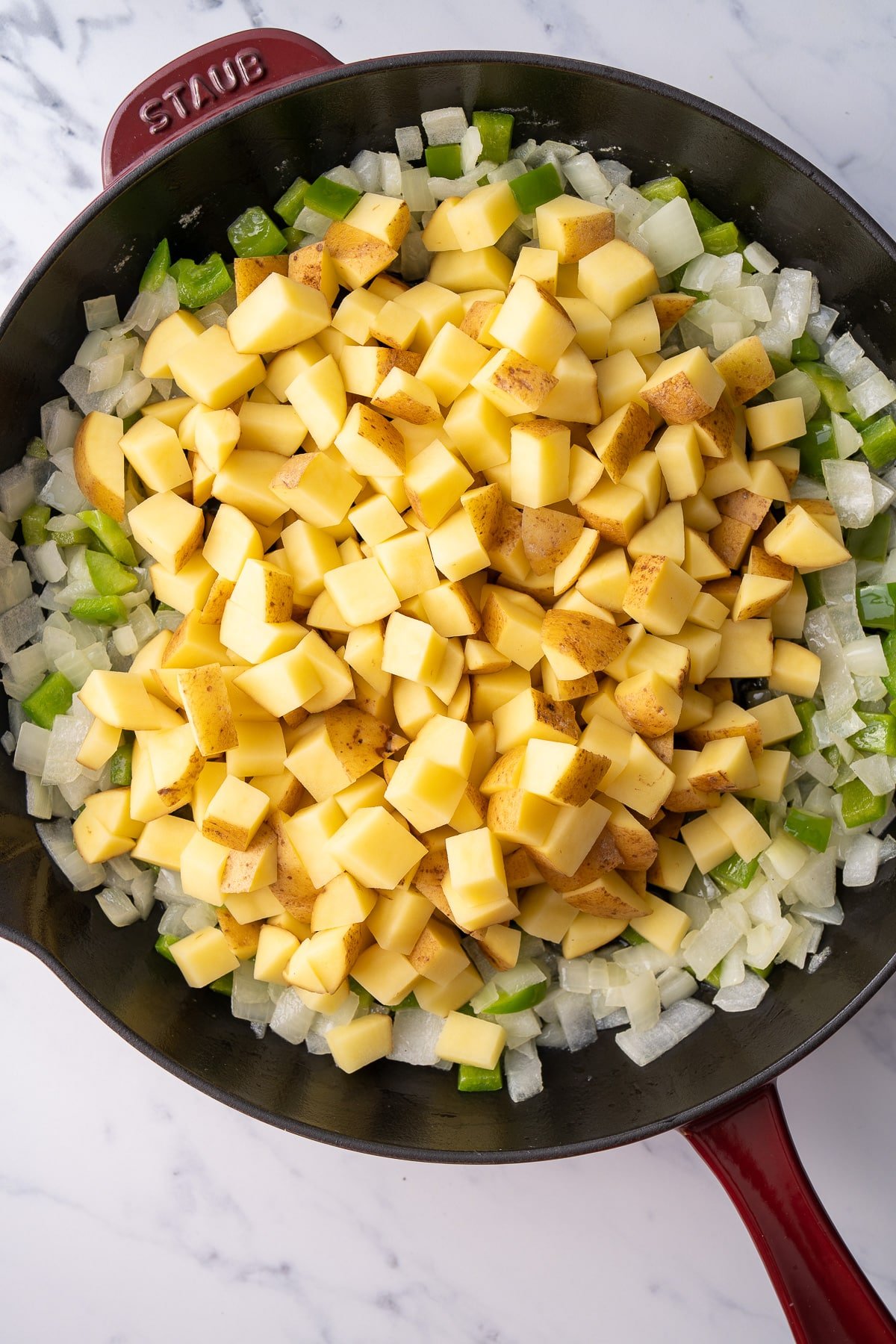
Increase the heat to medium-high. Use a spatula and push the onions and bell peppers to the edges of the pan. Place the potatoes in a flat layer in the pan in the middle of the onions and peppers.

Allow them to cook undisturbed for about 5-6 minutes, then use a spatula and stir the potatoes. Continue cooking for another 5 minutes.

potatoes and green peppers in cast iron pan

Step 4: Season and Cook

Add garlic powder, paprika, salt, and black pepper to the skillet. Mix well to ensure the vegetables are evenly coated with the seasonings.

Lower the heat, pour in the chicken broth, cover, and cook potatoes for 10-15 minutes until tender. Stir occasionally to prevent sticking and ensure even cooking.

seasoning added to potatoes
cooked smothered potatoes  in skillet

Variations

  • For a vegetarian option, use vegetable broth instead of chicken or beef broth.
  • Add chopped bacon or sliced sausage for extra flavor and protein.
  • Mix in other vegetables such as carrots, celery, or mushrooms to add more texture and nutrients.
  • Slice the potatoes rather than chopping them if you prefer.

Tanya's Tips for the Best Smothered Potatoes

  • Use starchy potatoes like Russet or Yukon Gold. They hold their shape when cooked and have a creamy texture that pairs well with the gravy.
  • Don't overcrowd the pan. This will prevent the potatoes from browning evenly.
  • For maximum flavor, let the potatoes cook undisturbed for 5 minutes.
  • Although any large pan will work, use a cast iron skillet for best results.

How to Store Smothered Potatoes

  • Refrigerator: Store any leftovers in an airtight container in the refrigerator for up to 3 days.
  • Reheating: Reheat in a skillet over medium heat until warmed through. You can add a bit of oil or butter to keep them from sticking.

FAQs

Why are my smothered potatoes mushy?

Potatoes turn mushy if the pan is overcrowded, if they are stirred too frequently, or if too much broth is added too early. To prevent this, cook them undisturbed in a single layer to develop a crust before covering and simmering.

What are the best potatoes to use for smothered potatoes?

Medium- to high-starch varieties like Yukon Gold or Russet potatoes work best. Yukon Golds hold their shape well while providing a creamy interior, whereas Russets break down slightly to create a thicker pan gravy.

Do I need to peel the potatoes before cooking?

Peeling is optional. Russet potatoes are typically peeled due to their thicker skin, but thin-skinned varieties like Yukon Gold or red potatoes can be left unpeeled for extra texture and quicker prep.

Make these Smothered Potatoes A Meal: Serve them with these dishes

  • Smothered Chicken. Golden chicken thighs in a rich, creamy onion gravy that comes together in under an hour, and the gravy is very happy to run over into the potatoes.
  • Smothered Turkey Wings. Slow roasted turkey wings with a homemade gravy built from the pan drippings, and it is the Sunday dinner plate these potatoes were made for.
  • Baked Chicken Leg Quarters. Crispy skinned leg quarters baked at 400 degrees with the same all purpose seasoning you can use in these potatoes, so one spice blend gets you the whole plate.
  • Slow Cooker Collard Greens. Tender greens that cook low and slow for six to seven hours with a splash of apple cider vinegar to cut through all that richness.
  • Air Fryer Egg Frittata. A fluffy egg frittata loaded with ham and cheddar in about fifteen minutes, which turns these potatoes into a full weekend breakfast.

I hope you love this recipe as much as we do. If you have tried this recipe or any other recipe on my blog, please rate it and let me know how it turned out in the comments below! Your feedback is invaluable and helps us grow. Thank you for your support!

smothered potatoes in cast iron skillet with wooden spatula sticking out
Print Recipe
4.20 from 5 votes

Smothered Potatoes Recipe

These Smothered Potatoes are the ultimate side dish. This classic Southern dish features tender potatoes, sautéed peppers, and delicious seasonings, creating a comforting meal.
Prep Time15 minutes mins
Cook Time25 minutes mins
Total Time40 minutes mins
Course: Side Dish
Cuisine: American
Keyword: smothered potatoes, southern smothered potatoes
Servings: 4 people
Calories: 264kcal
Author: Tanya Harris

Ingredients

  • 1.5 pounds of potatoes Yukon Gold or Russet, chopped into medium cubes
  • 1 large yellow onion chopped
  • ½ medium green bell pepper chopped into small pieces
  • 2 Tablespoons olive oil
  • 2 Tablespoons unsalted butter
  • ½ teaspoon garlic powder
  • ½ teaspoon paprika
  • Salt and black pepper to taste I use about ½ teaspoon salt, ¼ teaspoon black pepper
  • ¼ cup chicken broth

Instructions

  • Heat the oil and butter in a large skillet over medium heat. Add the chopped onions and green bell pepper, cooking and stirring occasionally until they soften and become fragrant approximately 5-7 minutes.
  • Increase the heat to medium-high. Use a spatula and push the onions and bell peppers to the edges of the pan. Place the potatoes in a flat layer in the pan in the middle of the onions and peppers.
  • Allow them to cook undisturbed for about 5-6 minutes, then use a spatula and stir the potatoes. Continue cooking for another 5 minutes.
  • Add garlic powder, paprika, salt, and black pepper to the skillet. Mix well to ensure the vegetables are evenly coated with the seasonings.
  • Lower the heat, pour in the chicken broth, cover, and cook potatoes for 10-15 minutes until tender. Stir occasionally to prevent sticking and ensure even cooking.

Notes

  • Don't overcrowd the pan. This will prevent the potatoes from browning evenly.
  • For maximum flavor, let the potatoes cook undisturbed for 5 minutes.
  • Peel the potatoes or keep them unpeeled, depending on your preference. 

Nutrition

Calories: 264kcal | Carbohydrates: 34g | Protein: 4g | Fat: 13g | Saturated Fat: 5g | Polyunsaturated Fat: 1g | Monounsaturated Fat: 7g | Trans Fat: 0.2g | Cholesterol: 15mg | Sodium: 68mg | Potassium: 811mg | Fiber: 5g | Sugar: 3g | Vitamin A: 358IU | Vitamin C: 48mg | Calcium: 34mg | Iron: 2mg

This was originally published on July 11th, 2024. It has been updated with new information.

Beef Tips with Rich Brown Gravy

August 14, 2026 by Tanya Harris Leave a Comment

beef tips with gravy with fork picking up beef

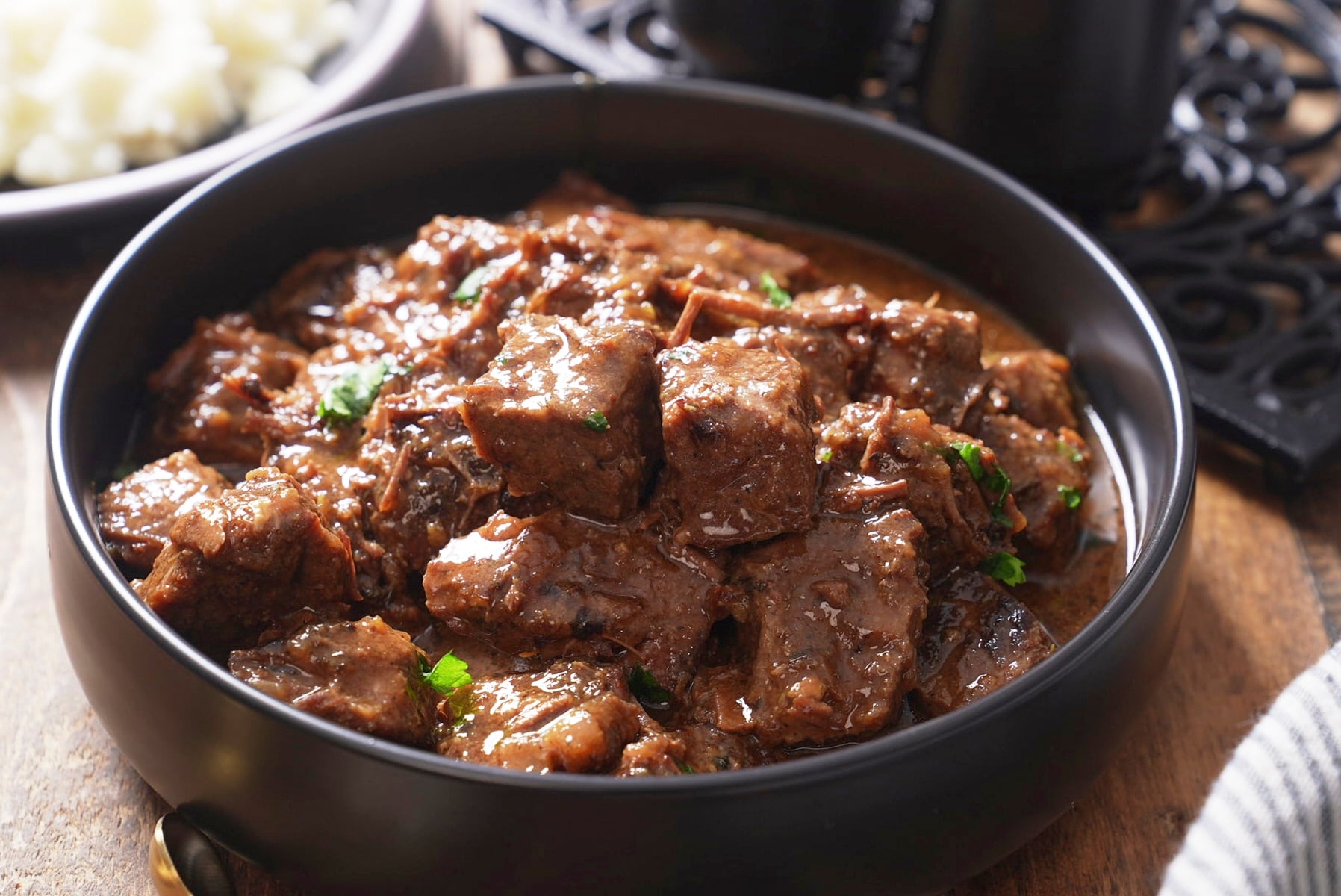
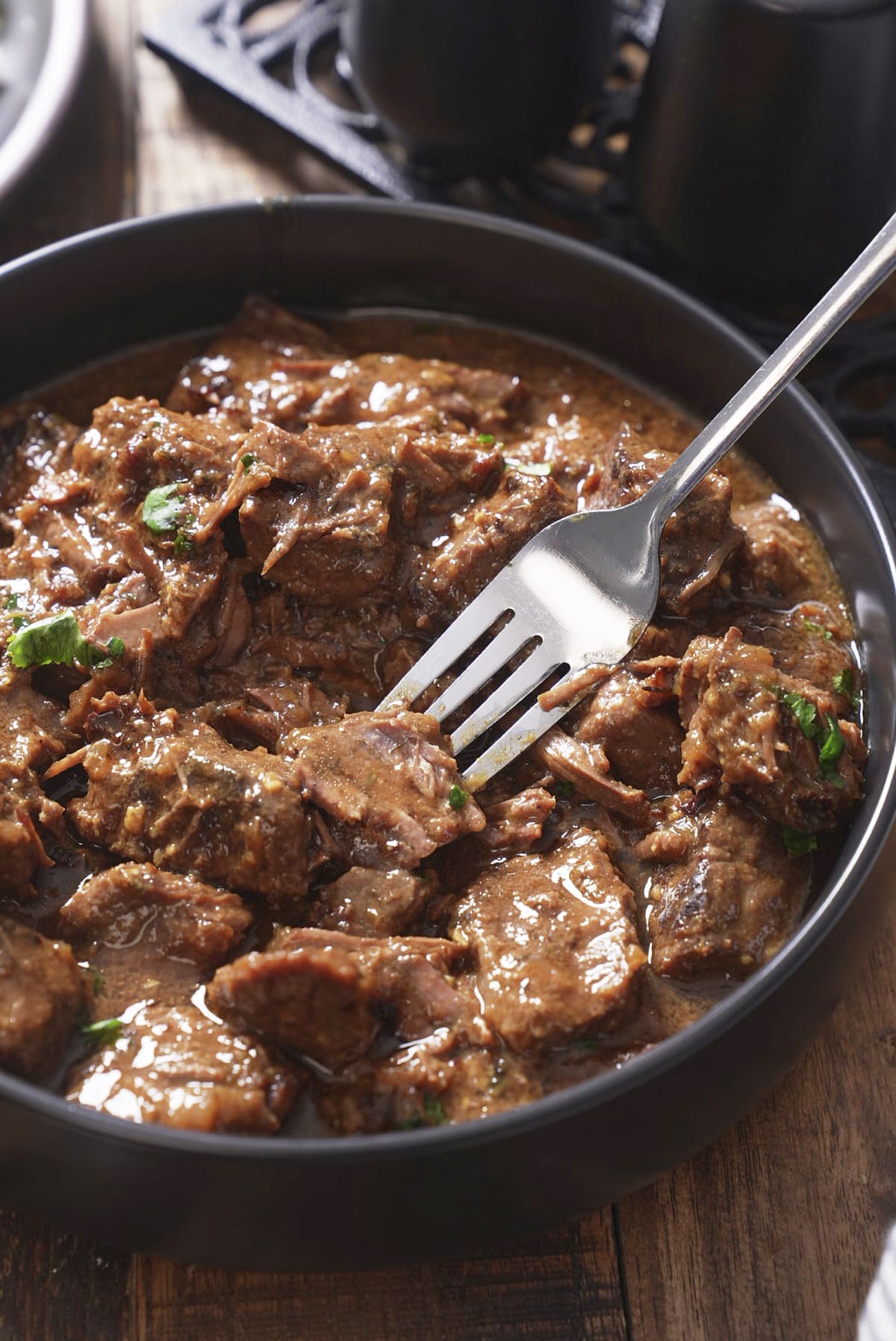
Beef tips are simmered slowly in a deep brown gravy until they are tender enough to cut with the side of a fork. It's the perfect cozy meal, especially when served over rice that can sop up all the gravy.

beef tips in bowl

You’ll find the full recipe with ingredient amounts and instructions in the recipe card at the bottom of this post. Be sure to check out the blog post itself for extra tips and tricks!

beef tips with fork sliding in to pick it up

Beef Tips at a Glance

  • Best for: a cozy Sunday dinner that reheats well.
  • Total Time: 2 hours 35 minutes
  • Yield: 6 servings
close up Tanya holding bowl

I have a real weakness for cozy beef dishes. Give me a stovetop beef stew or a pot of braised oxtail any day of the week, and I am a happy woman. Beef tips land in that same category for me.

This is a classic Southern dish that relies on low-and-slow cooking. Two hours on the stove is what turns tough little cubes of beef into something you can cut with a fork, and it gives the gravy time to thicken on its own. I serve mine over rice most nights, but a scoop of mashed potatoes underneath is never a bad idea.

Happy Cooking,

Tanya

Notes on the Ingredients

Ingredient amounts and full recipe instructions are on the printable recipe card at the bottom of the post.

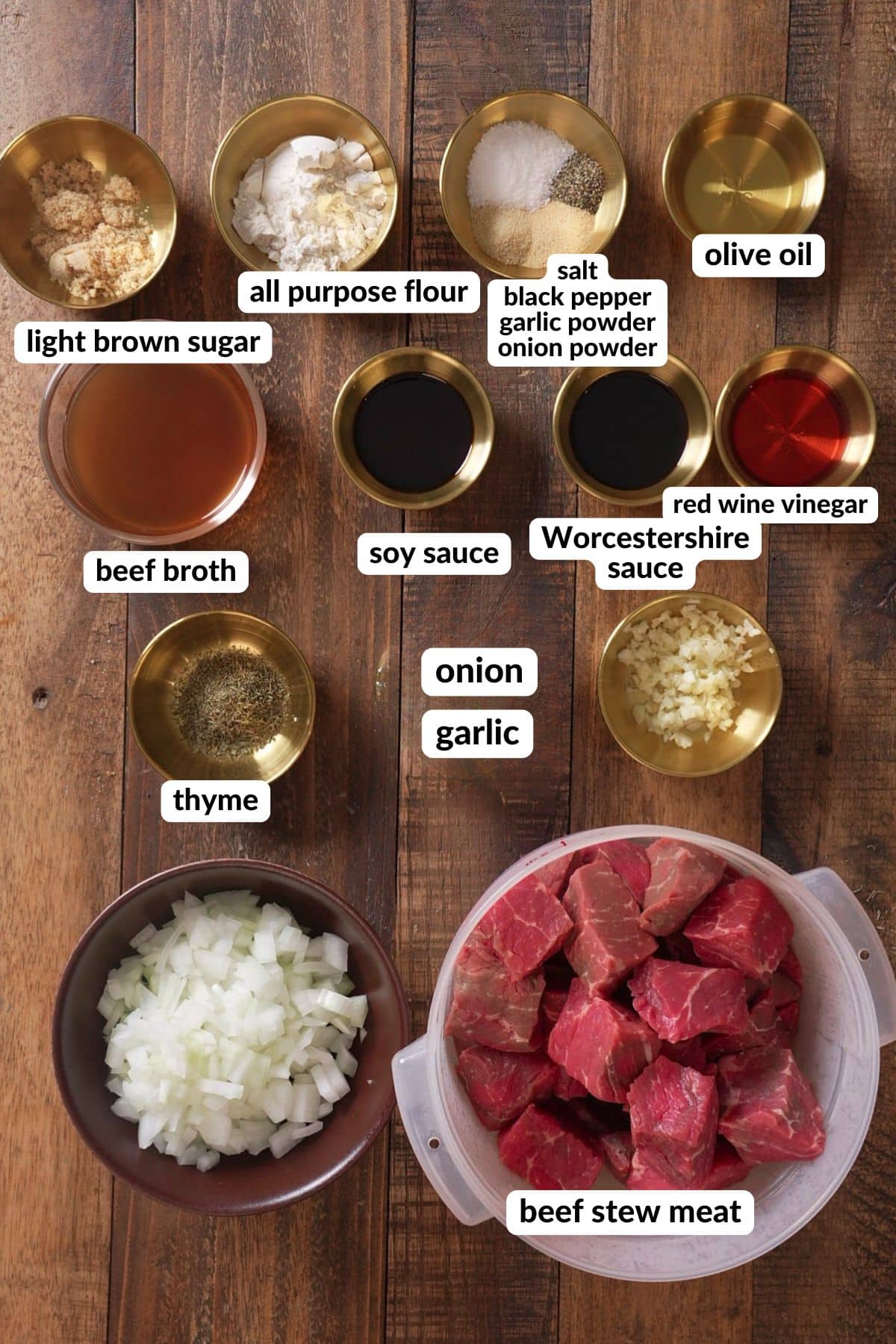
  • Beef stew meat. I buy the pre-cut packages at the store because it saves me from having to break down a whole roast on a weeknight, and stew meat is almost always cut from chuck. Chuck is exactly what you want here. It comes from the shoulder, which is a hard-working muscle, so it carries a lot of connective tissue that softens into the gravy over a long simmer. If you would rather cut your own, buy a boneless chuck roast and cut it into 1-inch cubes.
  • Light brown sugar. Just a small amount goes into the seasoning mix. It helps the beef brown more deeply in the pan and rounds out the salt from the soy sauce later on. The finished gravy does not taste sweet.
  • Garlic powder, onion powder, and black pepper. These season the beef itself.
  • Kosher salt. My amounts are measured with kosher salt, which is coarser than table salt. Table salt packs more into the same spoon, so if that is what you have, start with less and taste at the end.
  • All-purpose flour. The flour goes onto the seasoned beef instead of into the pot later, so it does two jobs. It helps build the crust when you sear, then it slowly thickens the gravy across the two-hour simmer. That is why there is no cornstarch slurry at the end of this recipe.
  • Olive oil. Any neutral oil works. You just need enough to get a good sear going, and the beef will release some of its own fat as it browns.
  • Yellow onion and fresh garlic. The onion cooks down until soft and sweet and practically disappears into the gravy. Fresh garlic goes in after the onion because it burns quickly and turns bitter if it hits the hot pot too early.
  • Low-sodium beef broth. There is already salt on the beef, plus soy sauce and Worcestershire going into the pot, and the liquid concentrates as it simmers.
  • Soy sauce and Worcestershire sauce. These two do the heavy lifting on the savory depth of the gravy. Worcestershire brings tang and soy sauce brings salt and color, which together give the sauce that dark restaurant look.
  • Red wine vinegar. A little acid at the end of a rich braise keeps the gravy from tasting flat and heavy. It is not enough to taste sour, but you would notice if it were missing.
  • Dried thyme. Thyme holds up well during a long simmer and has plenty of time to soften and release its flavor into the liquid.
beef tips ingredients

Main Equipment You'll Need

  • A 6-quart Dutch oven, which is the medium size most of us have in the cabinet. The heavy bottom keeps the beef from scorching over a long simmer and a tight lid keeps the liquid from cooking away.
  • Tongs for turning the beef as it sears.
  • A plate to hold the seared beef while you cook the onions.

How to Make Beef Tips and Gravy

Please see the recipe card below for the full printable recipe, ingredients, and instructions. Here you will find step-by-step photos of how to make this recipe.

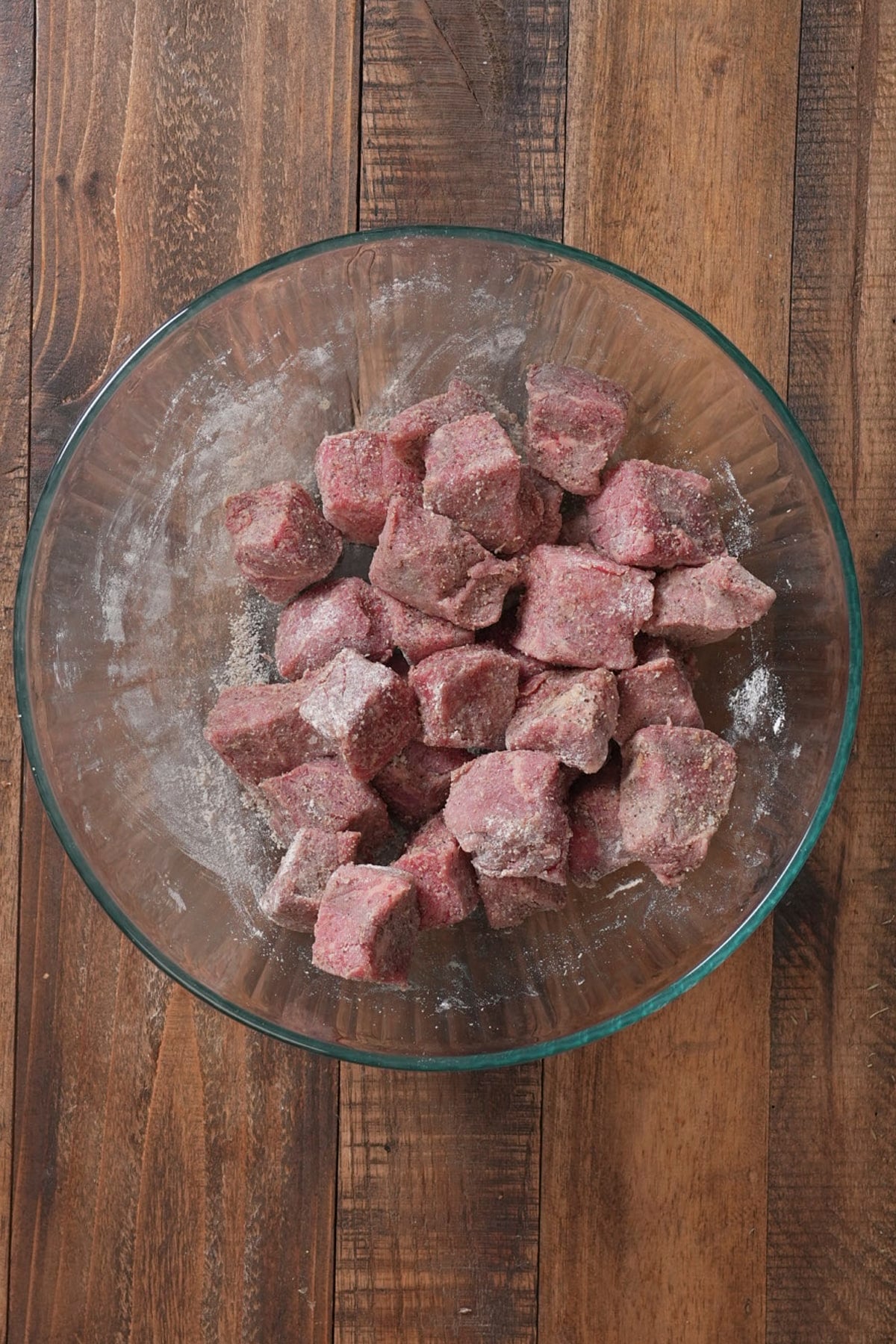
Step 1: Season and Coat the Beef. Pat the beef dry with paper towels first. Toss the beef in a large bowl with the brown sugar, salt, black pepper, garlic powder, onion powder, and flour until every piece has a light, even coating.

beef tips in bowl with seasoning and flour on it

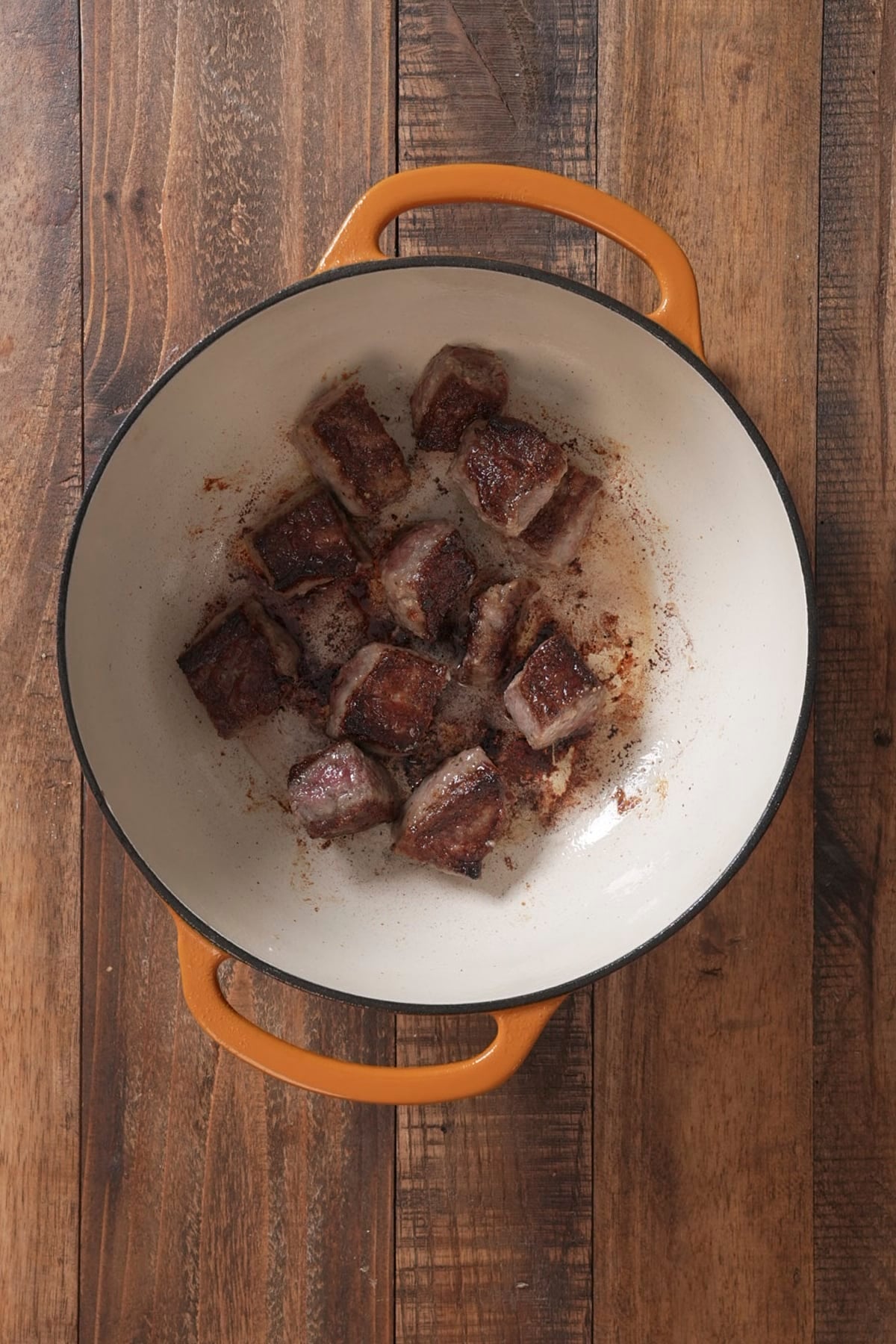
Step 2: Sear the Beef in Batches. Heat the olive oil over medium heat and add the beef in a single layer. Sear 2 to 3 minutes per side until the pieces are deeply browned, then move them to a plate. Work in two batches if you need to. The beef is not cooked through at this stage, and it does not need to be.

beef tips searing in pot

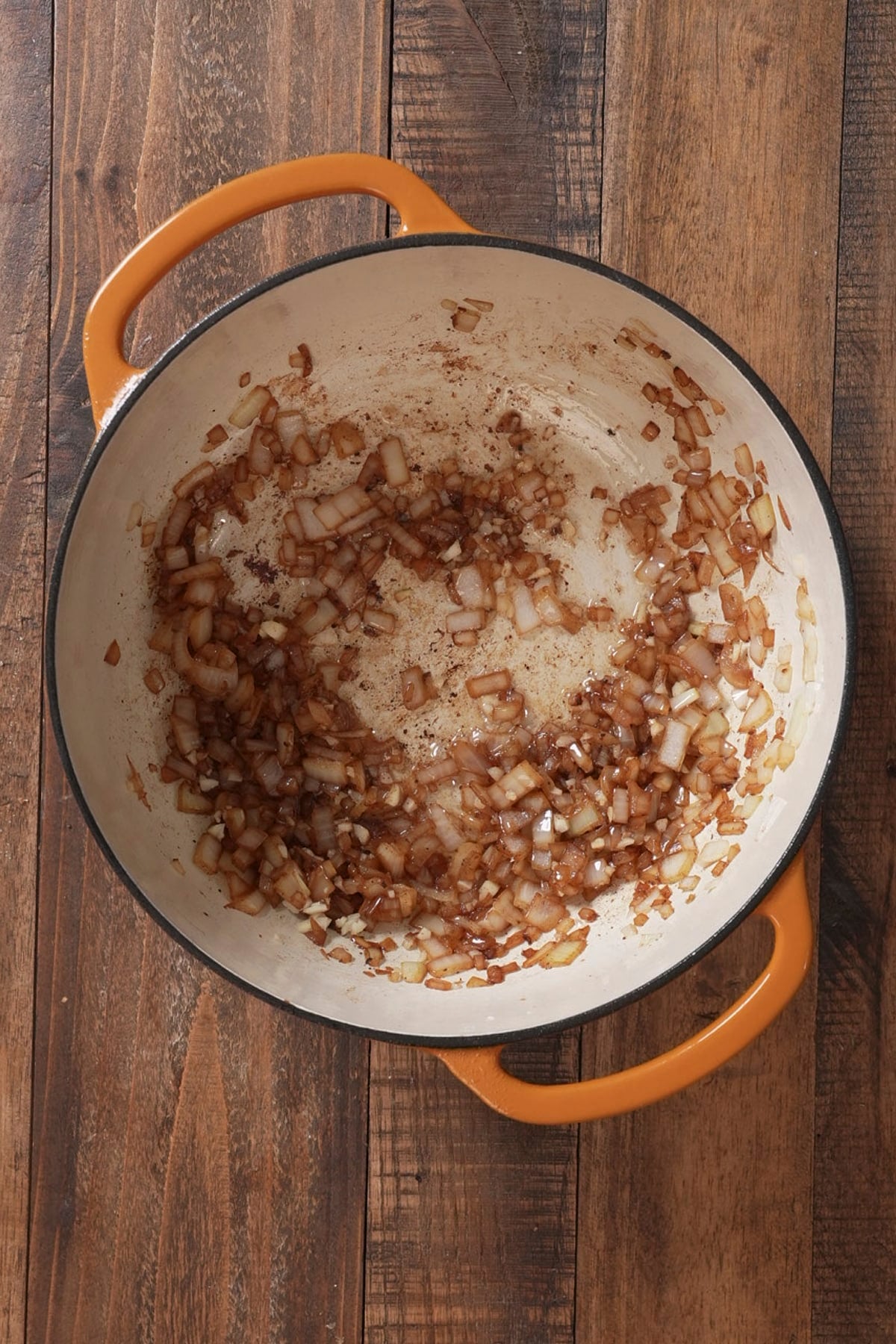
Step 3: Cook the Onions and Garlic. Add the diced onion to the oil and drippings left in the pot, along with a tablespoon of the beef broth. Cook 5 to 6 minutes until the onions are soft and translucent, scraping the bottom of the pot as they release their liquid so all those browned bits lift up. Stir in the garlic and cook 1 minute more, just until you can smell it.

onions and garlic sauteeing in pot

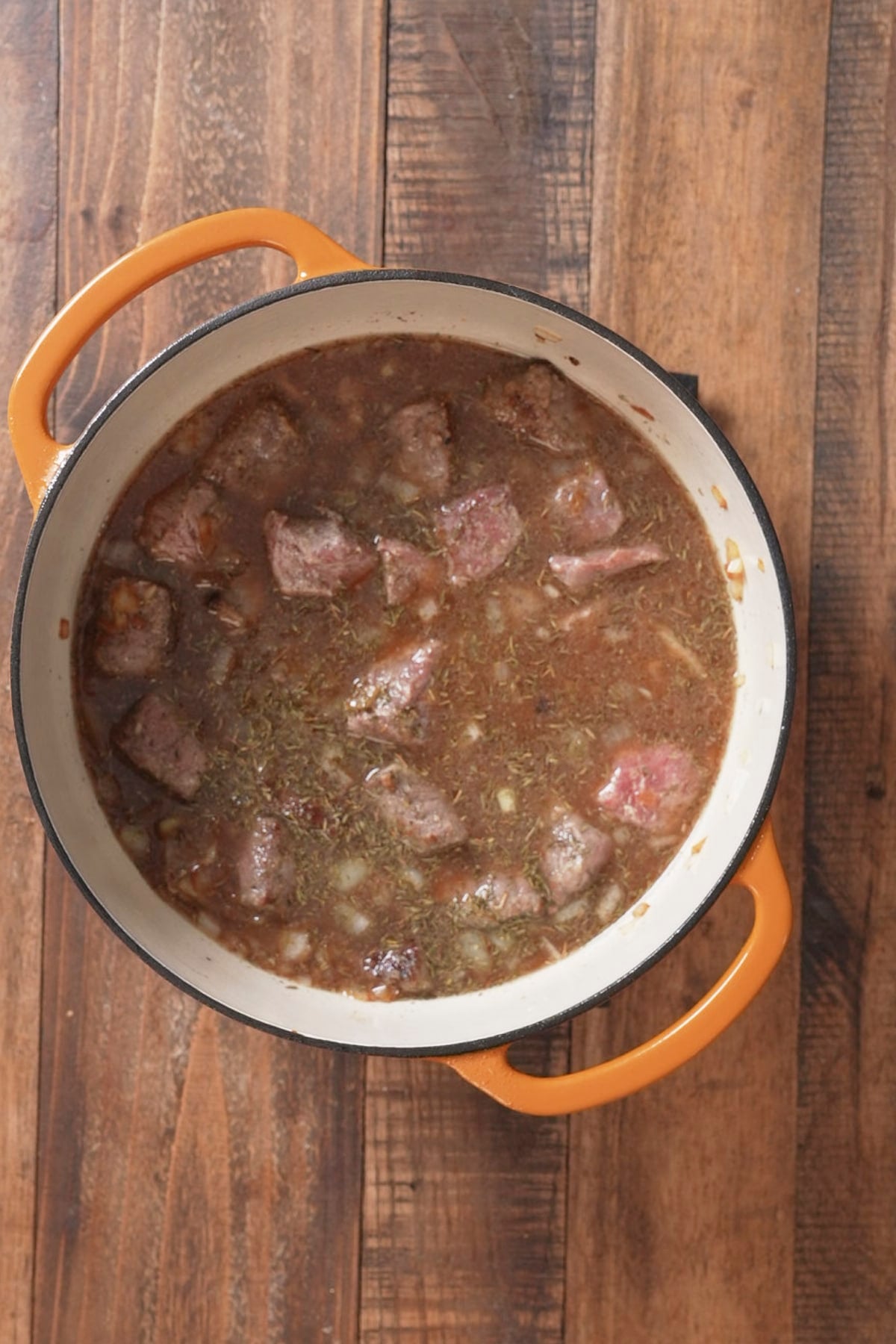
Step 4: Build the Gravy. Return the beef and any juices that collected on the plate back to the pot. Pour in the rest of the beef broth, then add the Worcestershire sauce, soy sauce, red wine vinegar, and thyme, and stir it all together.

beef tips in pot covered in broth

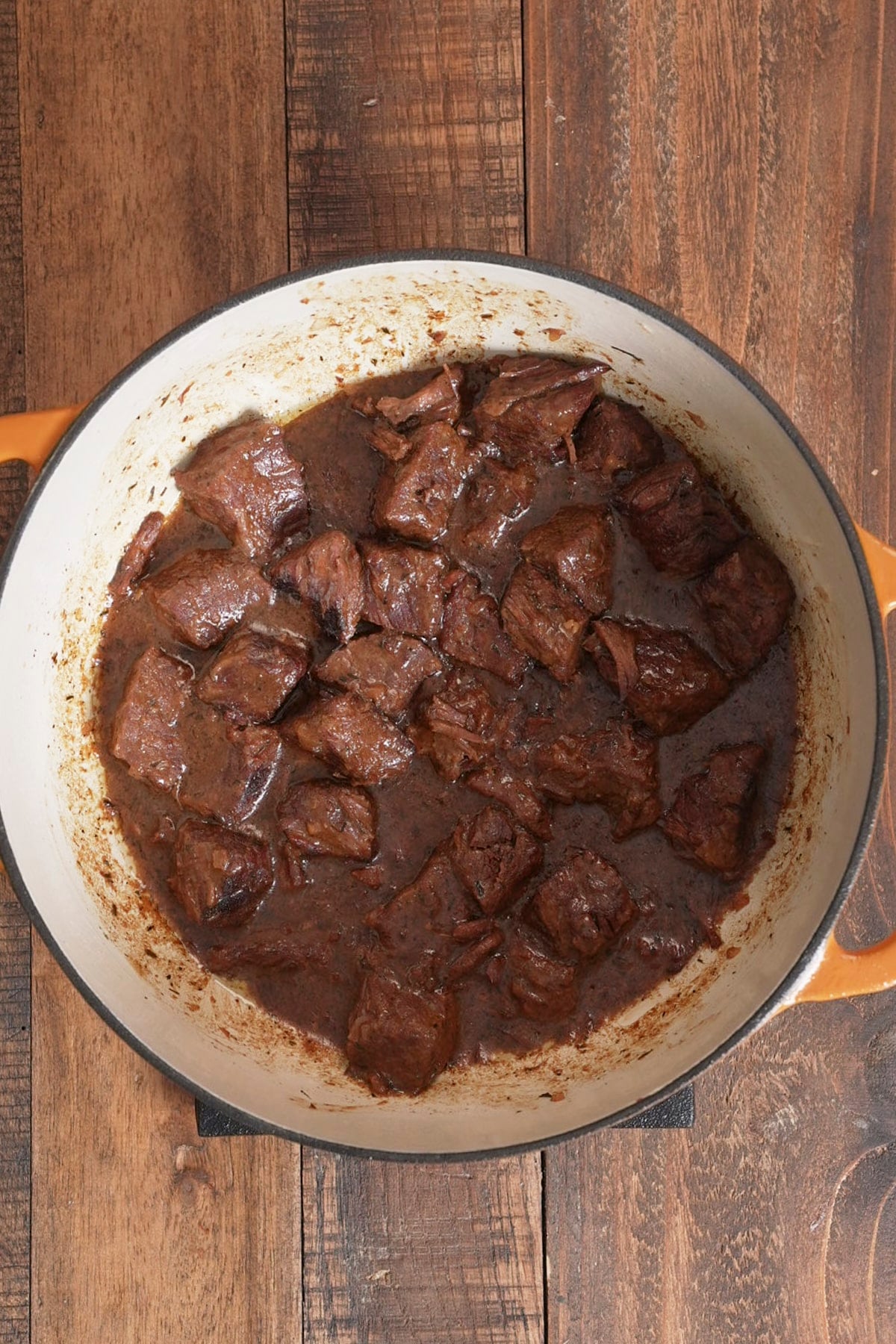
Step 5: Simmer Low and Slow. Bring the liquid up to a simmer, cover the pot tightly, and turn the heat down to low. You are looking for a lazy simmer with a few bubbles breaking the surface. Let it go about 2 hours.

Check on it every 30 minutes or so, give it a stir so nothing catches on the bottom of the pot, and if the liquid is getting low, add a splash more beef broth. How fast it reduces depends on your pot and how tight your lid sits, so this part is worth peeking at.

It is done when a fork slides into a piece of beef with no resistance and the gravy has thickened. If the beef is still firm, it needs more time.

beef tips in pot in gravy after simmering for hours

How to Make Beef Tips in the Slow Cooker

  • Sear first: Sear the beef and sauté the onions and garlic on the stove to build flavor, then transfer everything to the slow cooker.
  • Reduce liquid: Use only 2 cups of beef broth, as the slow cooker traps moisture.
  • Cook: Cover and cook on LOW for 7–8 hours (recommended for tender meat) or HIGH for ~4 hours.
  • Thicken (optional): If the gravy is too thin, stir in a cornstarch slurry (1 tablespoon cornstarch + 2 tablespoon cold water) and cook uncovered on HIGH for 20–30 minutes.

Tanya's Top Tips

  • Do not rush the simmer. The connective tissue in these cuts starts converting to gelatin somewhere around 160°F to 180°F (71°C to 82°C), and that conversion takes hours. Tough beef at the two hour mark usually just means it needs longer on the stove.
  • Check on the pot as it simmers. Stir every half hour so the bottom does not scorch, and top it off with a little more beef broth if the liquid drops too far. Different pots reduce at different rates.
  • Taste at the very end. The gravy concentrates over two hours, so wait until you know what you actually have before you reach for more salt.

Variations

  • Add mushrooms. Sliced cremini or white mushrooms cooked with the onions turn this into beef tips with mushroom gravy. Cook them until they release their water and start to brown before you move on.
  • Use chuck roast. A boneless chuck roast cut into 1-inch cubes behaves exactly like stew meat here, and you get to control the size of the pieces.
  • Add a splash of red wine. A little dry red in place of some of the broth adds depth if you have a bottle open.
  • Make it spicy. A pinch of cayenne or a few dashes of hot sauce in the braising liquid gives the gravy some heat behind it.
beef tips with fork sliding in to pick it up

What to Serve With Beef Tips

Rice is my default because it soaks up gravy better than almost anything. Mashed potatoes are the other classic, and buttered egg noodles are right there with them. To round the plate out the Southern way, Southern green beans and a pan of classic Southern cornbread turn this into a full Sunday dinner.

If this kind of slow-cooked beef is your thing, you might also like my braised beef shanks or my oxtail soup.

Storage, Reheating, and Freezing

  • Refrigerator: Cool the beef tips and store them in an airtight container with the gravy for up to 4 days. They taste even better on day two once the flavors settle.
  • Reheating: Warm them in a saucepan over low heat, stirring now and then until heated through. The gravy thickens in the fridge, so add a splash of beef broth or water to loosen it back up.
  • Freezer: These freeze well for up to 3 months in an airtight container with the gravy covering the beef. Thaw overnight in the refrigerator before reheating.

Beef Tips FAQs

What is the best cut of meat for beef tips?

It comes down to how long you plan to cook. Chuck roast and beef stew meat are the right call for a low and slow braise like this one, because they carry the connective tissue that breaks down into a silky gravy over a couple of hours. Sirloin and tenderloin are naturally tender and lean, which makes them better for a quick stove-top version. They do not have the connective tissue to reward a long cook and will dry out if you give them one.

Can I use beef stew meat for beef tips?

Yes, and it is what I use. Stew meat has a reputation for being tough, but that is usually a timing problem rather than a meat problem. It is typically cut from chuck or a similar working muscle, so it needs the full two hours to come around. Give it that time and it is tender, flavorful, and cheaper than sirloin.

Why are my beef tips still tough?

Nine times out of ten it is one of two things. Either the beef has not cooked long enough, or the pot was at a hard boil instead of a gentle simmer. Both are fixable. Turn the heat down, put the lid back on, and keep going until a fork slides in easily.

I hope you love this recipe as much as we do. If you have tried this recipe or any other recipe on my blog, please rate it and let me know how it turned out in the comments below! Your feedback is invaluable and helps us grow. Thank you for your support!

beef tips with gravy with fork picking up beef
Print Recipe
No ratings yet

Beef Tips and Gravy Recipe

Tender beef simmered low and slow in a rich brown gravy with onions, garlic, and thyme. A classic Southern dinner that is made for rice or mashed potatoes.
Prep Time15 minutes mins
Cook Time2 hours hrs 20 minutes mins
Total Time2 hours hrs 35 minutes mins
Course: Main Course
Cuisine: American
Keyword: beef tips, beef tips and gravy, beef tips recipe
Servings: 6
Calories: 294kcal
Author: Tanya Harris

Ingredients

  • 2 pounds beef stew meat cut into 1-inch cubes
  • 2 teaspoons light brown sugar
  • 2 teaspoons kosher salt
  • ½ teaspoon black pepper
  • ½ teaspoon garlic powder
  • ½ teaspoon onion powder
  • 2 tablespoons all-purpose flour
  • 2 tablespoons olive oil
  • 1 large yellow onion diced
  • 4 cloves garlic minced
  • 2 ¾ cups low-sodium beef broth divided
  • 1 tablespoon Worcestershire sauce
  • 1 tablespoon soy sauce
  • 1 tablespoon red wine vinegar
  • 2 teaspoons dried thyme

Instructions

  • Pat the beef dry with paper towels. In a large bowl, toss the beef with the brown sugar, salt, black pepper, garlic powder, onion powder, and flour until every piece is lightly coated.
  • Heat the olive oil in a 6-quart Dutch oven over medium heat. Add the beef in a single layer without crowding the pan, working in two batches if needed. Sear 2 to 3 minutes per side, until deeply browned. Transfer the beef to a plate and set aside.
  • Add the diced onion to the oil and drippings in the pot along with 1 tablespoon of the beef broth. Cook 5 to 6 minutes, until the onions are soft and translucent, scraping up the browned bits from the bottom of the pot. Stir in the garlic and cook 1 minute, until fragrant.
  • Return the beef and any accumulated juices to the pot. Pour in the remaining beef broth, then add the Worcestershire sauce, soy sauce, red wine vinegar, and thyme. Stir to combine.
  • Bring the liquid to a simmer, cover tightly, and reduce the heat to low. Simmer gently about 2 hours, until the beef is fork tender and the gravy has thickened. Stir every 30 minutes so the bottom does not scorch, and add more beef broth if the liquid reduces too far. Taste and adjust salt before serving.

Notes

  • Beef Cut: Use chuck stew meat cut into 1-inch pieces. Avoid lean cuts like sirloin, which dry out during a 2-hour simmer.
  • Salt: Recipe is tested with kosher salt. If using table salt, start with half and adjust to taste at the end.
  • Liquid Level: If the gravy reduces too fast, stir in a splash of broth. If too thin, simmer uncovered for a few minutes.
  • Slow Cooker: Sear beef and onions on the stove first. Transfer to slow cooker with only 2 cups of broth and cook on LOW for 7–8 hours (or HIGH for ~4 hours).
  • Storage: Keeps up to 4 days in the fridge or 3 months in the freezer. Loosen with a splash of broth when reheating.
  •  

Nutrition

Calories: 294kcal | Carbohydrates: 8g | Protein: 37g | Fat: 12g | Saturated Fat: 3g | Polyunsaturated Fat: 1g | Monounsaturated Fat: 7g | Cholesterol: 94mg | Sodium: 1268mg | Potassium: 824mg | Fiber: 1g | Sugar: 3g | Vitamin A: 16IU | Vitamin C: 3mg | Calcium: 52mg | Iron: 4mg

Sweet and Sour Cabbage (German-Style Braised Red Cabbage)

August 11, 2026 by Tanya Harris 18 Comments

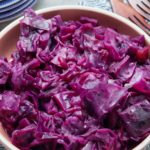
sweet and sour cabbage on plate

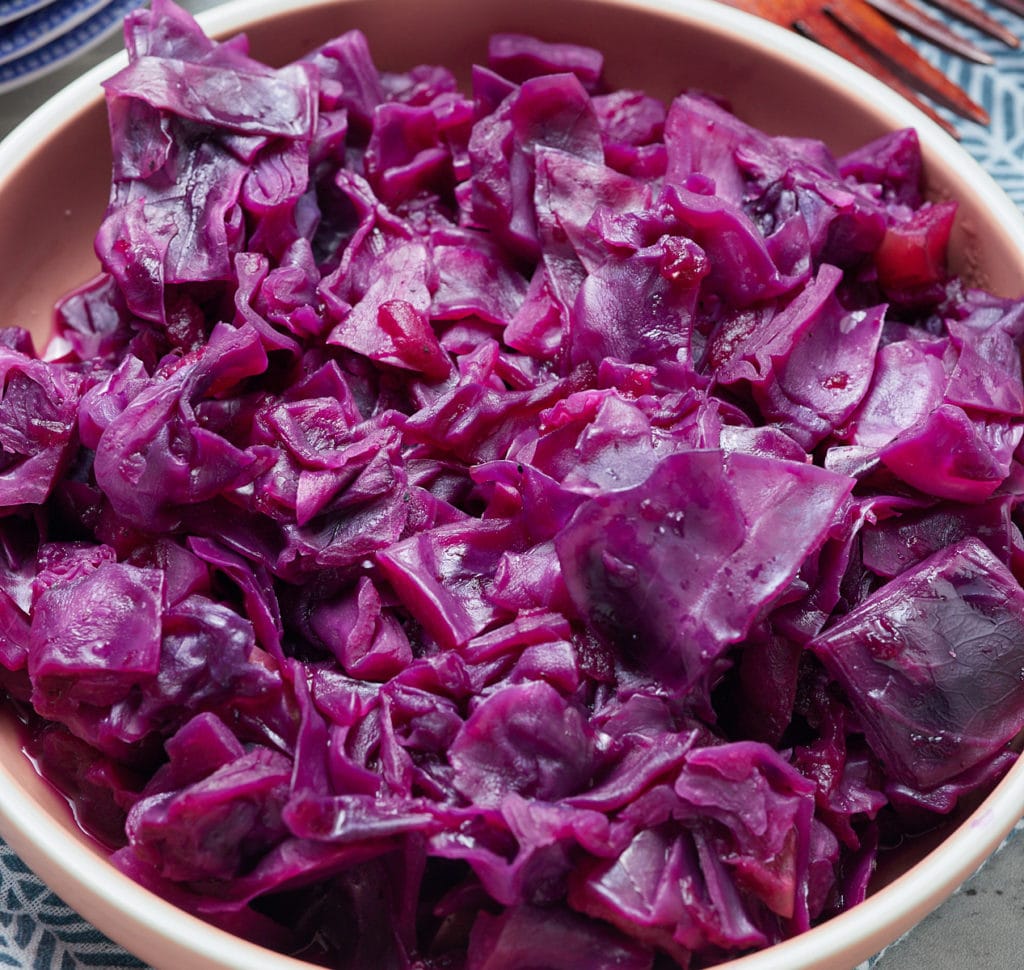
This sweet and sour cabbage is an easy one-pot side made with red cabbage, sweet apple, and apple cider vinegar. It braises low and slow until tender, with the right balance of sweet and tart in every bite.

sweet and sour cabbage on plate

You’ll find the full recipe with ingredient amounts and instructions in the recipe card at the bottom of this post. Be sure to check out the blog post itself for extra tips and tricks!

close up Tanya holding bowl

We love a good cabbage recipe in our house, and I’ve been searching for ways to add it to our meal rotation. I’m always drawn to red cabbage for its vibrant color, and this vinegar coleslaw is no exception. So when I made this sweet and sour cabbage, I was in love. 

Inspired by German sweet-and-sour cabbage recipes I saw online, I made this recipe, and I’ve been hooked ever since. There aren’t many ingredients, and all you’ll need is a little patience while the cabbage takes time to braise on the stovetop.

Be sure to try my Instant Pot Cabbage or Creamed Cabbage with Sausage recipes too. 

5 Star Review

⭐⭐⭐⭐⭐

Lorna. says, "This has an excellent balance of flavors. I like to saute the cabbage in a bit butter first but i give it 5 stars."

A Quick Look at the Ingredients

Ingredient amounts and full recipe instructions are on the printable recipe card at the bottom of the post.

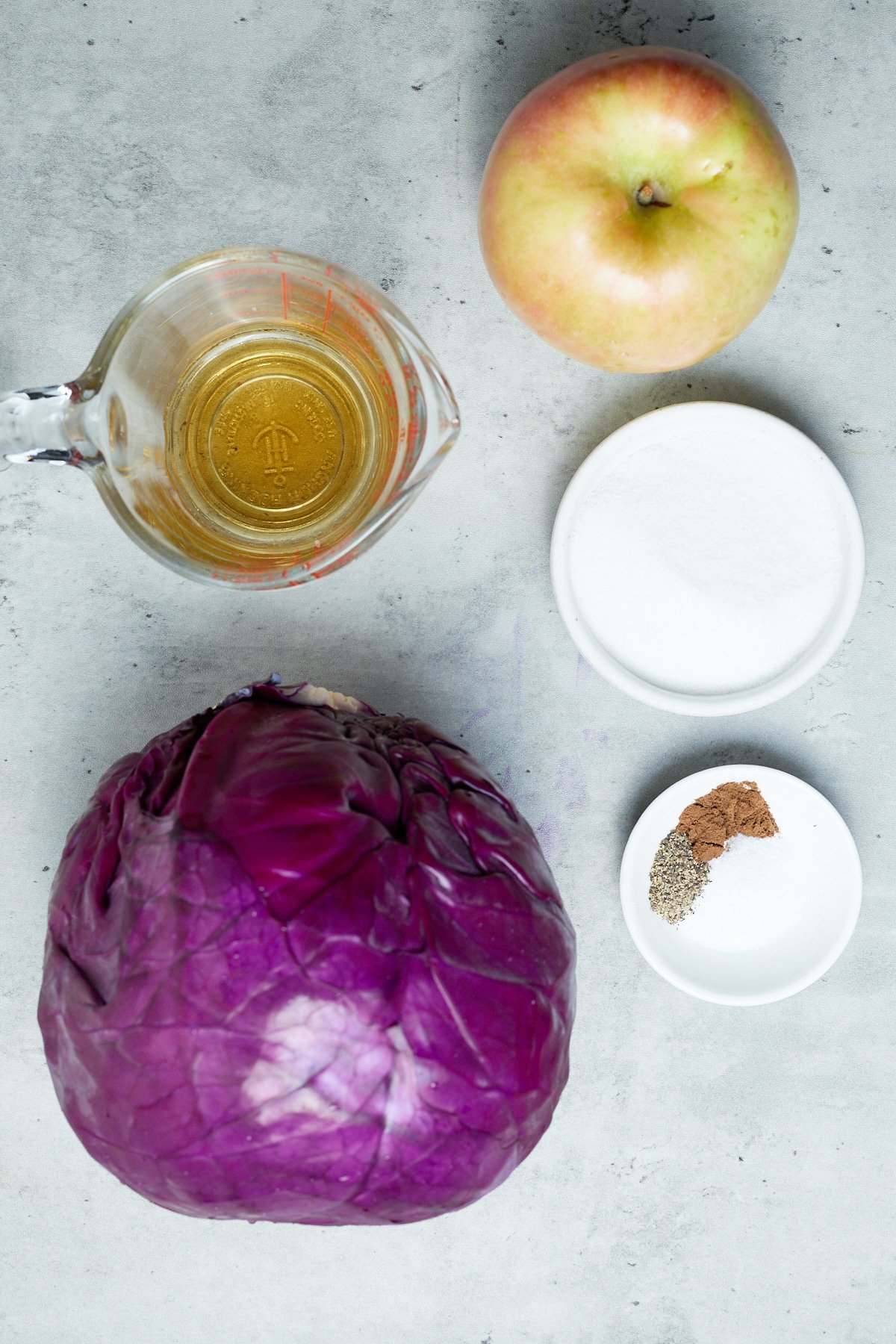
  • Red cabbage - Choose a firm head with vibrant color; chop into large chunks so they hold their shape during the long braise. If you don't have red cabbage, feel free to use a firm green cabbage instead.
  • Sweet apple - Fuji or Honeycrisp work, adding natural sweetness that balances the vinegar's tang.
  • Apple cider vinegar - This provides the signature tangy flavor that makes the dish "sour."
  • Granulated sugar - Balances the acidity and helps create that perfect sweet-and-sour flavor profile.
  • Kosher salt and ground black pepper- Season to your taste.
  • Ground Allspice - I use a ton of allspice in my cooking, and I just had to add it to this dish. Feel free to sub with another warm spice, like cinnamon or nutmeg.
ingredients for sweet and sour cabbage

How to make sweet and sour cabbage

Step 1: First, gather your ingredients. Chop your head of cabbage into large chunks and chop a sweet apple. I like to use a Fuji apple in this recipe.

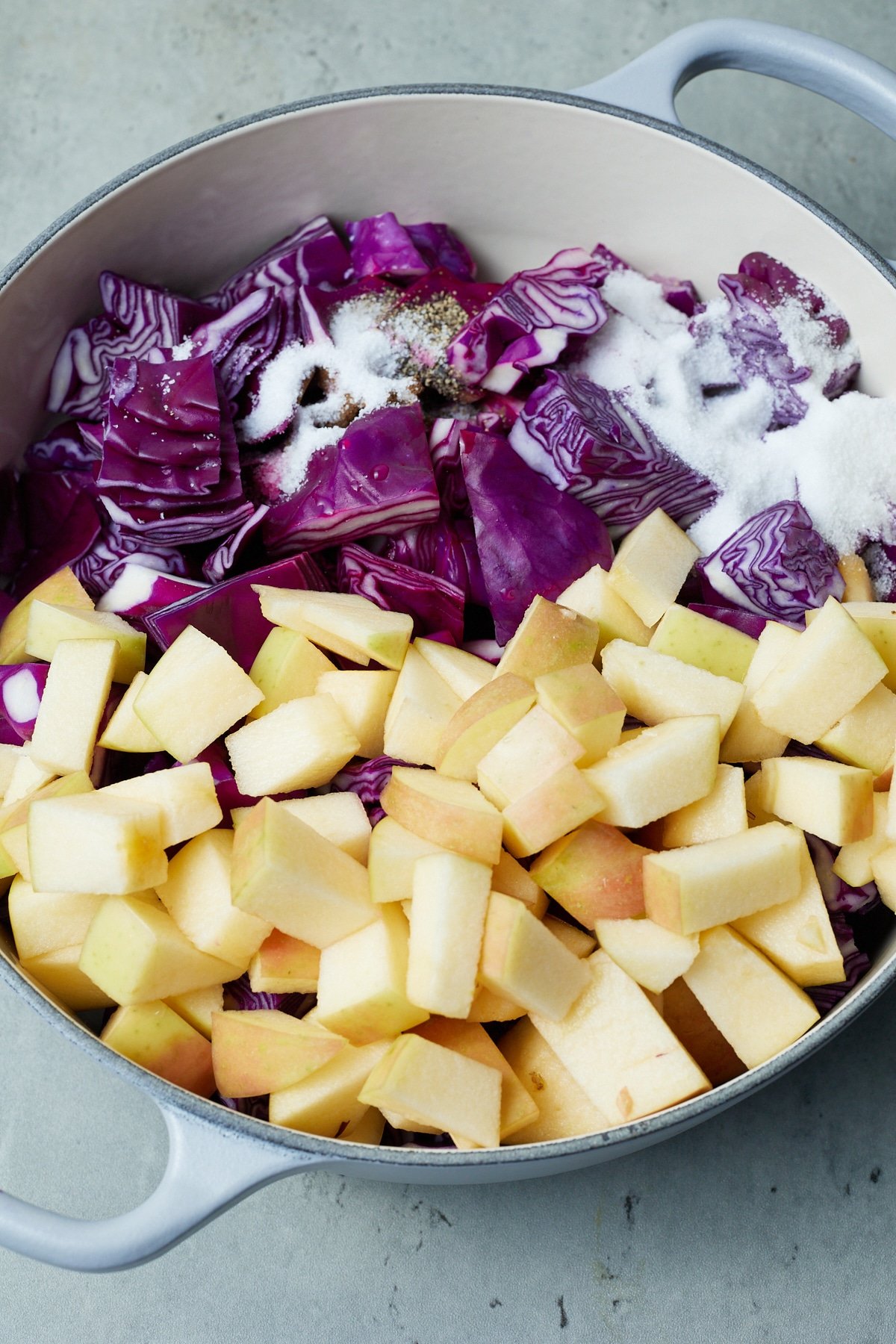
Step 2: Place the chopped cabbage, apple, apple cider vinegar, sugar, salt, black pepper, and allspice in a large heavy-bottomed pot. Cover the pot with a tight-fitting lid and place it over medium-low heat. 

cabbage, apples, salt, and pepper inside pot

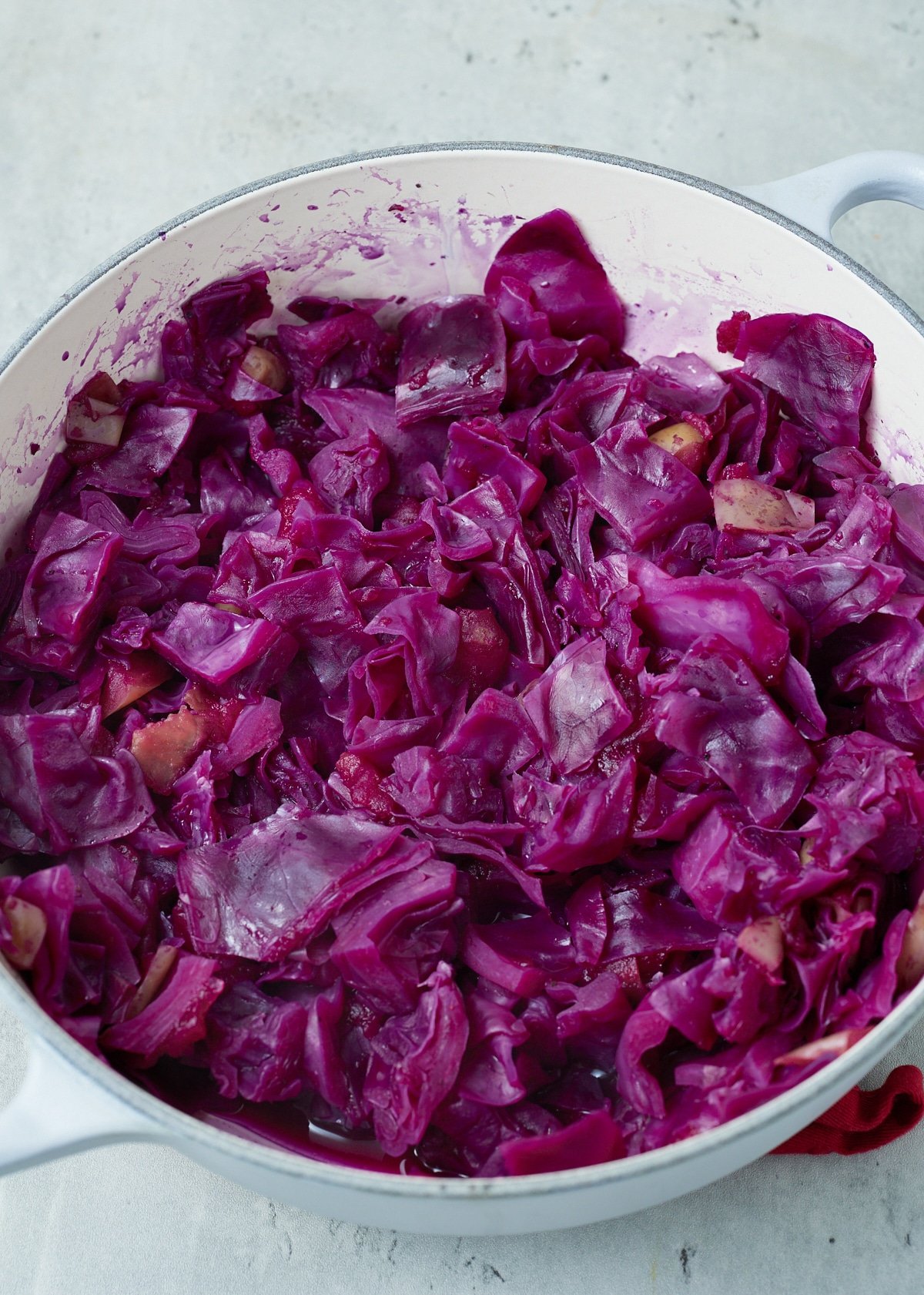
Step 3: Allow the cabbage to cook over medium-low heat for about 1 hour to 1 hour and 10 minutes, stirring every 20 minutes, until the cabbage is tender enough for your liking. Serve and enjoy 🙂

cooked cabbage inside pot

Variations

This cabbage is great as written, but here are a few ways I like to switch it up.

  • Add bacon. Cook a few slices until crisp, then crumble them in at the end for a smoky, salty bite. It's one of the more popular ways to make this dish and adds a nice richness.
  • Make it meaty. Stir in sliced smoked sausage, or serve it next to browned bratwurst for a heartier plate.
  • Turn up the heat. A pinch of red pepper flakes gives it a little kick.
  • Add carrots. They bring more color and a touch of natural sweetness.
  • Add maple syrup. One reader stirred in a little maple syrup along with rice vinegar and sweet chili sauce and loved the result.

Make Ahead and Storage

  • Fridge: Store leftovers in an airtight container for 3-4 days.
  • Reheat: Warm it on the stovetop over low heat or in the microwave until heated through. Add a small splash of water if it looks dry.
  • Serve warm or at room temperature: It's good both ways, which makes it easy to make ahead for a holiday spread or a potluck.
close up photo of cabbage

Tanya's Top Tips about Sweet and Sour Cabbage

  • Use a heavy-bottomed pot with a tight-fitting lid to keep the liquid inside. Cabbage will release a good bit of liquid while it cooks.
  • Keep the heat on medium-low and stir about every 20 minutes.

What should I serve this cabbage with?

  • Air Fryer Beef Tenderloin - A rich, special-occasion main. The sweet-and-sour bite of the cabbage cuts right through it.
  • Air Fryer Fried Chicken - Crispy and savory, and the cabbage adds a little brightness to the plate.
  • Mashed Sweet Potatoes - Another sweeter side that goes great with this cabbage.
  • Smothered Turkey Wings - Hearty and gravy-heavy. The cabbage lightens things up alongside it.

I hope you love this recipe as much as we do. If you have tried this recipe or any other recipe on my blog, please rate it and let me know how it turned out in the comments below! Your feedback is invaluable and helps us grow. Thank you for your support!

sweet and sour cabbage on plate
Print Recipe
4.50 from 6 votes

Sweet and Sour Cabbage

This sweet and sour cabbage is the perfect easy yet tasty side dish. Red cabbage and a sweet apple are braised in sugar and vinegar, resulting in the most tender and delicious cabbage.
Prep Time8 minutes mins
Cook Time1 hour hr
Total Time1 hour hr 8 minutes mins
Course: Side Dish
Cuisine: American, German
Keyword: red cabbage recipe, sweet and sour cabbage
Servings: 4 people
Calories: 52kcal
Author: Tanya Harris

Equipment

  • Heavy Bottom Pot

Ingredients

  • 1 medium head red cabbage chopped into large chunks (about 6-7 cups)
  • 1 sweet apple chopped. (Fuji, honey crisp, etc)
  • ¼ cup apple cider vinegar
  • ¼ cup granulated sugar
  • 1.5 teaspoons kosher salt or to taste
  • ¼ teaspoon ground black pepper or to taste
  • ¼ teaspoon ground allspice

Instructions

  • Place the chopped cabbage, apple, apple cider vinegar, sugar, salt, black pepper, and allspice in a large heavy-bottomed pot. Cover the pot with a tight-fitting lid and place it over medium-low heat.
  • Allow the cabbage to cook, over medium-low heat, for about 1 hour to 1 hour and 10 minutes, stirring every 20 minutes, until the cabbage is tender.
  • Remove from heat, serve, and enjoy.

Notes

  • Use a heavy-bottomed pot with a tight-fitting lid so the liquid stays inside the pot. Cabbage will release a good bit of liquid while it cooks.
  • Keep the heat on medium-low and stir about every 20 minutes.

Nutrition

Calories: 52kcal | Carbohydrates: 13g | Protein: 1g | Fat: 1g | Saturated Fat: 1g | Polyunsaturated Fat: 1g | Sodium: 873mg | Potassium: 14mg | Fiber: 1g | Sugar: 13g | Vitamin A: 1IU | Vitamin C: 1mg | Calcium: 3mg | Iron: 1mg

This post was originally published on October 6, 2021. It has been updated with new information.

Easy Stuffing Recipe (Classic & Herby)

August 11, 2026 by Tanya Harris Leave a Comment

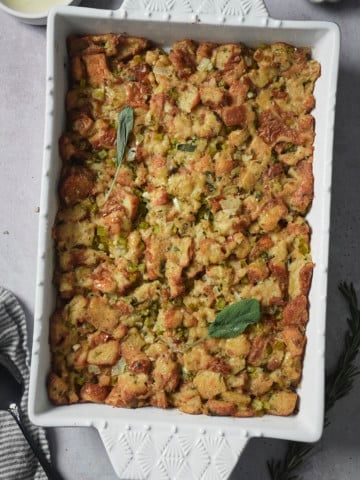
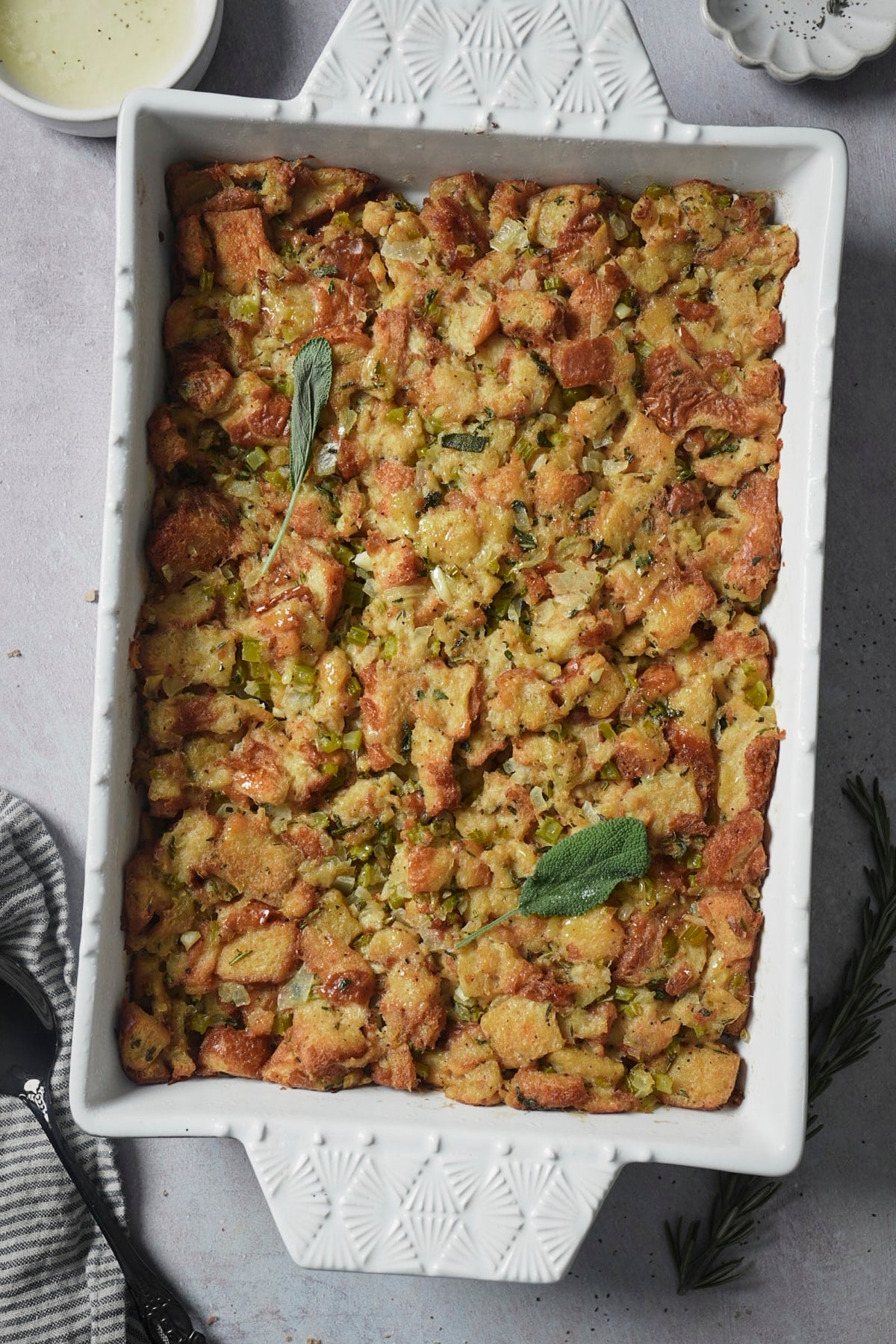
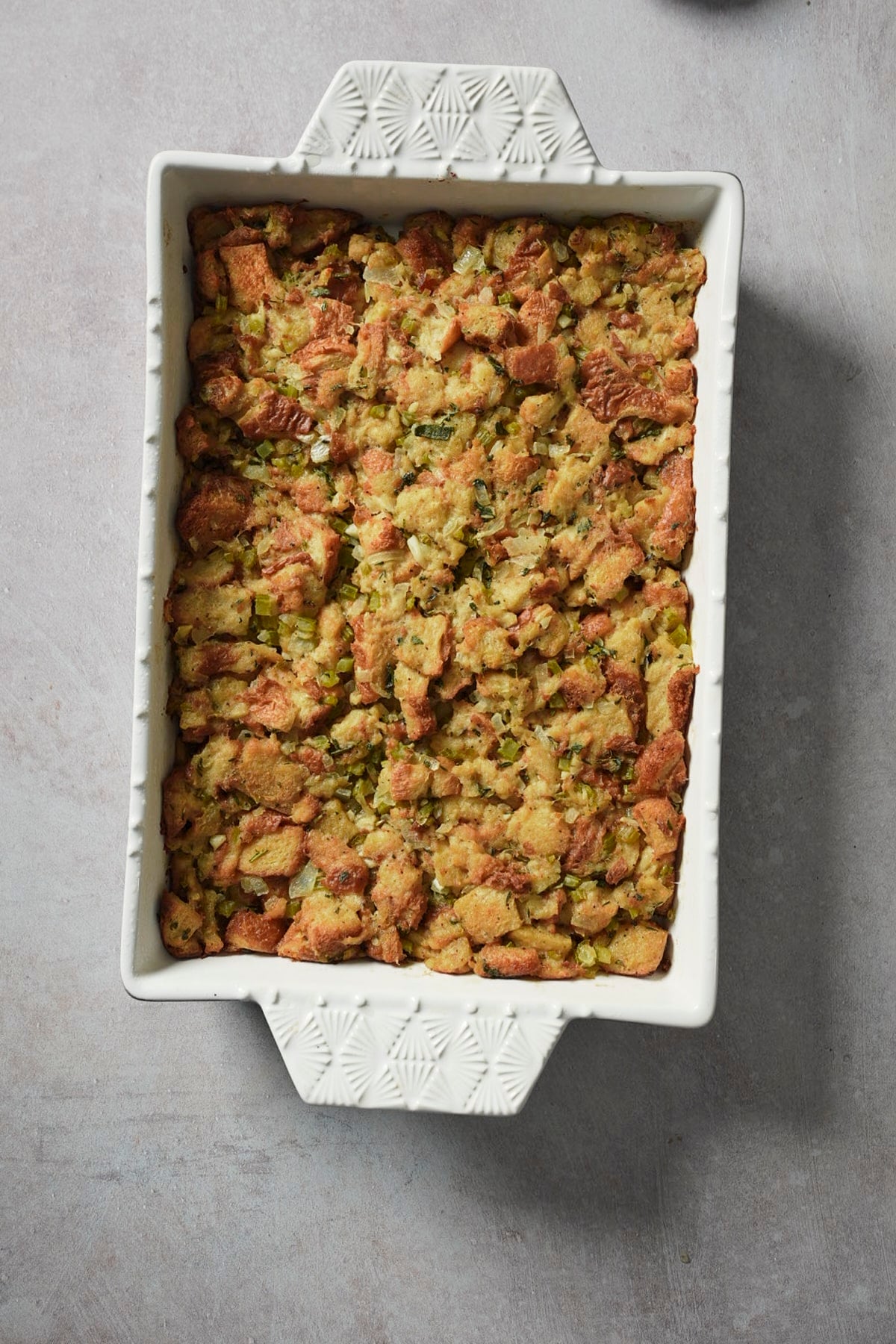
stuffing in casserole dish

My homemade stuffing recipe is a classic. Made with simple, fresh ingredients, it's the savory side dish I find myself coming back to for every holiday and weeknight meal alike. 

stuffing in casserole dish

You’ll find the full recipe with ingredient amounts and instructions in the recipe card at the bottom of this post. Be sure to check out the blog post itself for extra tips and tricks!

close up Tanya holding bowl

Stuffing is a big deal in my house. We don’t mind the boxed stuff, but I love making things homemade or semi-homemade. This stuffing is so simple to make, but the flavor is delicious. With three types of fresh herbs, the aromatics really come to life. 

This recipe is pretty straightforward, with a few tips and techniques that make the texture and flavor just right.

If you’re a fan of Thanksgiving sides, then you’ll love this cornbread dressing.

Happy Cooking,

Tanya

stuffing in casserole dish

Easy Stuffing Recipe at a Glance

  • Best for: Thanksgiving, Christmas, or any holiday spread that needs a classic bread stuffing
  • Prep time: about 25 minutes (drying the bread and prepping the vegetables)
  • Cook time: 45 to 50 minutes
  • Total time: about 1 hour 10 minutes
  • Servings: 10

Ingredient Notes

Ingredient amounts and full recipe instructions are on the printable recipe card at the bottom of the post.

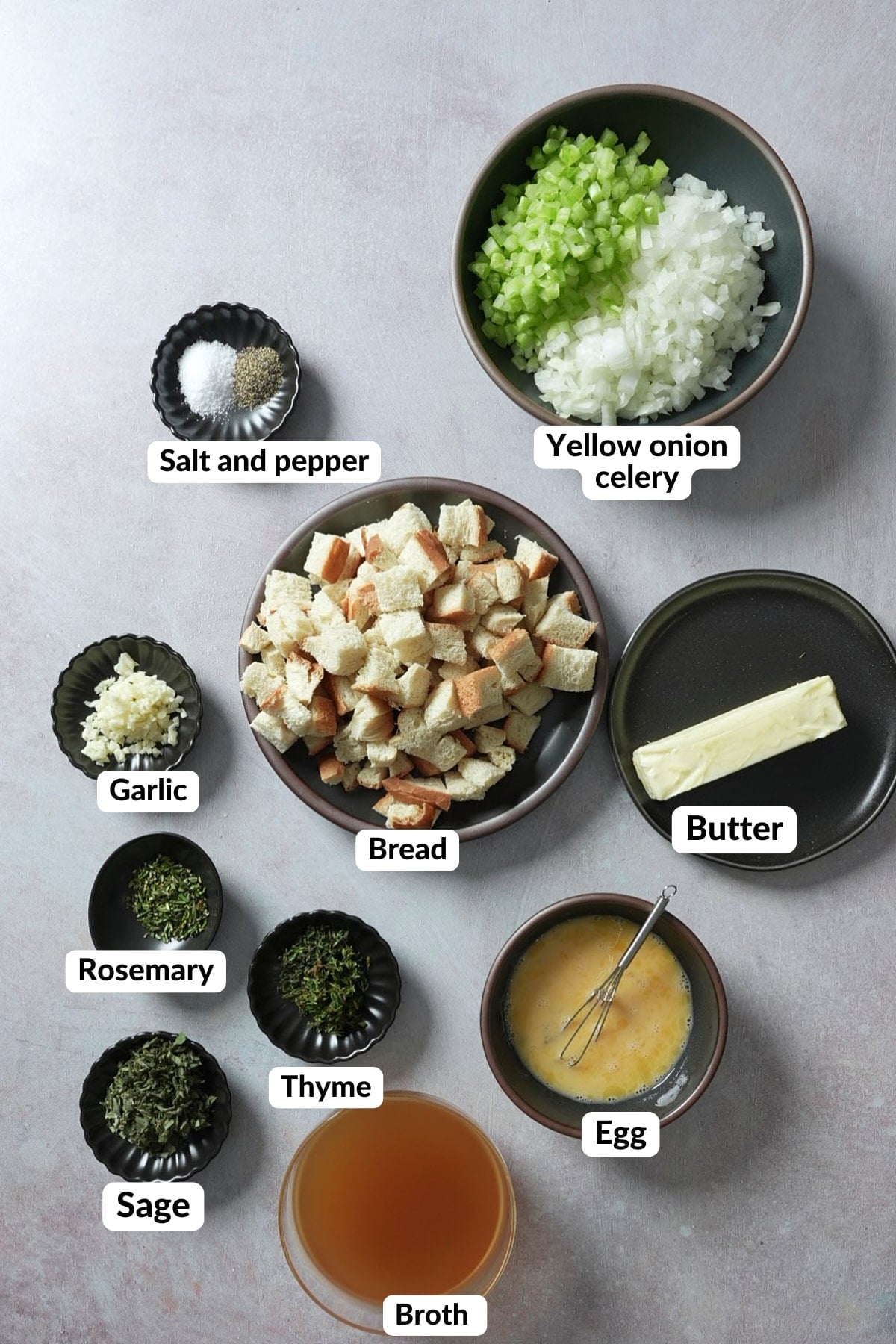
  • Bread. You'll need about 1 pound (roughly 10 cups) of bread cut into ½-inch cubes. I use white sandwich bread, but sourdough or French bread work as well. Sandwich bread gives you a softer stuffing, while sourdough or French bread holds up a little firmer and adds more chew. Whatever you use needs to be cut and dried completely before it goes anywhere near the broth. 
  • Aromatics. Yellow onion, celery, and garlic are the base. Dice them small, so they cook evenly and disappear into the stuffing instead of standing out in big chunks.
  • Fresh herbs. Sage, thyme, and rosemary are what make this taste like Thanksgiving. Fresh is worth it here if you can get it. If you only have dried herbs on hand, use about a third of the amount the recipe calls for, since dried herbs are more concentrated, and add them in with the onions and celery so they have time to soften. You could also use dried poultry seasoning instead of fresh herbs.
  • Broth and eggs. Low-sodium turkey or chicken broth lets you control the seasoning, and you can swap in vegetable broth for a meatless version. The eggs are what bind everything together, so your stuffing holds its shape instead of falling apart when you scoop it.
ingredients for stuffing

How to make this Stuffing Recipe

Please see the recipe card below for the full printable recipe, ingredients, and instructions. Here you will find step-by-step photos of how to make this recipe.

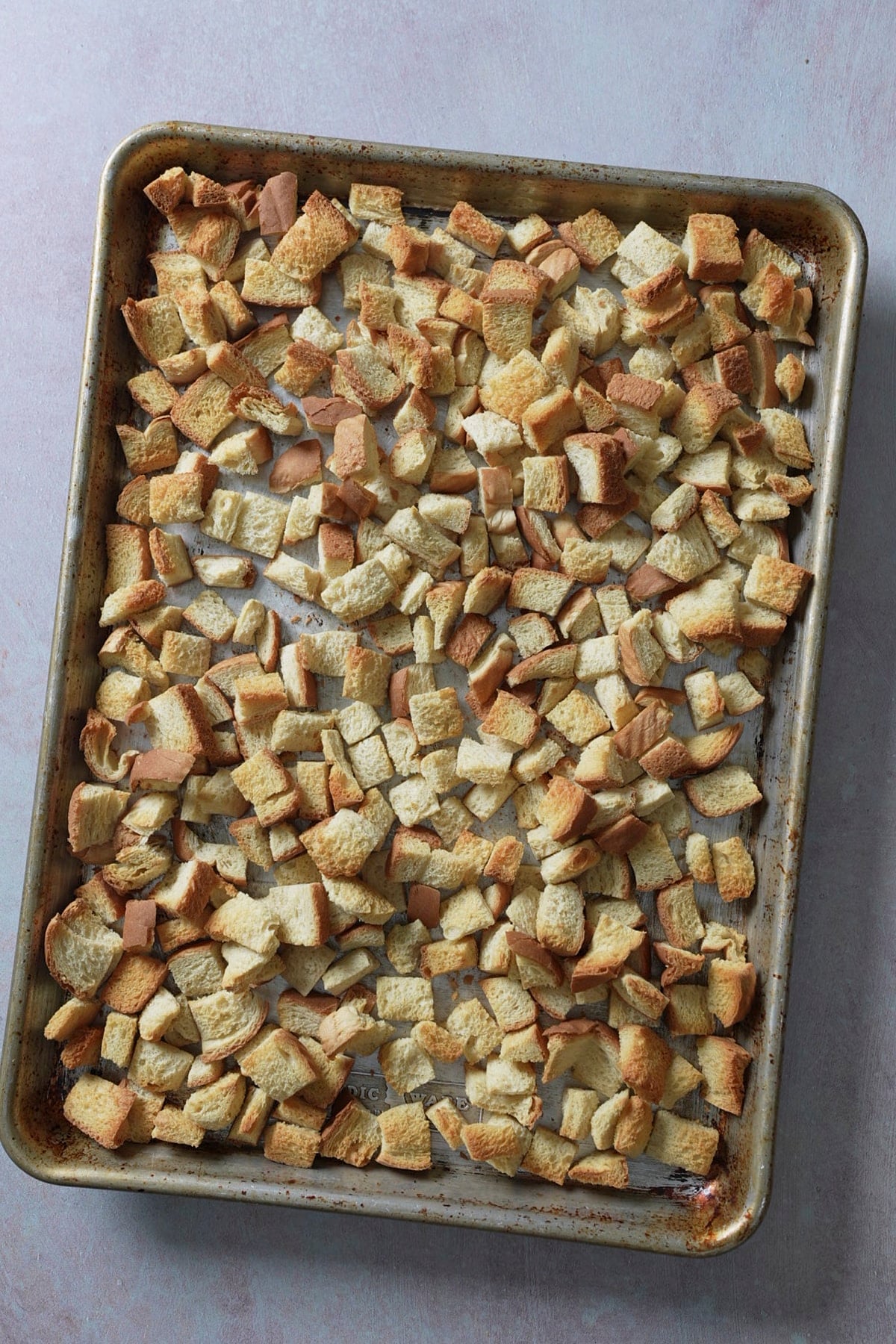
Step 1: Dry the bread. Preheat your oven to 300°F (150°C). Spread the bread cubes on baking sheets in a single layer and bake for 20 to 25 minutes, until they're completely dried out and crisp. Let them cool completely before you move on.

toasted bread on sheetpan

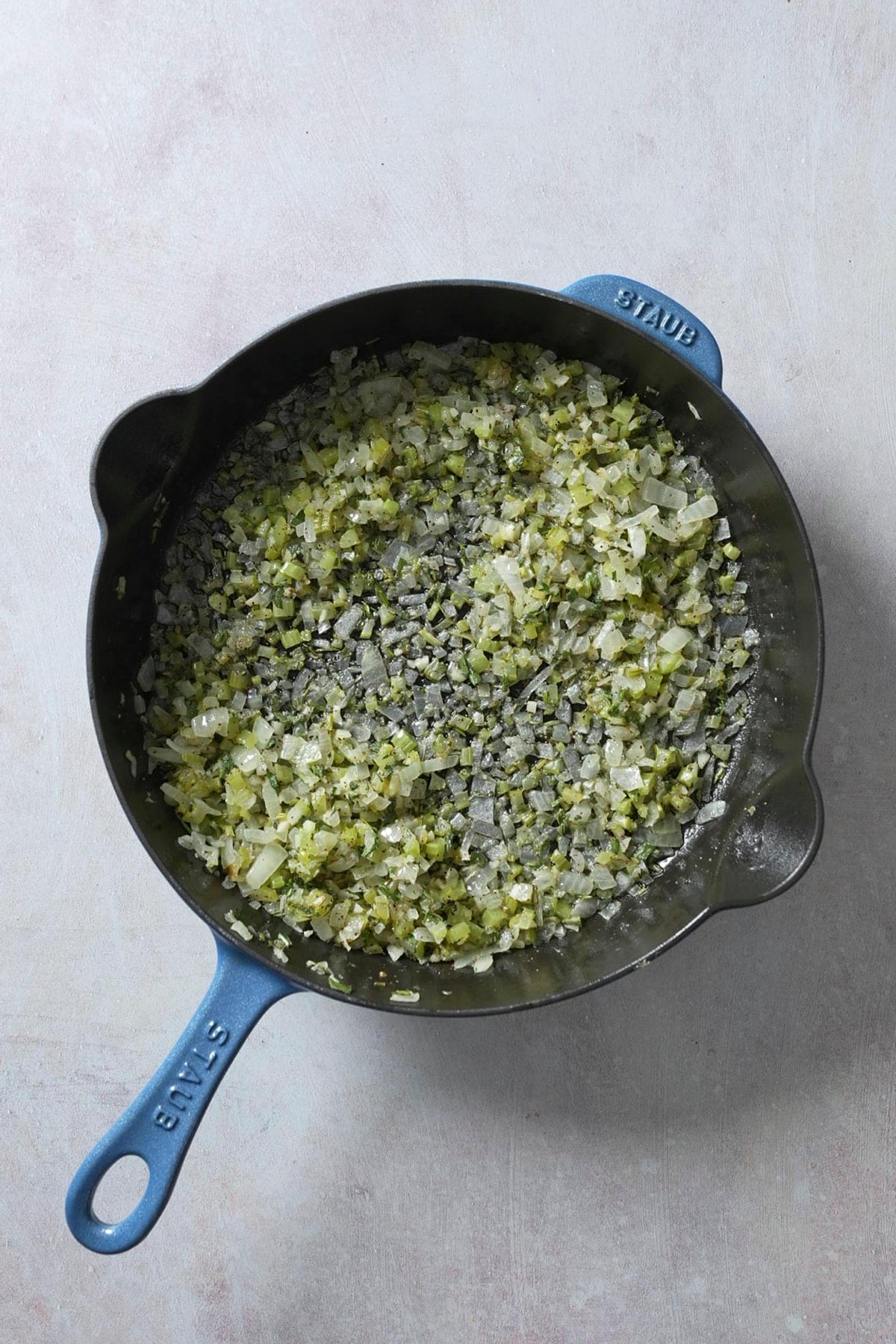
Step 2: Cook the aromatics. Once the bread is drying, bump your oven up to 350°F (175°C) and grease a 9x13-inch (23x33 cm) baking dish. Melt the butter in a large skillet over medium heat. Add the onions and celery and cook for 8 to 10 minutes, until soft. Stir in the garlic, sage, thyme, rosemary, salt, and pepper, and cook for another 1 to 2 minutes, just until fragrant. Take it off the heat.

butter and onion, garlic, and celery with seasoning in skillet for stuffing

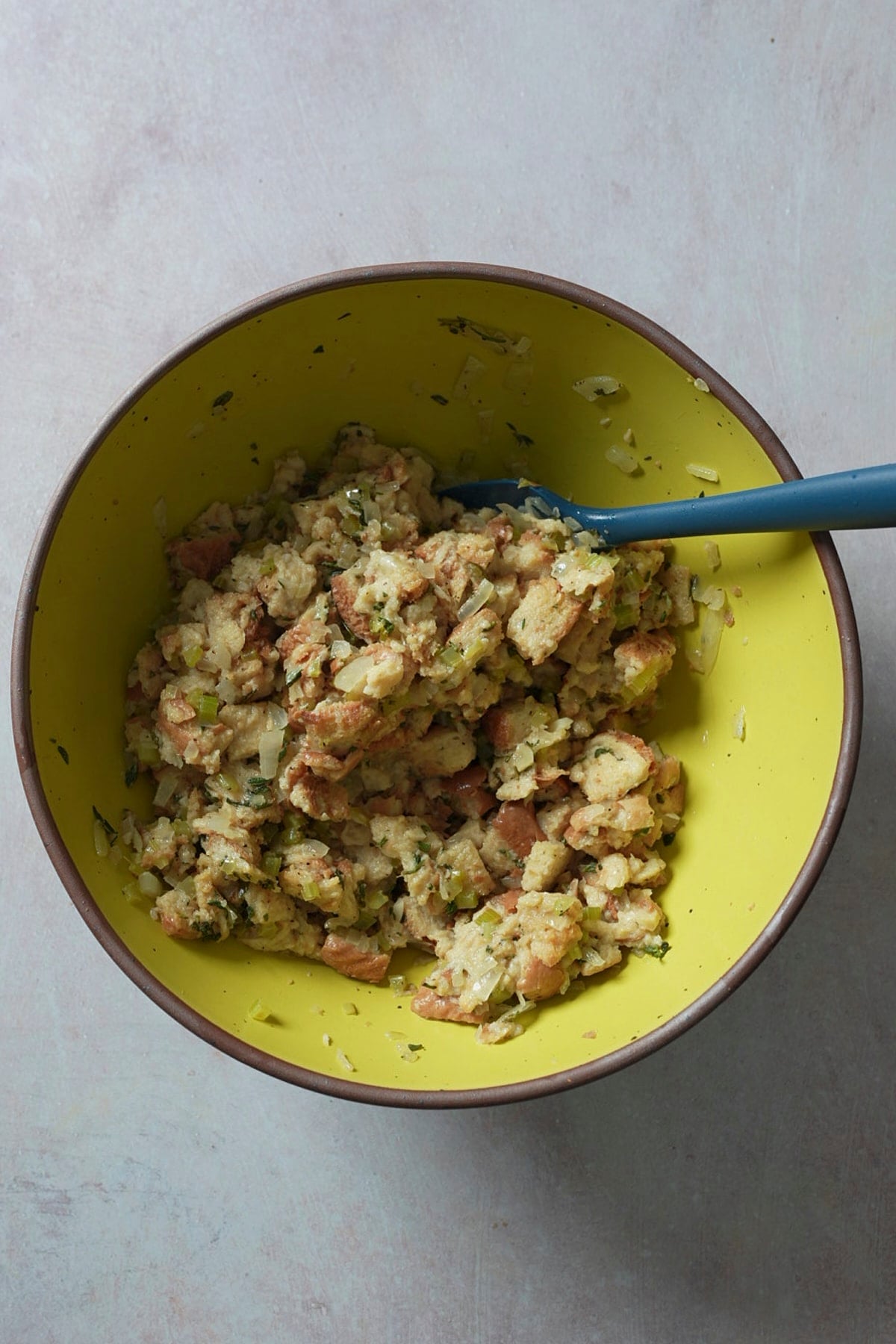
Step 3: Combine. Place the dried bread cubes in a large mixing bowl, then pour the warm butter and vegetable mixture over them. Toss gently to coat. In a separate bowl, whisk the broth with the eggs, then pour that over the bread mixture and fold everything together gently until the broth is absorbed.

stuffing ingredients in bowl mixed up

Step 4: Bake. Transfer to your prepared baking dish, cover tightly with foil, and bake for 30 minutes. Uncover and bake for another 15 to 20 minutes, until golden brown and crispy on top.

baked stuffing in baking dish

technique

For stuffing the bird

Want to stuff a turkey instead? Cool the stuffing completely first, then spoon it loosely into the cavity right before roasting, never ahead of time. Loose filling lets heat move through evenly, and you'll want to check with a food thermometer that the very center reaches 165°F (74°C) before serving, same as if it were baked in a dish.

Tanya's Top Tips

  • Don't rush the bread-drying step. If your bread isn't fully dry and a little crisp, your stuffing will be dense and soggy instead of that soft, custardy texture you want.
  • Fold the broth mixture in gently. You want every piece of bread moistened, but you're not trying to mash it into a paste.
  • Taste your butter and aromatic mixture before you combine everything. It's much easier to adjust salt and pepper here than after the stuffing is baked.

Variations

  • Stir in ½ to 1 cup of chopped apples or dried cranberries with the broth mixture for a little sweetness.
  • Add ½ cup toasted pecans or walnuts for crunch.
  • Swap half the bread cubes for cubed cornbread if you want something closer to my cornbread dressing. Dry or lightly toast the cornbread first so it doesn't turn mushy, and know that it'll bake up a little more crumbly and slightly sweet.
  • Leave the eggs out if you prefer a looser, more scoopable stuffing rather than one that holds together in slices.

What to Serve With Easy Stuffing

This stuffing belongs right next to the turkey and gravy, but here's what else rounds out the table:

  • Gravy from drippings of the turkey or chicken or giblet gravy poured over the top
  • Mashed red skinned potatoes or microwave mashed potatoes if you're short on stovetop space
  • Smothered green beans or southern green beans
  • Carrot soufflé for something a little sweeter on the plate
  • Cranberry sauce, for the tartness this stuffing doesn't have on its own
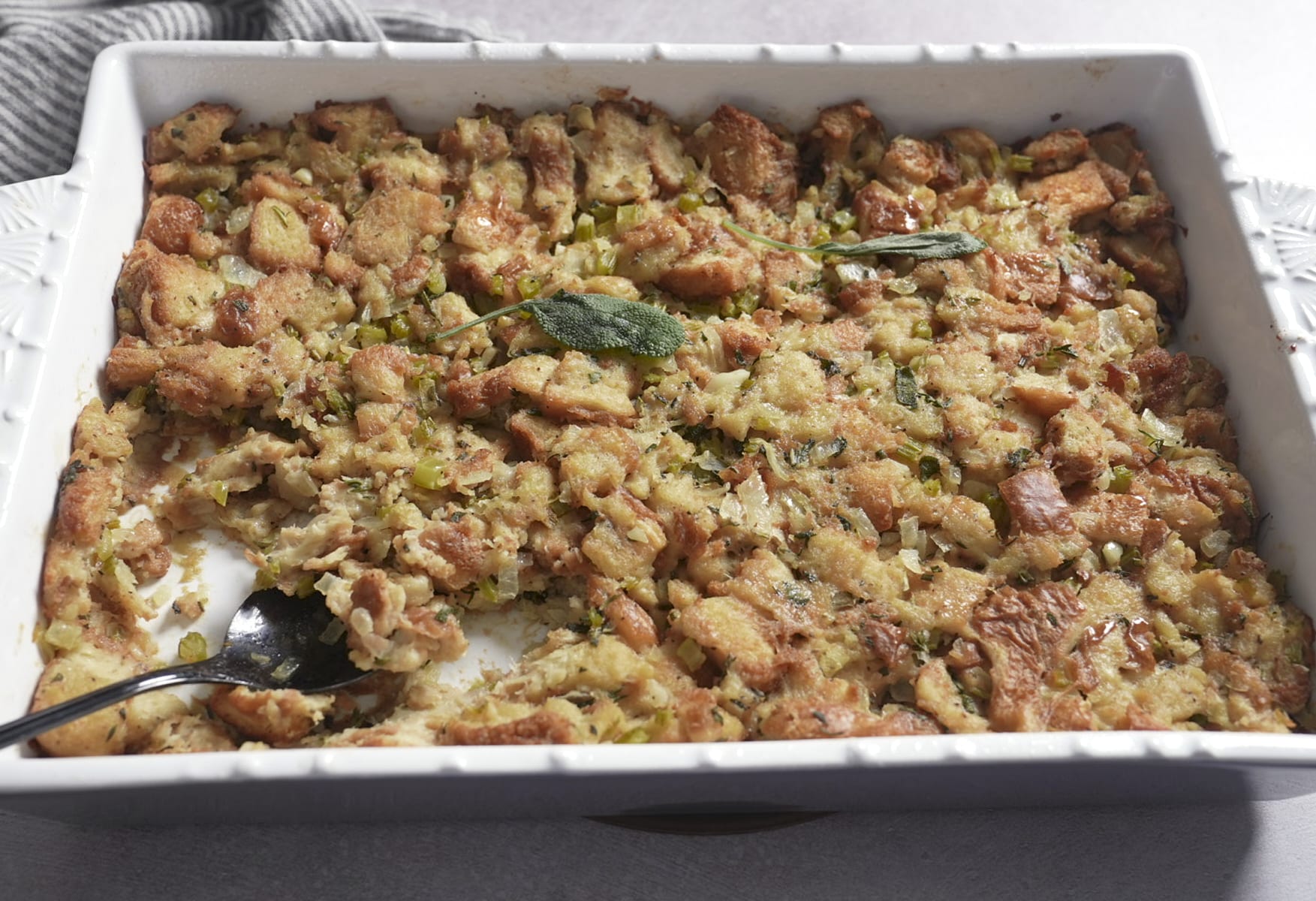
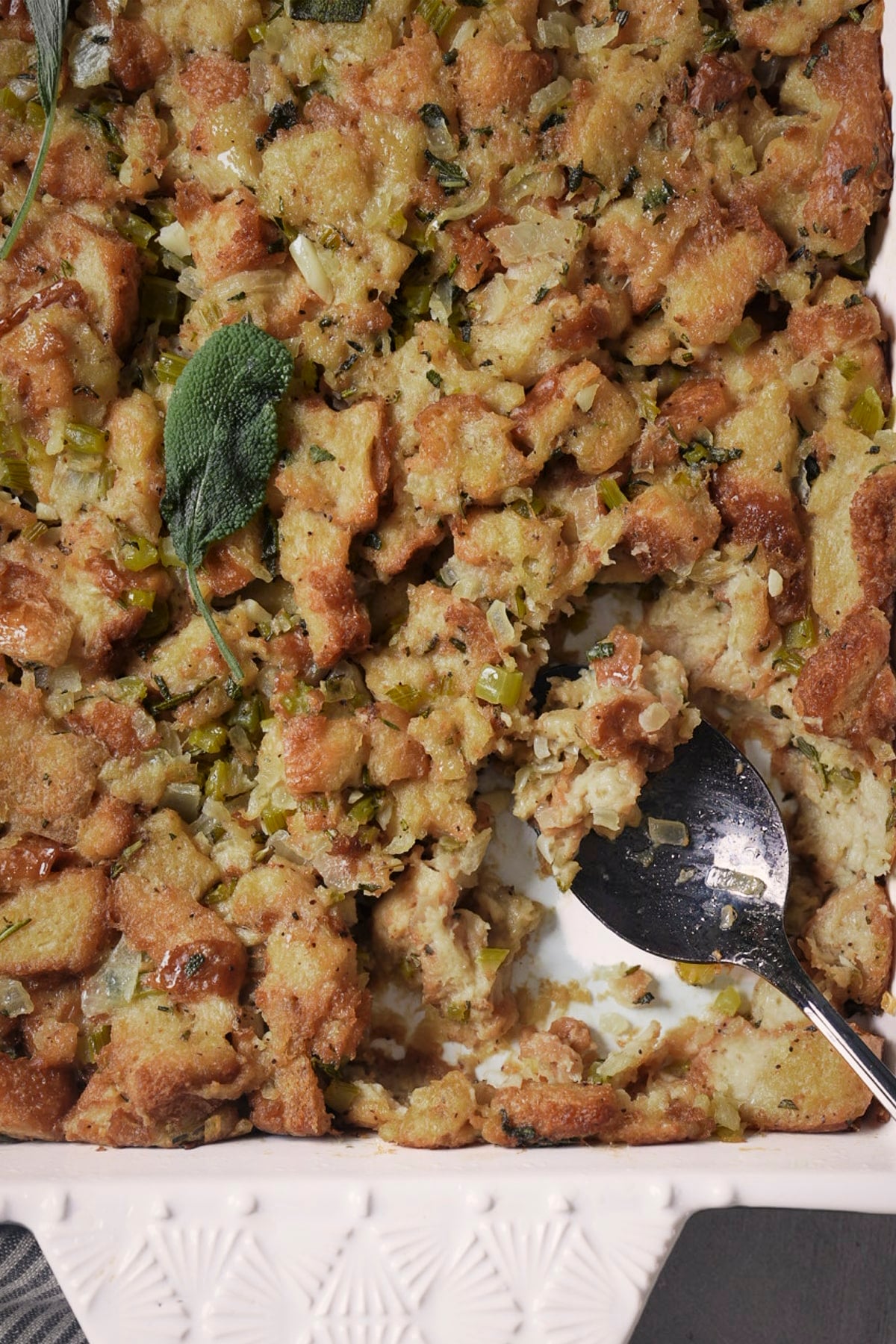
close up of spoon picking up stuffing

Make-Ahead, Storage & Freezing

Make ahead. You can dry the bread cubes and chop the vegetables up to 2 days ahead; store them separately in the refrigerator. Combine the stuffing just before baking. If you need to make it ahead of time, assemble it in a freezer-safe dish and freeze it unbaked immediately. Bake from frozen until the center reaches 165°F.

Leftovers. Refrigerate leftover stuffing in an airtight container within 2 hours and enjoy within 3 to 4 days. Reheat, covered, at 350°F (175°C) until hot throughout, then uncover for a few minutes to crisp the top. Individual portions can also be reheated in the microwave.
Freezing. Cooked stuffing freezes well for up to 1 month. Store it tightly wrapped or in a freezer-safe airtight container. Thaw overnight in the refrigerator, add a splash of broth if needed, and reheat covered at 350°F (175°C) until hot throughout.

FAQs

Can I make this stuffing without eggs?

Yes. The eggs help bind everything together, but you can leave them out for a looser, more scoopable stuffing. If you skip them, add a little extra broth so the bread doesn't dry out, and bake it covered a bit longer to help it set.

What's the difference between stuffing and dressing?

Traditionally, stuffing is cooked inside the turkey, and dressing is baked separately in its own dish, though many home cooks use the terms interchangeably. Stuffing cooked inside the bird tends to come out moister and more compact, and it needs to reach 165°F (74°C) in the center to be safe to eat. This recipe works either way, baked in a dish as written or spooned into the turkey just before roasting.

What if my stuffing turns out too dry?

Drizzle warm broth and a little melted butter over the top, cover with foil, and pop it back in a 350°F (175°C) oven for 10 to 15 minutes to rehydrate it. Dry bread cubes that weren't dried long enough, or stuffing left uncovered too long while baking, are usually the culprits. Next time, keep it covered a little longer or add a splash more broth before baking.

stuffing in casserole dish

I hope you love this recipe as much as we do. If you have tried this recipe or any other recipe on my blog, please rate it and let me know how it turned out in the comments below! Your feedback is invaluable and helps us grow. Thank you for your support!

stuffing in casserole dish
Print Recipe
No ratings yet

Easy Stuffing Recipe

A classic, savory stuffing made with dried bread cubes, butter, onion, celery, and fresh sage, thyme, and rosemary.
Prep Time25 minutes mins
Cook Time45 minutes mins
Total Time1 hour hr 10 minutes mins
Course: Side Dish
Cuisine: American
Keyword: stuffing recipe
Servings: 10 people
Calories: 117kcal
Author: Tanya Harris

Ingredients

  • 1 pound about 10 cups white sandwich bread, sourdough, or French bread, cut into ½-inch cubes
  • ½ cup unsalted butter 1 stick
  • 2 cups diced yellow onion about 2 medium onions
  • 1 cup diced celery about 4 stalks
  • 1 tablespoon minced garlic about 4 cloves
  • 2 tablespoons fresh sage finely chopped
  • 2 tablespoons fresh thyme leaves
  • 1 tablespoon fresh rosemary finely chopped
  • 1 teaspoon kosher salt
  • ½ teaspoon ground black pepper
  • 2¾ cups low-sodium turkey or chicken broth use vegetable broth for a meatless version
  • 2 large eggs whisked

Instructions

  • Preheat oven to 300°F (150°C). Spread bread cubes on baking sheets and bake for 20 to 25 minutes, until completely dried and crispy. Cool completely.
  • Increase oven temperature to 350°F (175°C) and grease a 9x13-inch (23x33 cm) baking dish. Set aside.
  • Melt butter in a large skillet over medium heat. Add onions and celery and cook 8 to 10 minutes, until soft. Stir in garlic, sage, thyme, rosemary, salt, and pepper. Cook 1 to 2 minutes, until fragrant, then remove from heat.
  • Place dried bread in a large mixing bowl. Pour the warm butter and vegetable mixture over the bread and toss gently.
  • Whisk broth with the eggs. Pour over the bread mixture and fold gently until absorbed.
  • Transfer stuffing to the prepared baking dish and cover tightly with foil. Bake covered for 30 minutes, then uncover and bake an additional 15 to 20 minutes, until golden brown and crispy on top.

Notes

  • Make ahead: For best texture, dry your bread cubes and sauté the vegetables up to 2 days in advance, storing them in separate airtight containers. Assemble with the broth and eggs right before baking. If you need to make it further ahead, assemble the casserole completely, cover, and freeze unbaked. Bake from frozen, adding extra time as needed until the center reaches 165°F.

Nutrition

Calories: 117kcal | Carbohydrates: 5g | Protein: 2g | Fat: 10g | Saturated Fat: 6g | Polyunsaturated Fat: 1g | Monounsaturated Fat: 3g | Trans Fat: 0.4g | Cholesterol: 58mg | Sodium: 496mg | Potassium: 119mg | Fiber: 1g | Sugar: 2g | Vitamin A: 451IU | Vitamin C: 5mg | Calcium: 38mg | Iron: 1mg

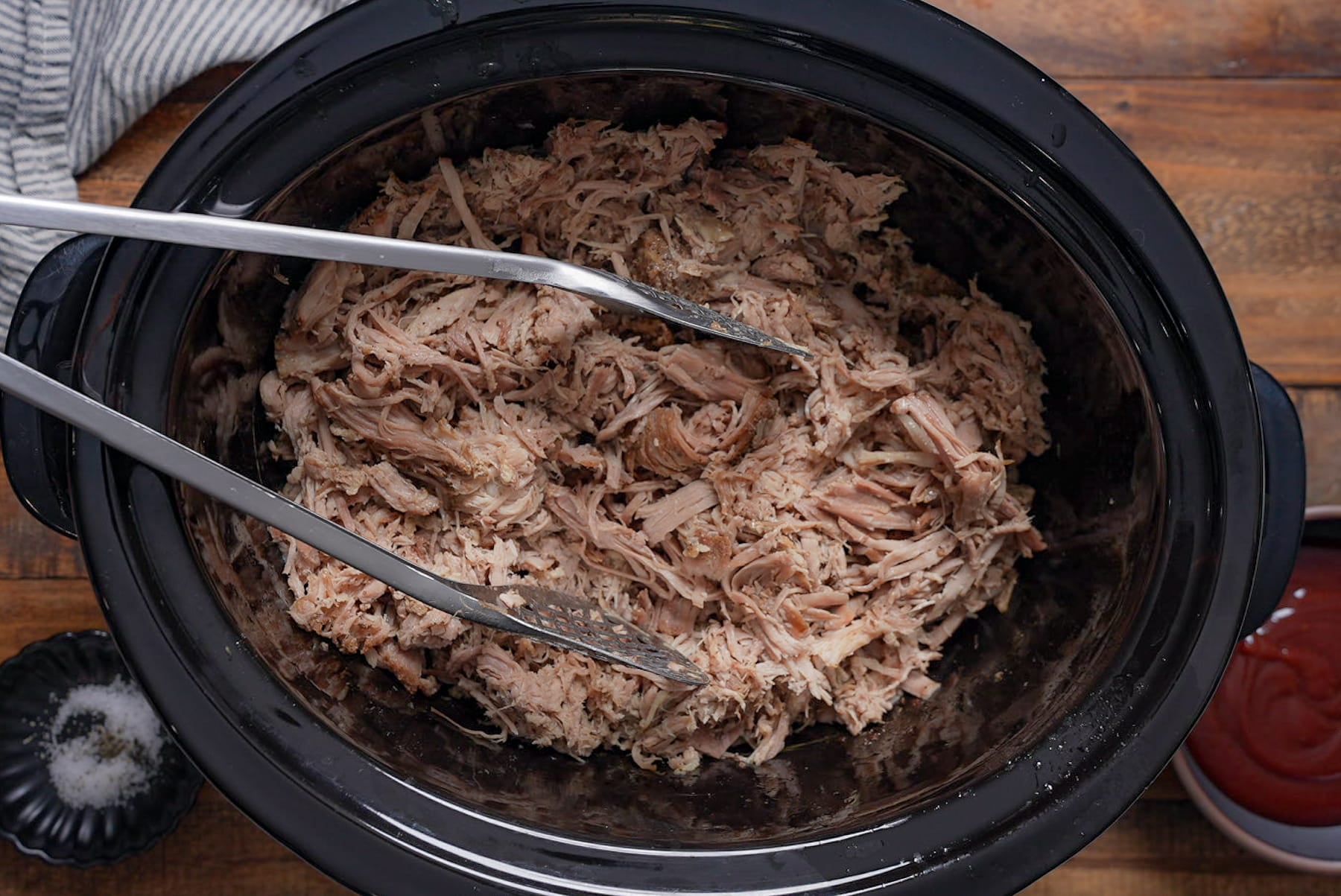
Slow Cooker Pulled Pork

August 9, 2026 by Tanya Harris 4 Comments

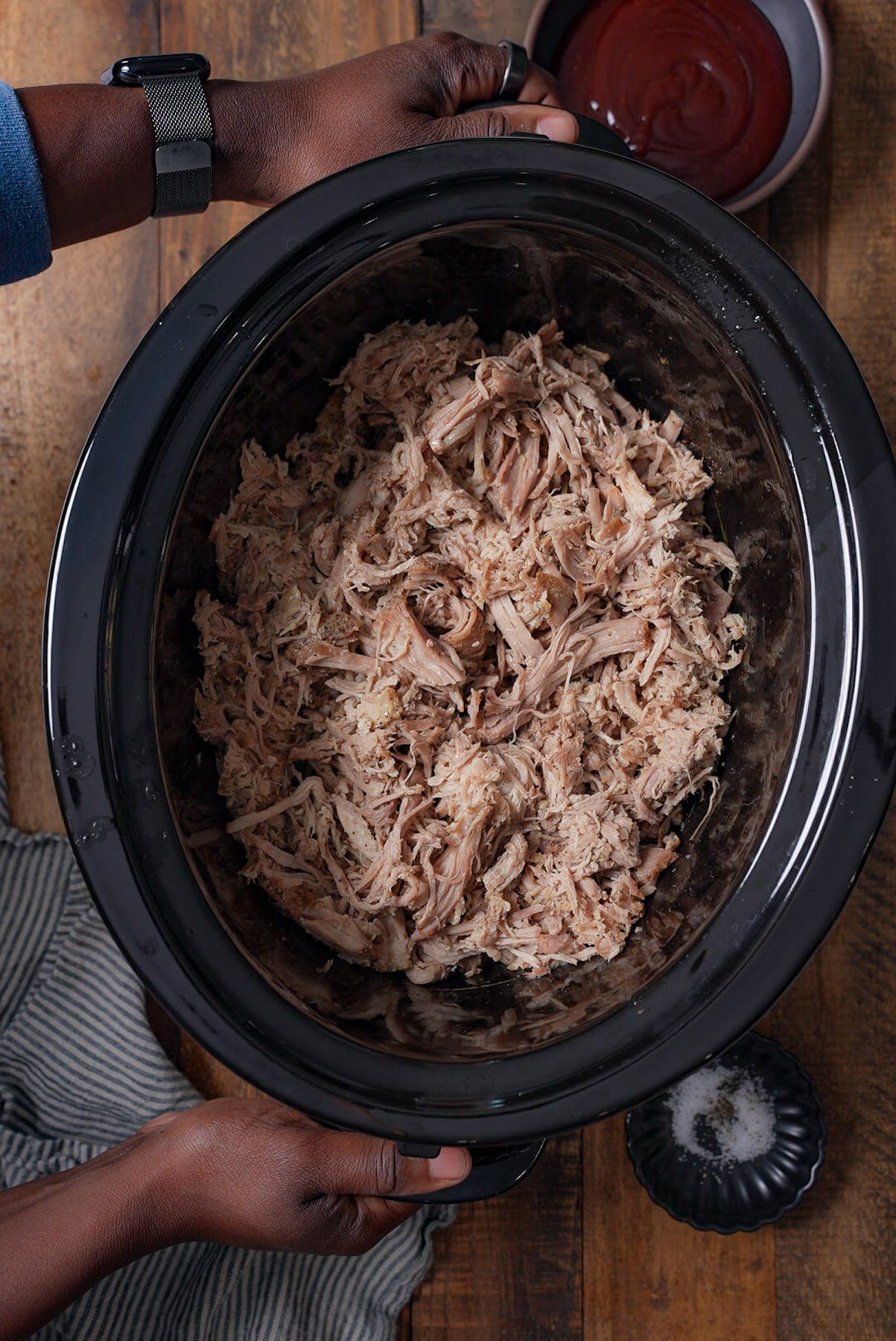
pulled pork inside of slow cooker insert

My slow cooker pulled pork is about as hands-off as barbecue gets. Season a pork butt, set the cooker, and hours later, you've got tender, shreddable meat ready for whatever you're in the mood for.

Pulled pork in slow cooker insert

You’ll find the full recipe with ingredient amounts and instructions in the recipe card at the bottom of this post. Be sure to check out the blog post itself for extra tips and tricks!

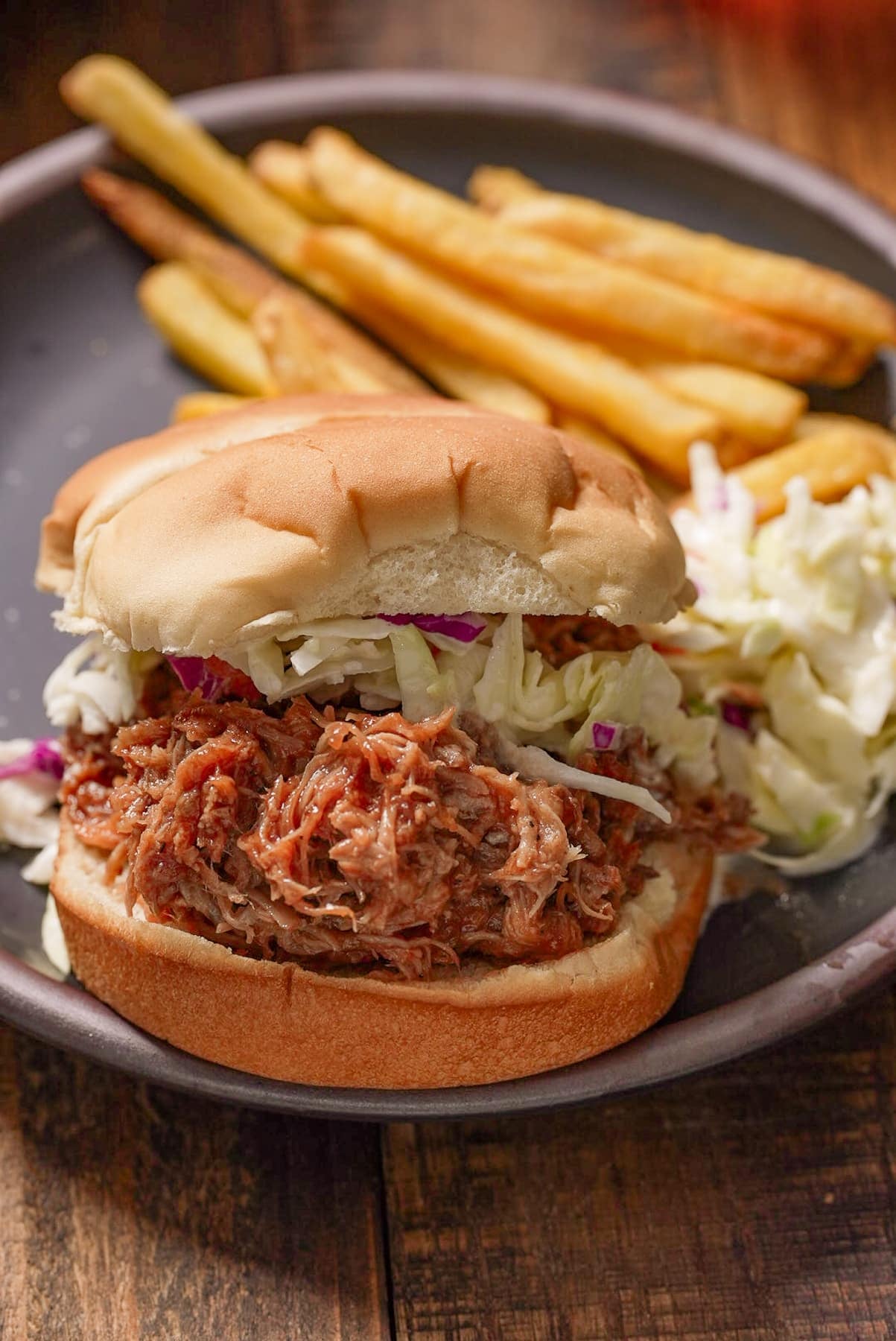
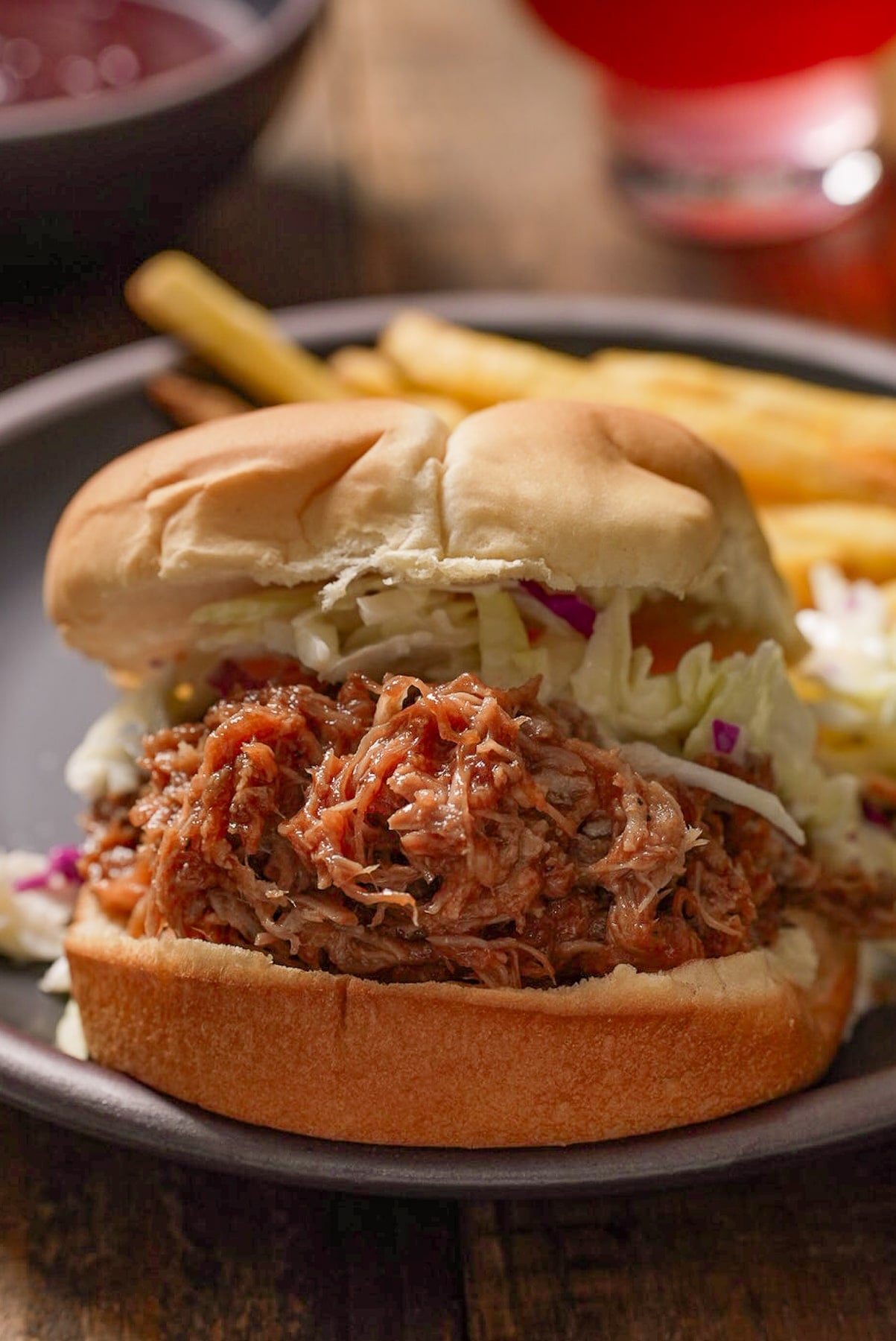
Pulled pork sandwich on bread with coleslaw and fries in the background.

Slow Cooker Pulled Pork at a Glance

  • Best for: hands-off barbecue, meal prep, feeding a crowd
  • Prep time: 10 minutes 
  • Cook time: 6 to 8 hours on LOW (recommended) or 3 to 4 hours on HIGH
  • Servings: about 6 to 9 servings from a 6-pound pork butt
tanya standing looking at camera

I'm a huge barbecue fan, and pulled pork, in particular, has always been my thing. I'm constantly finding new ways to make it work for whatever's going on that week. My North Carolina Instant Pot Pulled Pork came out of my love for that tangy vinegar style, and I always keep a batch of my homemade BBQ rub and homemade BBQ sauce on hand for it. But when I don't want to babysit the pressure cooker, or I need something that just runs while I'm out doing errands, this slow cooker version is what I reach for.

What I like about this method is that it gives you a blank canvas. I keep the rub simple on purpose, just salt, garlic powder, onion powder, pepper, and smoked paprika. This has flavor without the sauce, but then it’s like a choose-your-own-adventure, and you can add any type of sauce. This is great for a family dinner or party.

Happy Cooking,

Tanya

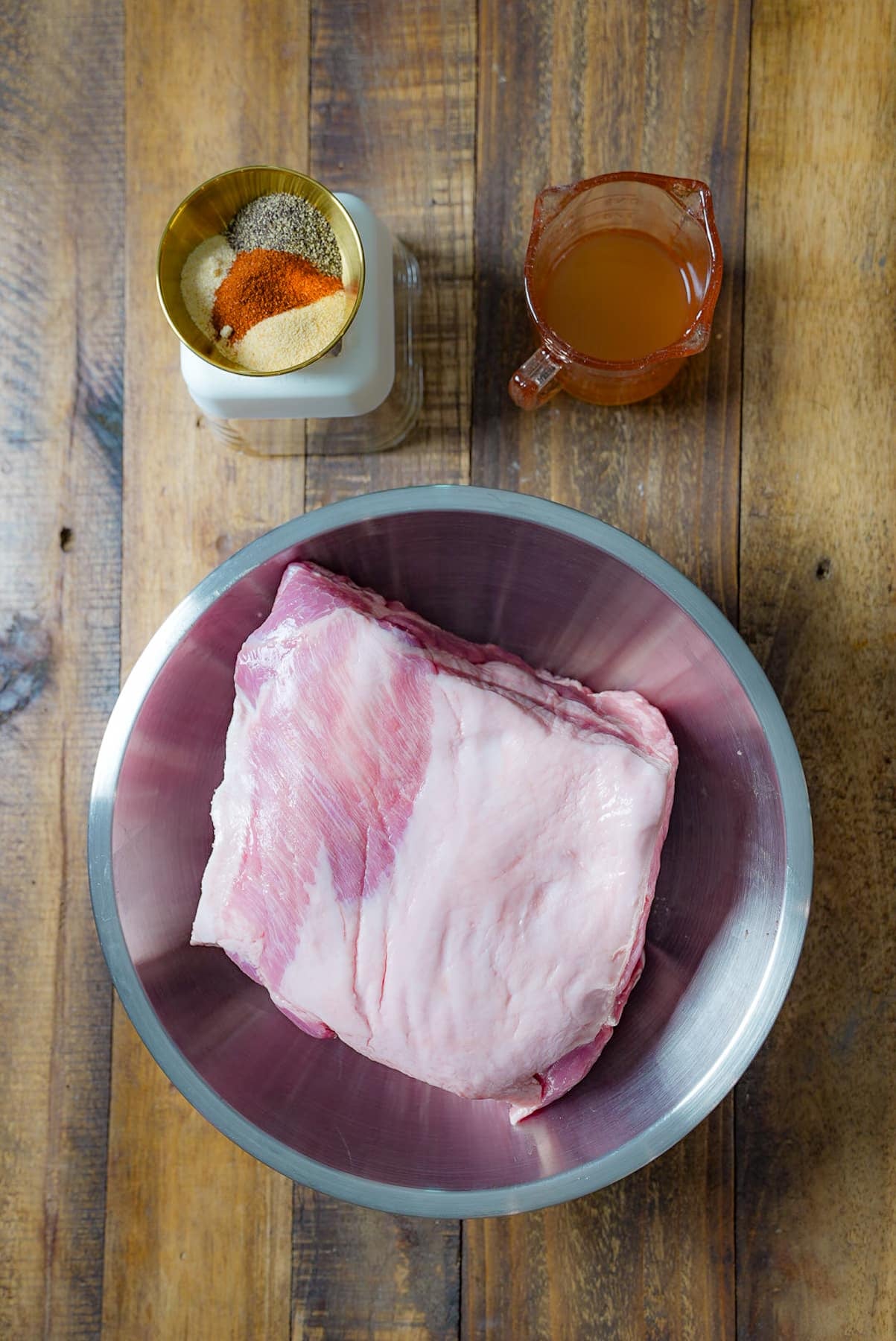
Ingredient Notes

Ingredient amounts and full recipe instructions are on the printable recipe card at the bottom of the post.

  • Pork butt (Boston butt): Bone-in or boneless both work.
  • Kosher salt, garlic powder, onion powder, black pepper, smoked paprika: This is a plain rub with no sugar in it, and that's on purpose. It keeps the pork neutral enough that you can finish it with vinegar sauce, sweet BBQ sauce, or lime juice. Sweet paprika works fine if that's what you have.
  • Chicken broth, apple cider vinegar, or light beer: Pick based on where you're taking the pork. Broth keeps it savory, apple cider vinegar leans toward my Carolina style, and beer adds a little malty depth. 
  • BBQ sauce, lime juice, or pan juices: Add BBQ sauce after your pork has been cooked and shredded. Stir in BBQ sauce for sandwiches, lime juice if it's headed for tacos, or just moisten it with the reserved pan juices and let whatever you're serving it with do the flavor work.
ingredients for pulled poork

How to Make Slow Cooker Pulled Pork

Please see the recipe card below for the full printable recipe, ingredients, and instructions. Here you will find step-by-step photos of how to make this recipe.

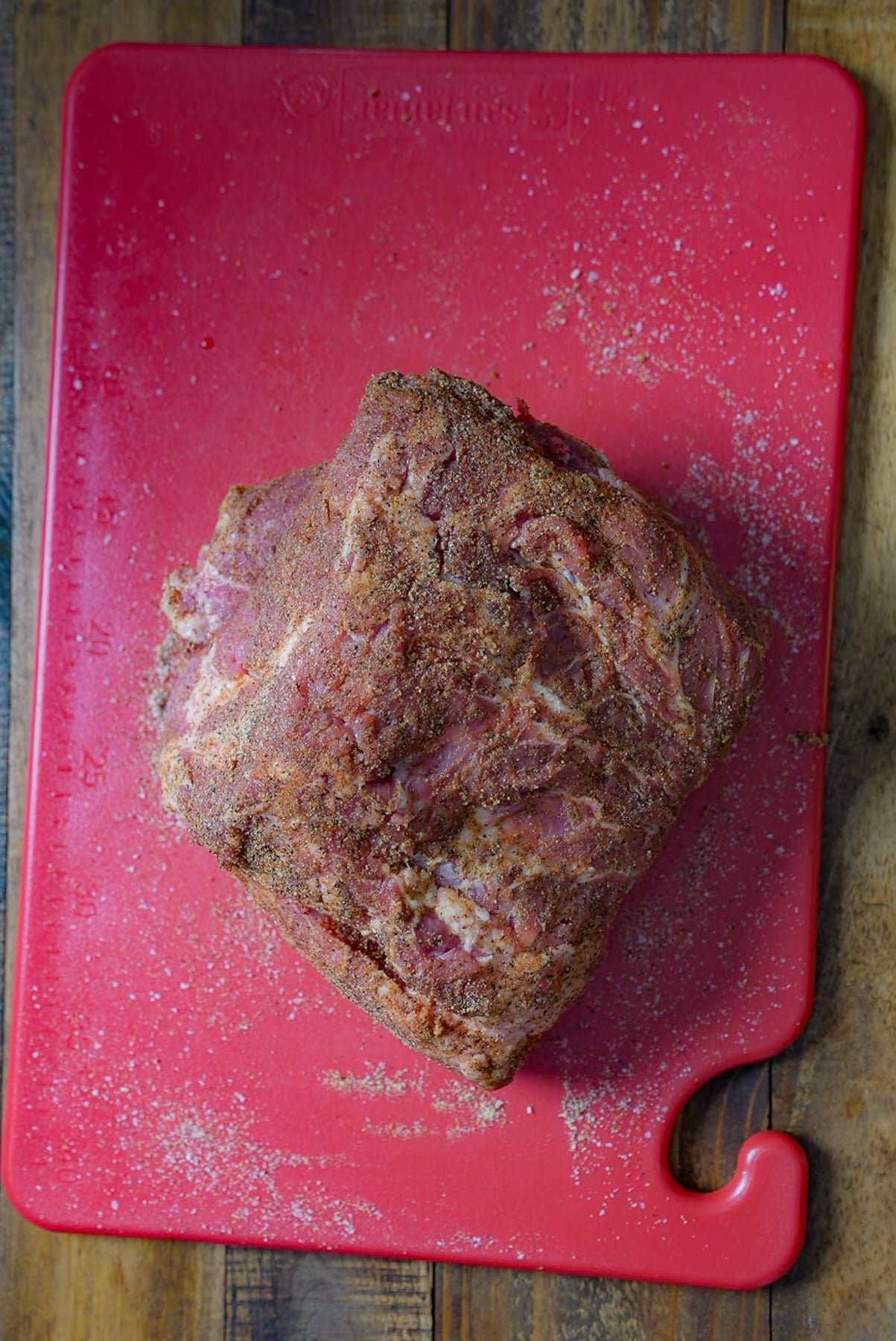
Step 1: Trim and Season the Pork. Pat the pork dry with paper towels; a dry surface holds seasoning better. Trim off any large slabs of excess fat, but leave a thin, quarter-inch layer for moisture. In a small bowl, combine the kosher salt, garlic powder, onion powder, black pepper, and smoked paprika. Rub the mixture over every side of the pork, pressing it in so it sticks.

Raw pork butt on a red cutting board

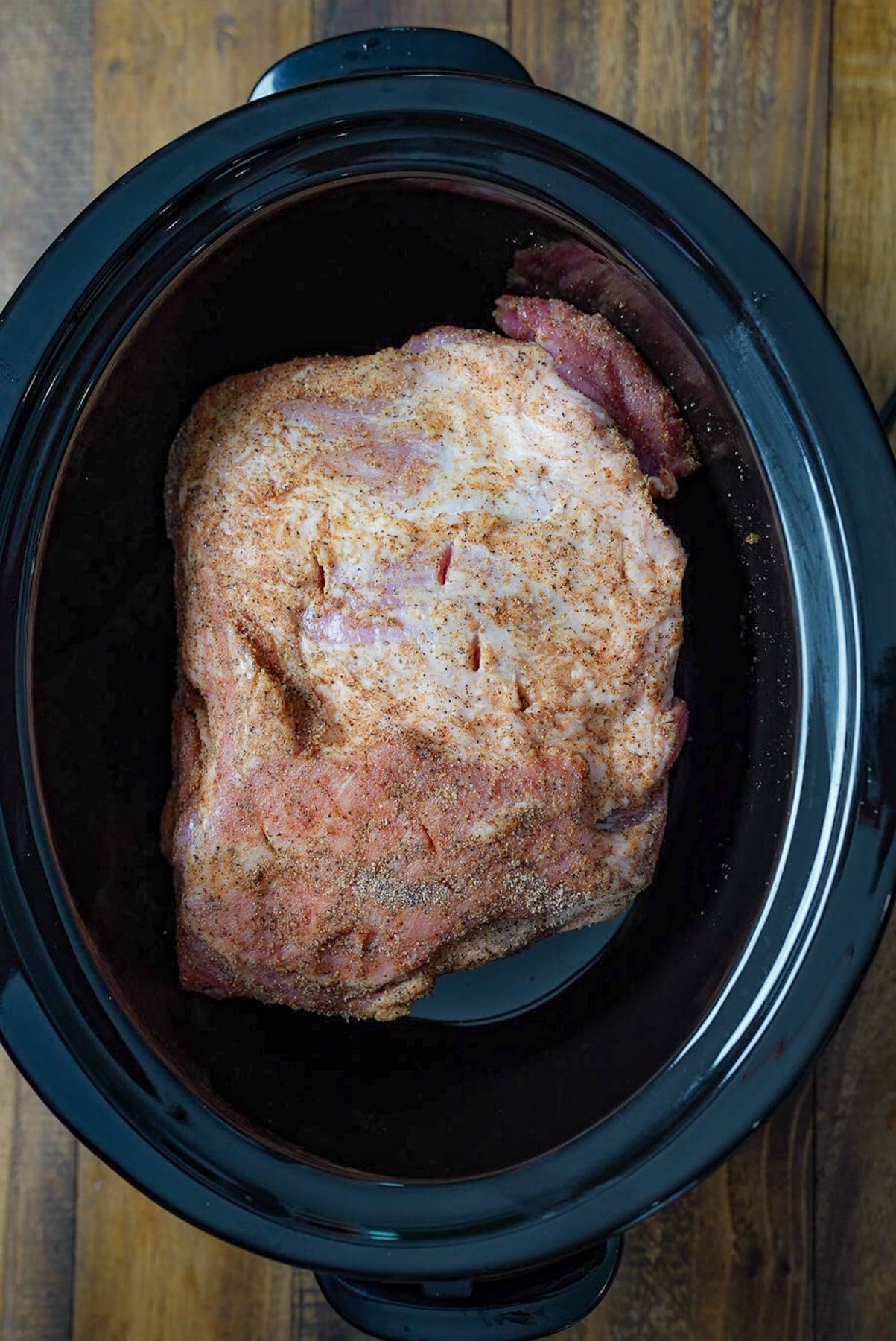
Step 2: Load the Slow Cooker. Pour your chosen liquid; chicken broth, apple cider vinegar, or light beer, into the bottom of the slow cooker. Set the seasoned pork on top, fat-side up if it's bone-in, so the fat renders down and bastes the meat as it cooks.

Raw pork and slow cooker insert

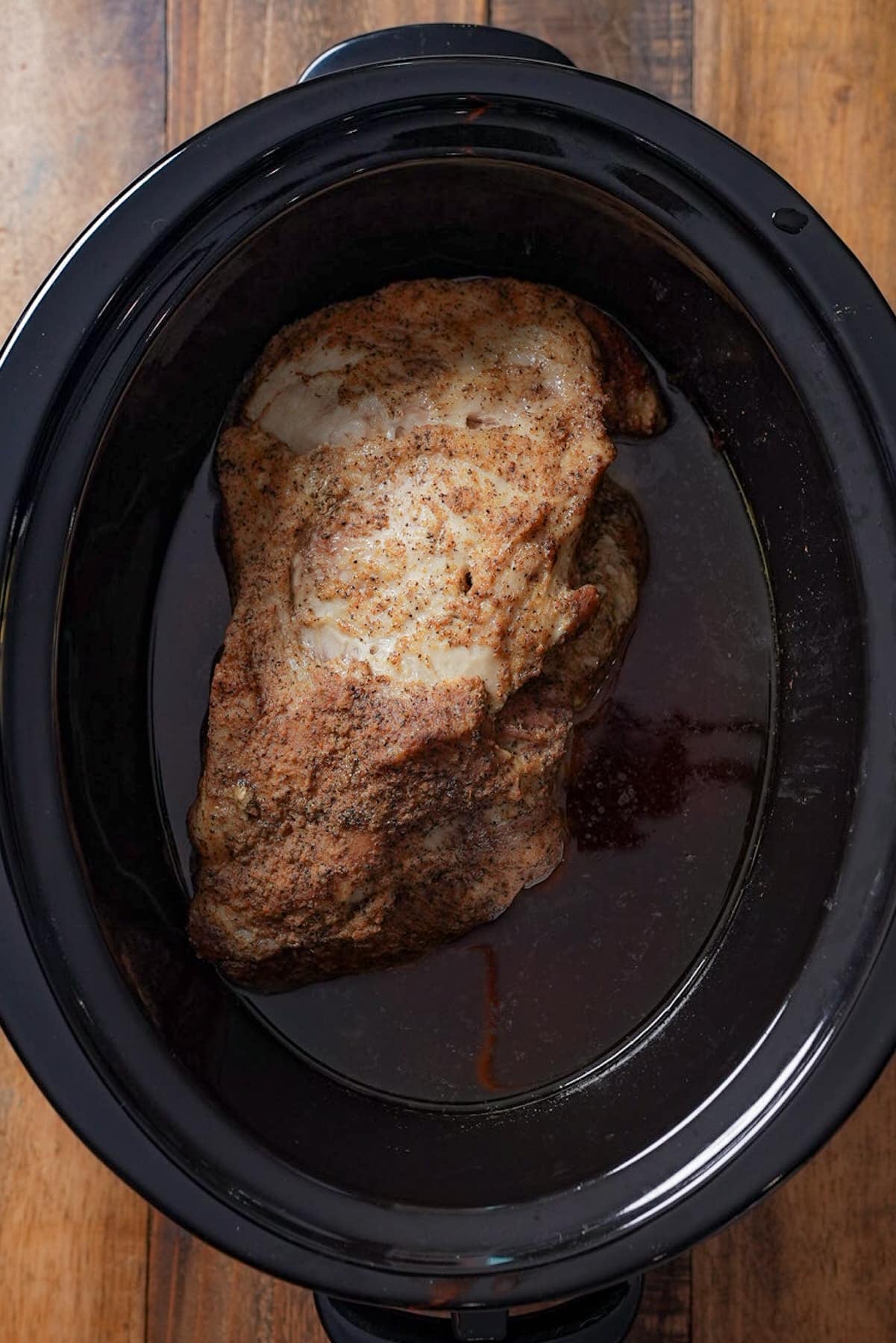
Step 3: Cook It Low and Slow. Cover and cook on LOW for 6 to 8 hours, or on HIGH for 3 to 4 hours. LOW is the better bet for even, tender results. You're looking for the pork to pull apart with almost no resistance when you twist a fork into the thickest part.

If you're using a probe thermometer, that's around 200°F (93°C), don't pull it before 195°F (90°C), since the connective tissue needs that heat to fully break down.

Pork butt in slow cooker insert

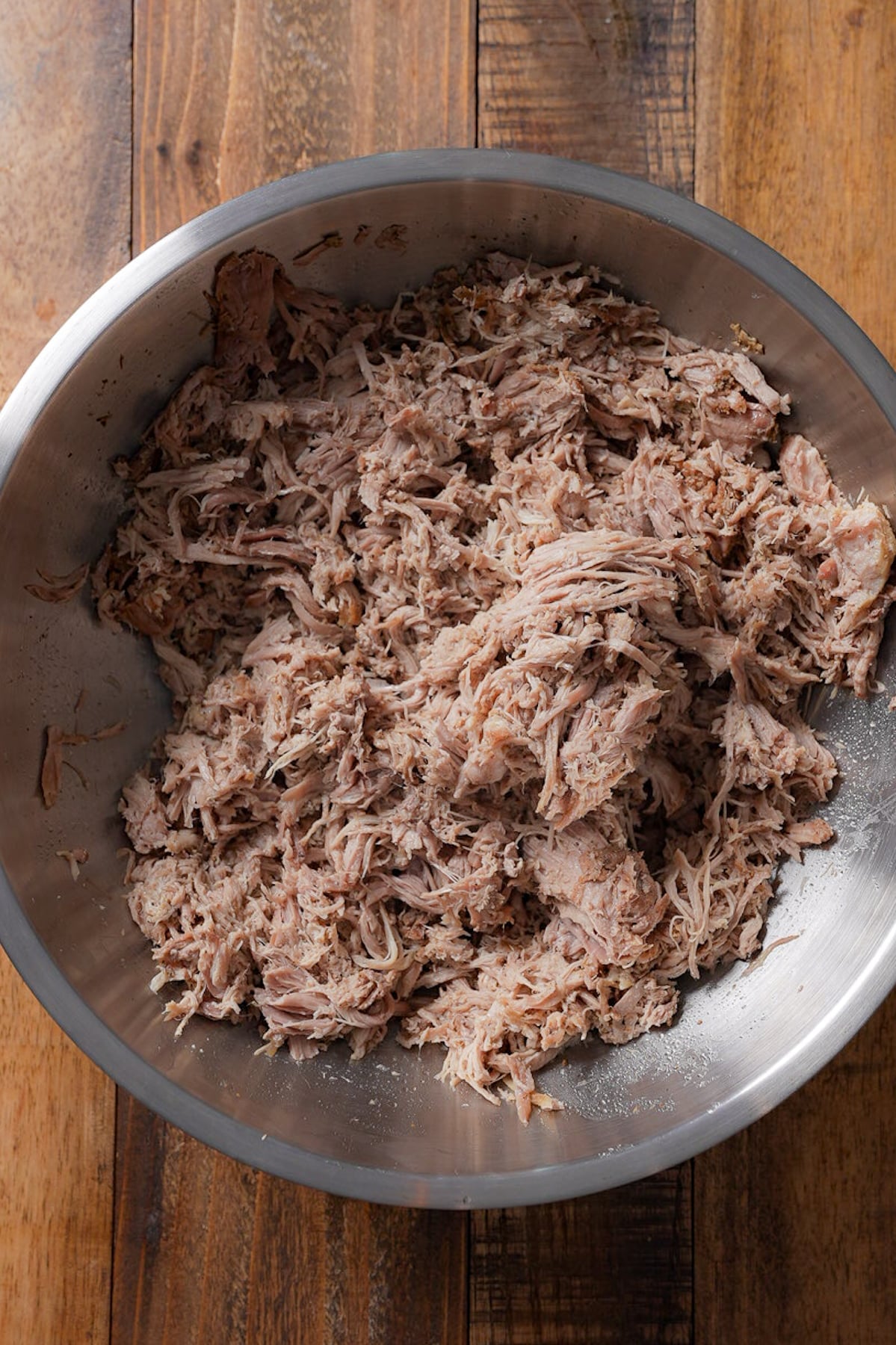
Step 3: Shred and Finish. Transfer the pork to a large bowl or cutting board and let it sit a few minutes before handling. If using a bone-in pork, remove any bones and big chunks of gristle, then shred with two forks.

Toss the shredded pork with a few tablespoons of the warm cooking liquid to keep it from drying out, then stir in BBQ sauce and a squeeze of lime juice, or leave it as is with the reserved pan juices, depending on what you're making.

Pulled pork in metal bowl.

important tip

Slow cooker size

I made this in a 6-quart slow cooker, and a 6-pound bone-in butt fits with room to spare. If you only have a 4-quart, size down to a 3 to 4 pound piece of pork shoulder, or cut a larger butt in half so it isn't packed in past the rim. An overcrowded cooker won't heat evenly and can leave you with a raw-ish center even after the full cook time.

Pulled pork sandwich with barbecue and coleslaw on bread.

Tanya's Top Tips

  • Buy a bigger butt than you think you need. Pork shoulder loses close to half its weight once it's cooked, boned, and trimmed, so a 6-pound raw butt isn't as much finished meat as it sounds like.
  • Don't skip fat-side up. That fat cap renders down over the long cook and bastes the meat the whole time, so you're not doing any extra work.
  • Save the cooking liquid. That's flavor you already built in. Skim the fat off the top and use what's left to loosen the pork before serving or when you reheat it later.

Variations

  • Go full Carolina style and stir in my vinegar BBQ sauce with a scoop of coleslaw right on the sandwich. Or go with thick and sweet BBQ, like my homemade BBQ sauce or your favorite store-bought brand.
  • Skip the sauce entirely and use lime juice for taco or burrito filling.
  • Swap the broth for light beer in the bottom of the cooker if you want a little more depth in the background flavor.

What to Serve With Slow Cooker Pulled Pork

Pile it onto toasted buns with vinegar coleslaw or a classic coleslaw for a proper sandwich. Round out the plate with Southern potato salad and homemade baked beans. It also works well in tacos, over nachos, stuffed into a baked potato, or piled onto a burrito bowl with rice and beans.

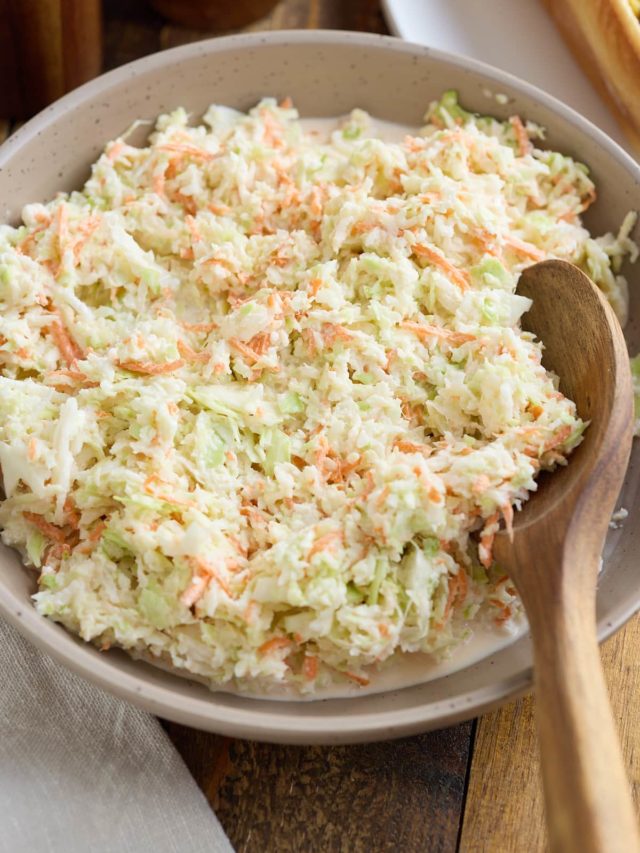
Coleslaw in a serving bowl with a wooden spoon.

Coleslaw

This Pork pairs well with a classic coleslaw. Make it from scratch, or use a coleslaw package as a shortcut.

Get the Coleslaw Recipe

Storage, Reheating, and Freezing

Storing: Let the pork cool, then transfer it to an airtight container with a little of the reserved cooking liquid to keep it moist. Refrigerate and use within 3 to 4 days.

Freezing: Portion the shredded pork into freezer bags or containers, press out the air, and freeze with a little of the reserved cooking liquid. It's safe to keep longer, but for the best texture and flavor, use it within about 3 months. Defrost overnight in the fridge before reheating.

Reheating: Warm it gently in a covered skillet over medium-low with a splash of the reserved liquid or broth, or microwave in short bursts with a little added liquid, stirring in between. Either way, bring it back up to 165°F (74°C) before eating.

pulled pork inside of slow cooker insert

FAQs

Does bone-in or boneless matter?

Both work here. Bone-in holds moisture slightly better and gives you a visual cue, the bone should wiggle loose when the pork's close to done. Boneless is easier to trim and portion but can overcook a little faster, so start checking it toward the earlier end of the time range.

What if my pork isn't tender at 6 hours?

Keep going. Check back every 30 to 45 minutes on LOW until a fork twists through with no resistance. Cook time varies some depending on the exact size and shape of your pork butt.

Can I make this ahead for a party?

Yes. Cook it the day before, refrigerate it with some of the cooking liquid, and reheat gently on the stovetop or in the slow cooker on LOW before serving. It also holds well on the WARM setting for a few hours if you're serving buffet-style.

Can I use pork tenderloin for this recipe?

No, it’s not recommended. Pork tenderloin is extremely lean and lacks the fat and connective tissue needed for slow cooking. Cooking it low and slow for hours will leave it dry and tough rather than juicy and tender. Stick to pork shoulder (Boston butt) for the best results!

I hope you love this recipe as much as we do. If you have tried this recipe or any other recipe on my blog, please rate it and let me know how it turned out in the comments below! Your feedback is invaluable and helps us grow. Thank you for your support!

pulled pork inside of slow cooker insert
Print Recipe
5 from 2 votes

Slow Cooker Pulled Pork Recipe

A simple, hands-off slow cooker pulled pork made with a 5-ingredient rub, good for sandwiches, tacos, and meal prep all week.
Prep Time10 minutes mins
Cook Time6 hours hrs
Total Time6 hours hrs 10 minutes mins
Course: entree, Main Course
Cuisine: American
Keyword: crockpot pulled pork, slow cooker pulled pork
Servings: 8 people
Calories: 306kcal
Author: Tanya Harris

Ingredients

  • 4 to 6 pounds pork butt Boston butt, bone-in or boneless (I used a 6-pound bone-in butt in a 6-quart slow cooker)
  • 1 tablespoon kosher salt
  • 2 teaspoons garlic powder
  • 1 ½ teaspoons onion powder
  • 1 ½ teaspoons ground black pepper
  • 1 teaspoon smoked paprika or sweet paprika
  • ½ cup chicken broth apple cider vinegar, or light beer
  • BBQ sauce lime juice, or reserved pan juices, for serving

Instructions

  • Pat the pork dry with paper towels. Trim excess surface fat, leaving a thin, ¼-inch layer for moisture.
  • In a small bowl, combine the kosher salt, garlic powder, onion powder, black pepper, and smoked paprika. Rub the mixture over every side of the pork.
  • Pour the chicken broth (or apple cider vinegar or light beer) into the bottom of the slow cooker. Set the seasoned pork on top, fat-side up.
  • Cover and cook on LOW for 6 to 8 hours, or on HIGH for 3 to 4 hours, until the pork pulls apart easily with a fork (internal temperature around 200°F/93°C).
  • Transfer the pork to a large bowl or cutting board. Remove any bones or gristle, then shred with two forks.
  • Toss the shredded pork with a few tablespoons of the warm cooking liquid. Stir in BBQ sauce, lime juice, or serve as is with the reserved pan juices.

Notes

Pork Cut: Use pork shoulder (Boston butt). Bone-in stays a bit moister, but boneless works great too.
Storage & Freezing: Refrigerate with a splash of cooking liquid in an airtight container for 3–4 days, or freeze for up to 3 months. Thaw overnight in the fridge before reheating.
Reheating: Warm gently in a covered skillet or microwave with extra liquid until it reaches 165°F (74°C).
Save the Pan Juices: Skim off the fat and toss a few tablespoons of reserved liquid back into the pork to keep it moist.
Fat-Side Up: Place pork fat-side up in the slow cooker so it bastes itself as it cooks.
Yield: Pork shoulder shrinks by about half when cooked; a 6-lb raw butt yields roughly 6–9 servings.

Nutrition

Calories: 306kcal | Carbohydrates: 1g | Protein: 43g | Fat: 13g | Saturated Fat: 5g | Polyunsaturated Fat: 1g | Monounsaturated Fat: 6g | Trans Fat: 0.1g | Cholesterol: 136mg | Sodium: 1075mg | Potassium: 795mg | Fiber: 0.3g | Sugar: 0.1g | Vitamin A: 125IU | Vitamin C: 0.1mg | Calcium: 37mg | Iron: 3mg

Homemade Sweet and Sour Chicken

August 7, 2026 by Tanya Harris Leave a Comment

swet and sour chicken in bowl next to rice

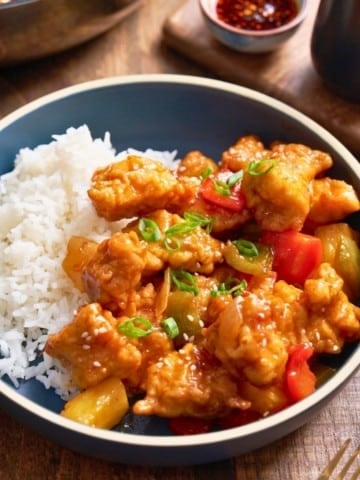
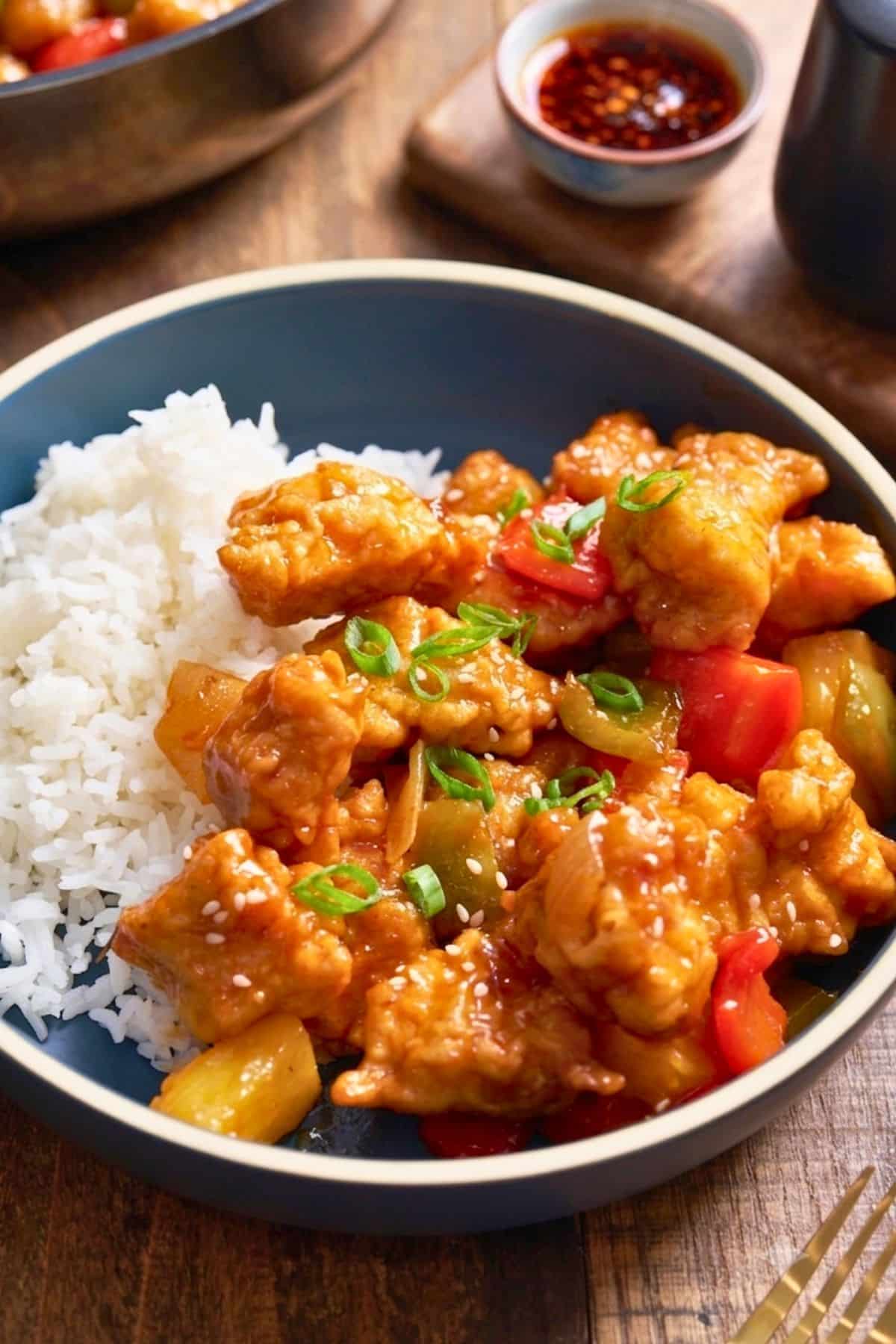
Crispy, double-fried chicken tossed in a glossy homemade sweet and sour sauce with bell peppers and pineapple. This is my take on the Chinese-American takeout order I love, made at home.

sweet and sour chicken in bowl next to rice

You’ll find the full recipe with ingredient amounts and instructions in the recipe card at the bottom of this post. Be sure to check out the blog post itself for extra tips and tricks!


close up Tanya holding bowl

Sweet and sour chicken is one of my go-to takeout orders. One thing I always noticed is that a lot of places serve sweet and sour sauce on the side, so you pour it on your food right before you eat, or dip your chicken into it. I wanted a version where everything comes together in one pan instead: the chicken gets battered and fried twice for a shell that holds up, then it all gets tossed with the peppers, pineapple, and sauce right before serving so every bite is coated. It pairs easily with a batch of oven-baked rice or my Steak Kimchi Fried Rice if you want to switch things up.

This sauce leans tangy rather than spicy, more like the mellow, brighter cousin to something like General Tso's. It's perfect for weeknight dinners when you want restaurant quality at home.

Happy Cooking,

Tanya

sweet and sour chicken in skillet with spoon scooping it

Sweet and Sour Chicken at a Glance

  • Best for: weeknight dinner, feeding a family, replacing takeout night
  • Prep time: 20 min
  • Cook time: 30 min
  • Total time: 50 min
  • Serves: 4
  • Good to know: the chicken is double-fried for extra crispiness, and the sauce uses reserved pineapple juice for real fruit flavor instead of relying only on sugar

Ingredient Notes

Ingredient amounts and full recipe instructions are on the printable recipe card at the bottom of the post.

  • Chicken breast: I use boneless, skinless breast here, but thighs work too if you want something juicier. Just know thighs will need a little extra time in that first fry.
  • Cornstarch: Used in two places, the batter and the sauce. In the batter, it's what keeps the coating light instead of doughy. In the sauce, it thickens it and gives the sauce that silky, clingy texture.
  • Baking powder: Just a half teaspoon, but it's what gives the batter a little lift.
  • Ketchup: I tested this with regular ketchup. A low-sugar or unsweetened brand will throw off the sweet-and-sour balance, so you'd need to add more sugar to compensate.
  • Rice vinegar or white vinegar: Either works here. Rice vinegar is milder; white vinegar is sharper. Use whichever you have.
  • Pineapple chunks and reserved pineapple juice: I use a small 8-ounce can of chunks. You'll want to drain the chunks, but don't discard the juice. Both are used in this recipe.
  • Ginger powder and garlic powder: I use the dried, ground kind for this recipe. Fresh grated ginger and garlic work as well.
  • Bell peppers: Red and green are here mostly for color and a little sweetness. Feel free to use two of the same color if that's what you have in your fridge.
  • Neutral oil: I fry the chicken in oil before tossing it in sauce. Any oil with a high smoke point works, such as vegetable or canola oil.

How to Make Sweet and Sour Chicken

Please see the recipe card below for the full printable recipe, ingredients, and instructions. Here you will find step-by-step photos of how to make this recipe.

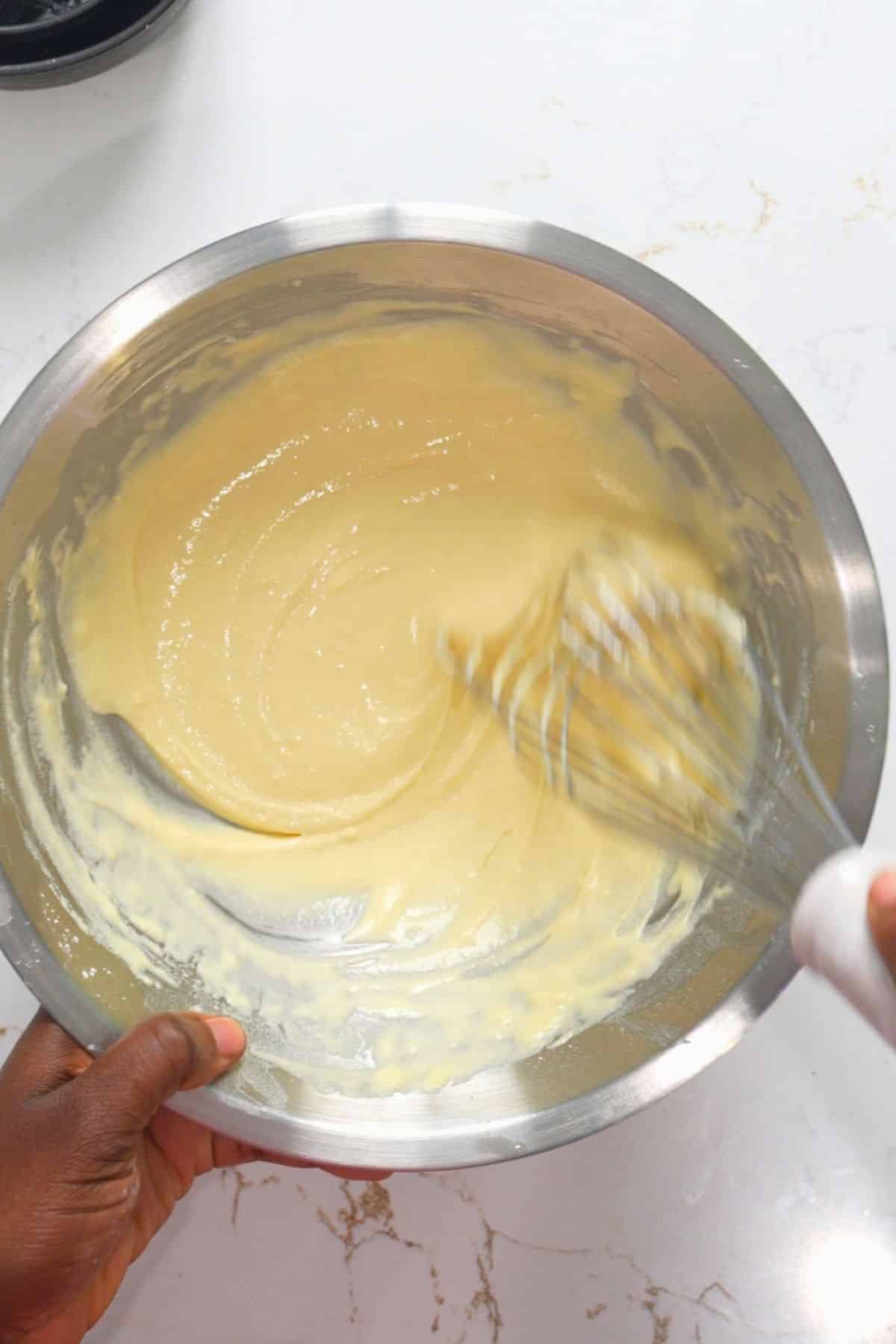
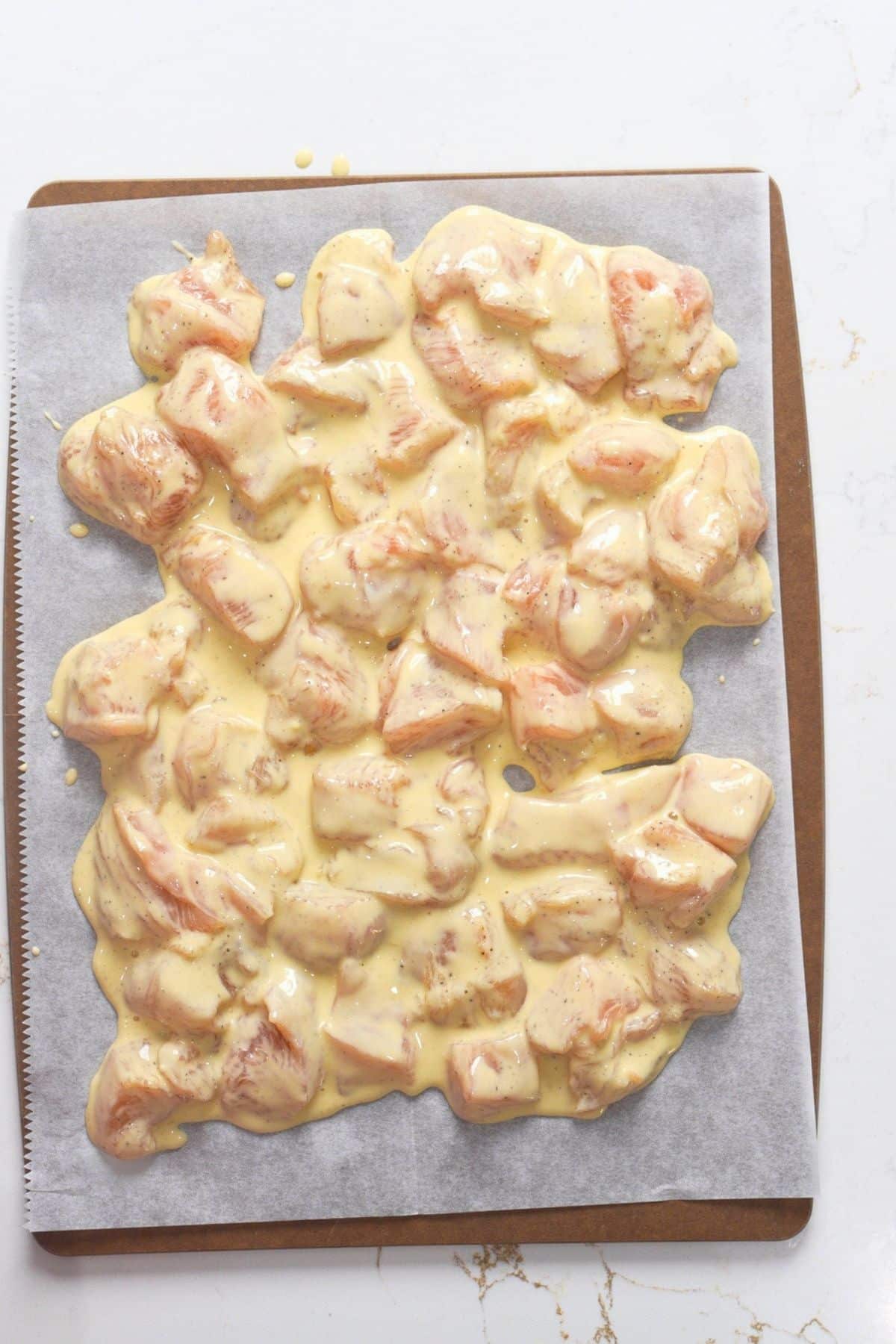
Step 1: Season and batter the chicken. Toss the chicken pieces with salt, black pepper, and garlic powder and set aside. In a separate bowl, whisk together the flour, cornstarch, and baking powder, then whisk in the beaten egg and cold water until you get a smooth batter that coats the back of a spoon.

wet batter being whisked in bowl

Step 2: Heat the oil and batter the chicken. Add 1 ½ to 2 inches of neutral oil to a Dutch oven or deep skillet and heat to 350°F (177°C). While it heats, fold the seasoned chicken into the batter until every piece is coated. Pull the pieces out onto a cutting board or plate and let them rest about 5 minutes while the oil finishes heating. That short rest helps the batter set so it actually sticks during frying instead of sliding off.

battered chicken on cutting board resting

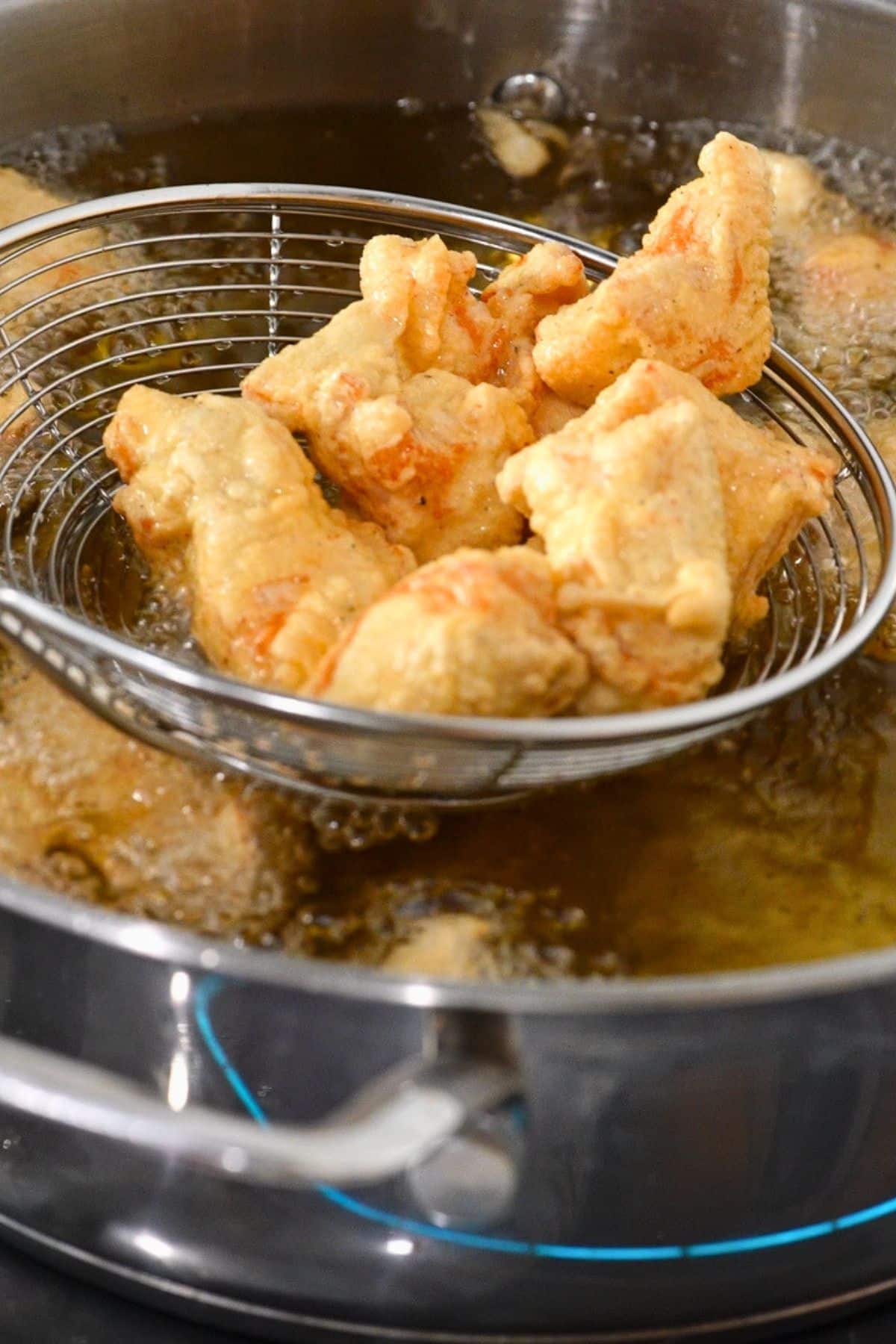
Step 3: Fry, then fry again. Working in batches so the pieces don't clump together, lower the chicken into the hot oil one piece at a time. Fry for 4 to 6 minutes, turning occasionally, until golden and cooked through (chicken is safely cooked at 165°F/74°C internally).

Move each batch to the wire rack. Once all the chicken is fried once, bump the oil up to 375 to 380°F (191 to 193°C) and fry everything again in batches for just 30 to 60 seconds. This second fry is what makes the coating extra crispy and is worth the extra few minutes.

chicken frying in oil, getting lifted out of oil

Pro tip

For the crispiest results, fry again

The second fry is optional. However, I found that the coating was extra crispy with that second fry, so I like to do it rather than skip it.

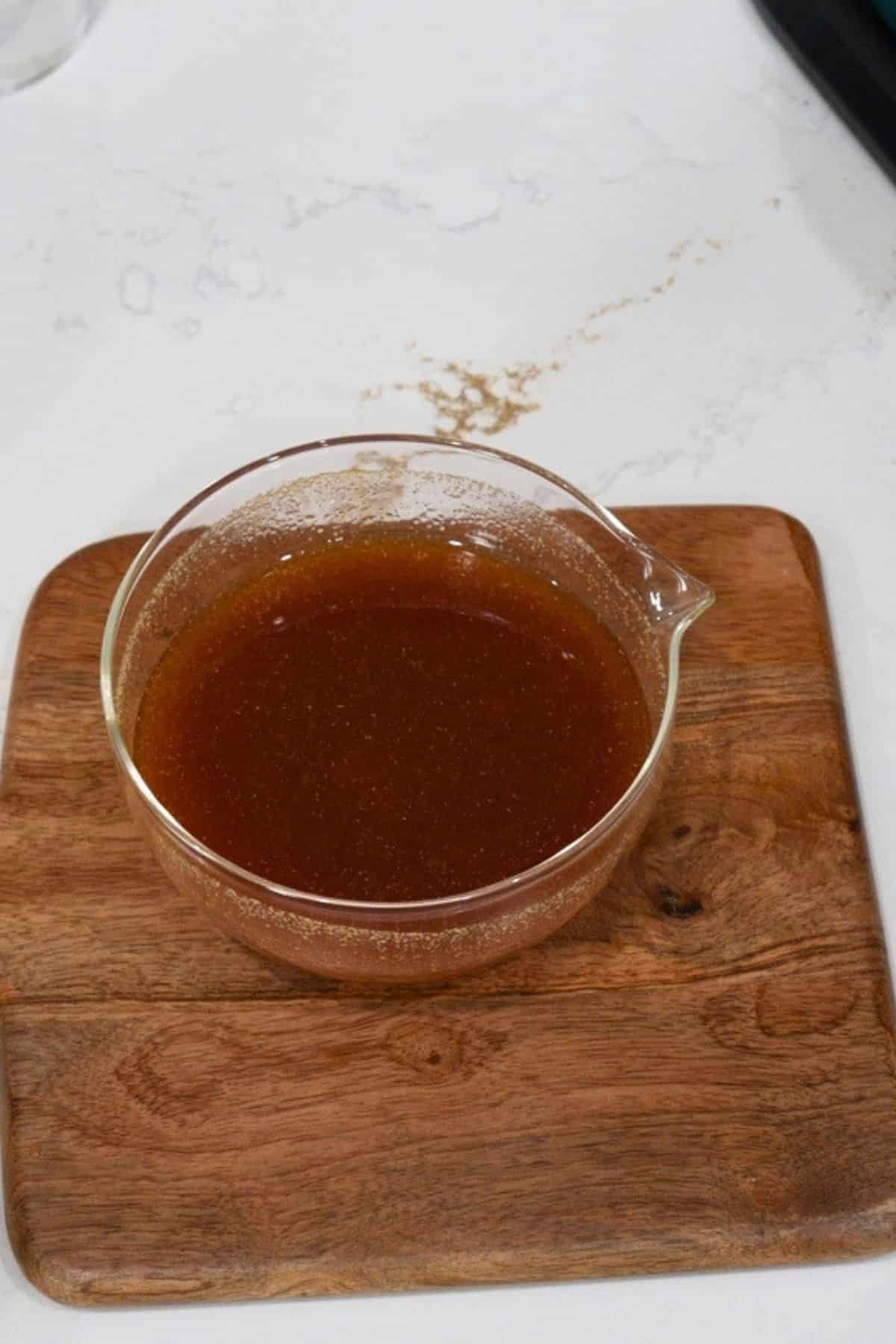
Step 4: Make the sauce. In a small bowl, stir together the ketchup, sugar, vinegar, reserved pineapple juice, soy sauce, garlic powder, and ginger powder.

sauce for sweet and sour chicken in glass bowl

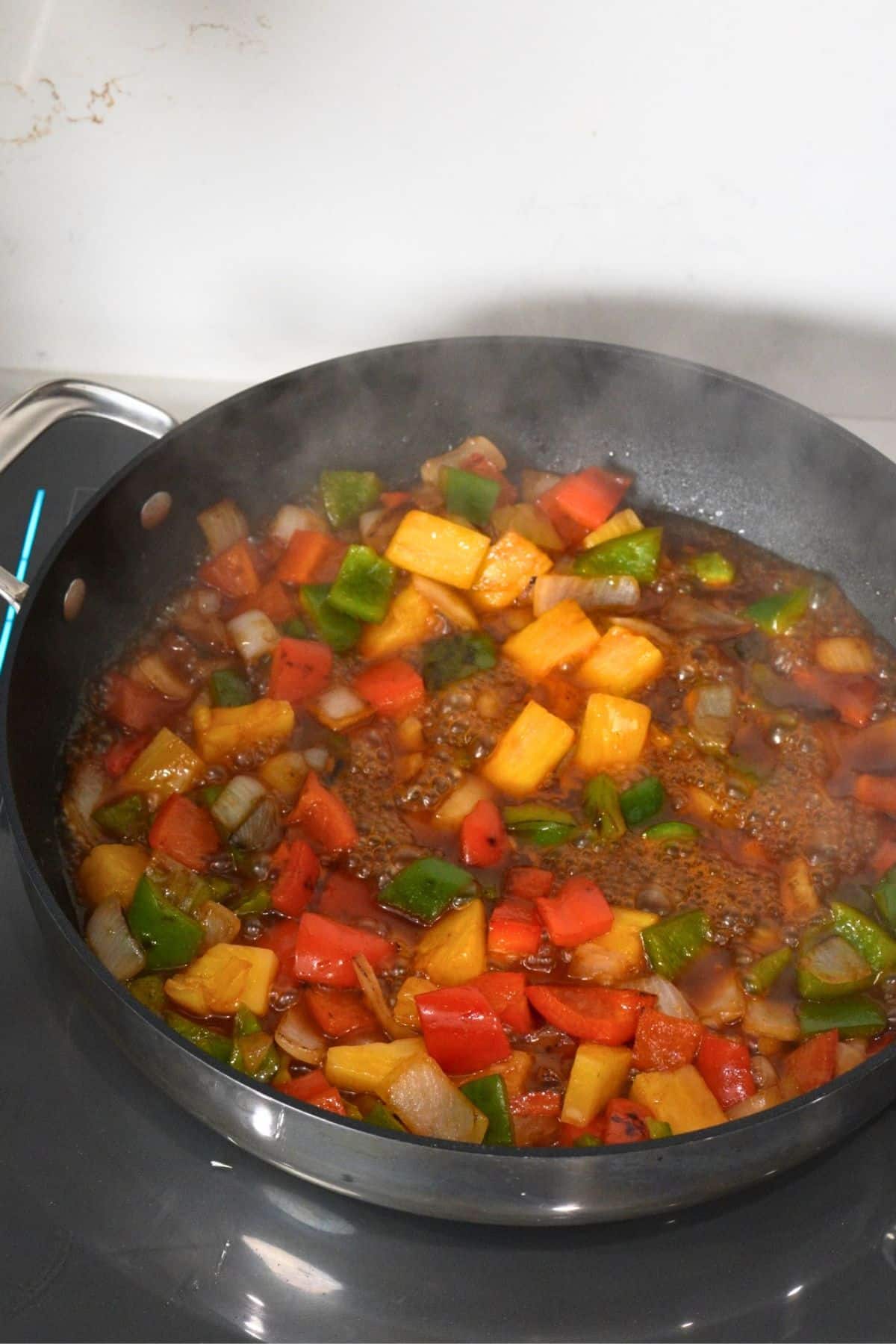
Step 5: Stir-fry the vegetables and pineapple. Heat the neutral oil in a clean, large skillet or wok over medium-high heat. Add the onion and cook for 1 to 2 minutes until it begins to soften, then add the red and green bell peppers and cook for another 3 to 4 minutes until crisp-tender. Stir in the pineapple chunks and cook for about 1 minute more.

sauce for the sweet and sour chicken in skillet

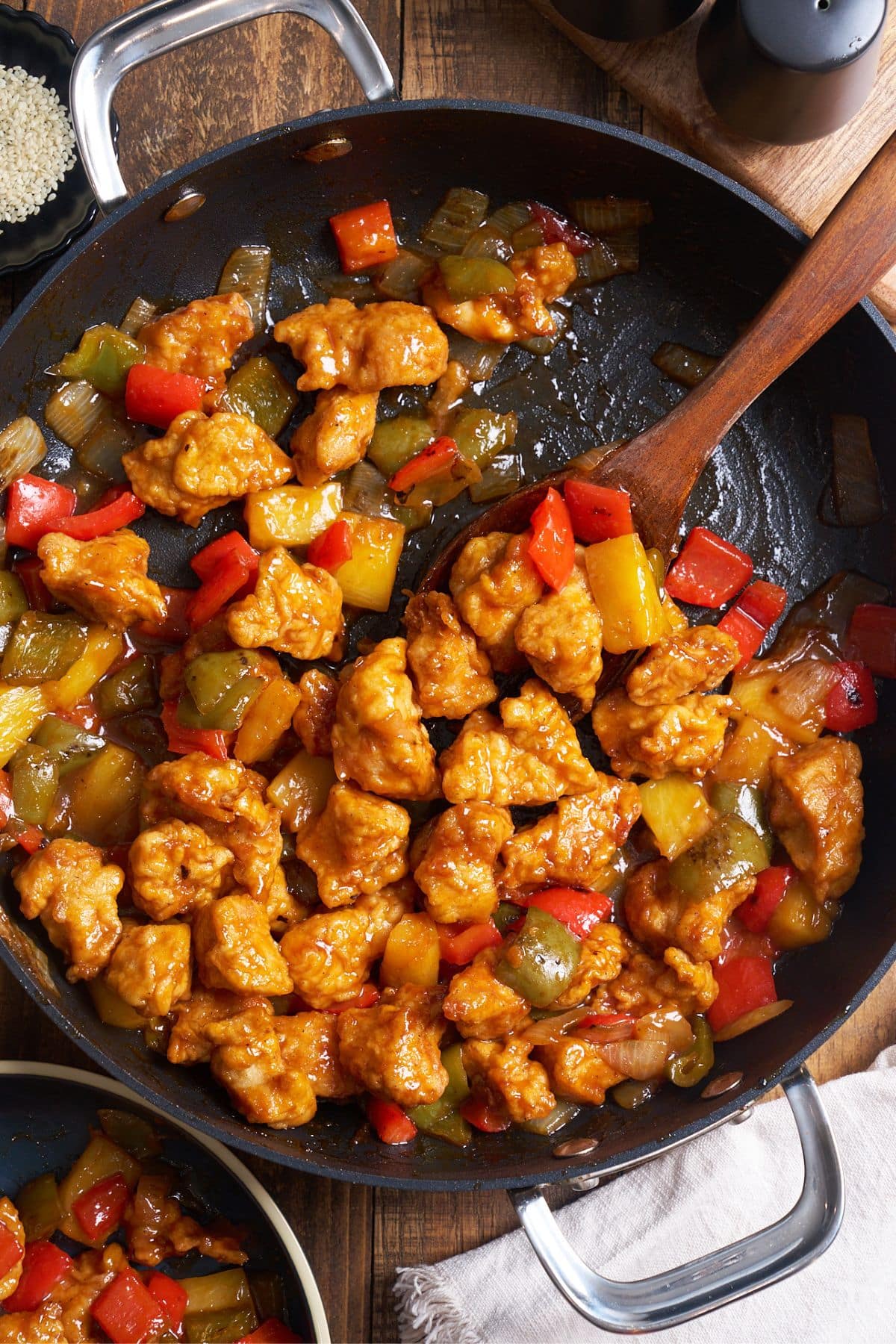
Step 6: Bring it all together. Pour the sauce over the vegetables and bring it to a simmer. In a separate small bowl, stir the cornstarch and cold water into a slurry, then drizzle it into the simmering sauce while stirring, and cook about 1 minute until it turns glossy and thickens. Add the fried chicken and toss until everything is coated. Serve immediately over rice so the chicken stays as crispy as possible under the sauce.

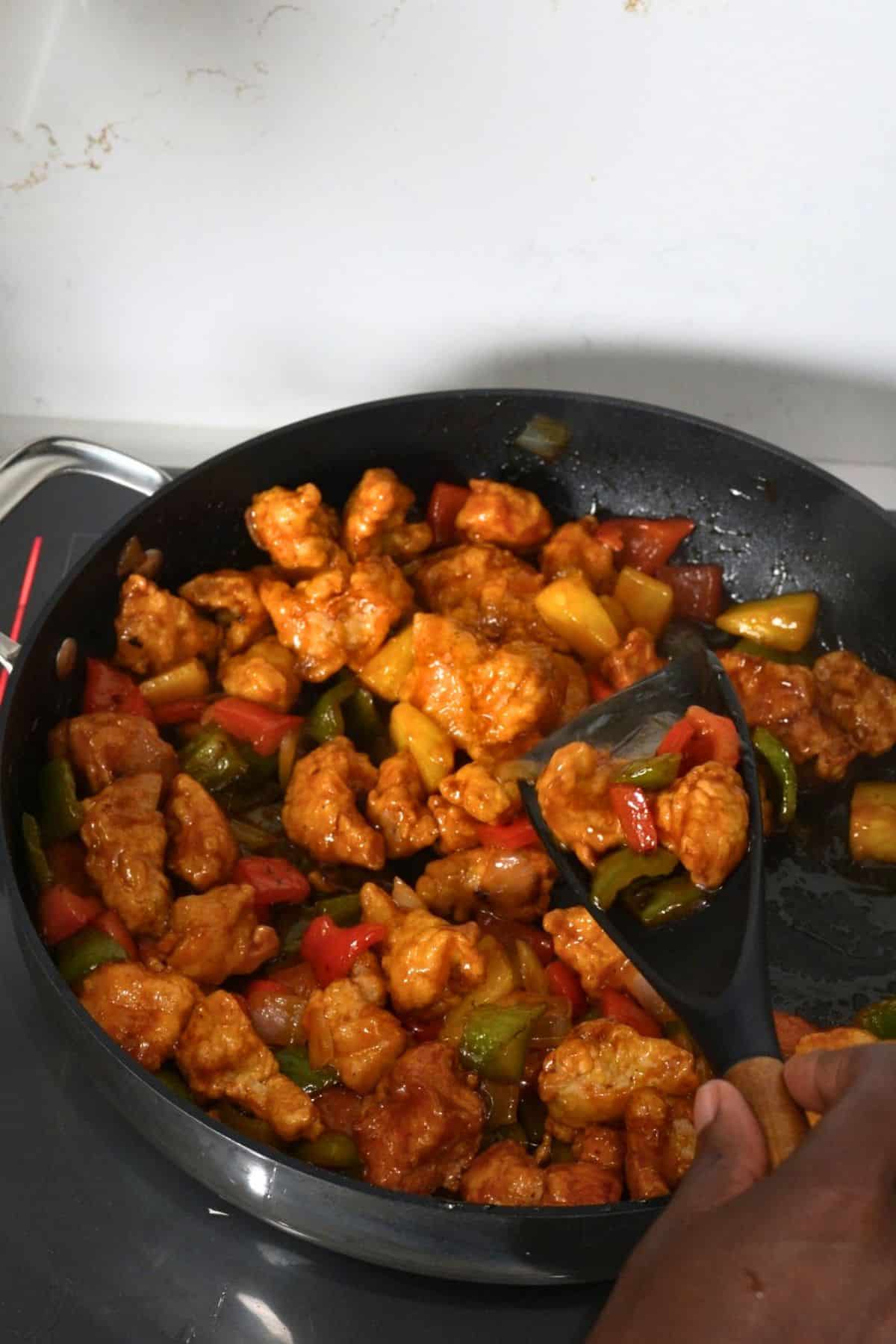
sweet and sour chicken in skillet with spatula

Variations

  • Swap the protein. Shrimp or pork work well in the same sauce. Shrimp cooks much faster than chicken, so watch it closely and pull it as soon as it turns opaque.
  • Add more vegetables. Snap peas, carrots, or baby corn are easy additions to the stir-fry step if you want more veggies in the mix.
  • Bring the heat. If you like a little spice, add a few red pepper flakes or a small drizzle of chili garlic sauce stirred into the sauce.
  • Swap the fruit. Mandarin orange segments, instead of pineapple chunks, give a slightly different sweetness if that's what you have on hand.

What to Serve With Sweet and Sour Chicken

Steamed white or jasmine rice is the obvious pick since it soaks up any extra sauce, and my Oven Baked Rice is a hands-off way to get there. For something with more personality, my Steak Kimchi Fried Rice is a fun twist if you want to mix up your takeout night.

On the side, Broccoli Slaw adds crunch and freshness without any extra cooking. If you're going all in on a takeout-at-home spread, Air Fryer Egg Rolls or General Tso's Shrimp round out the table nicely.

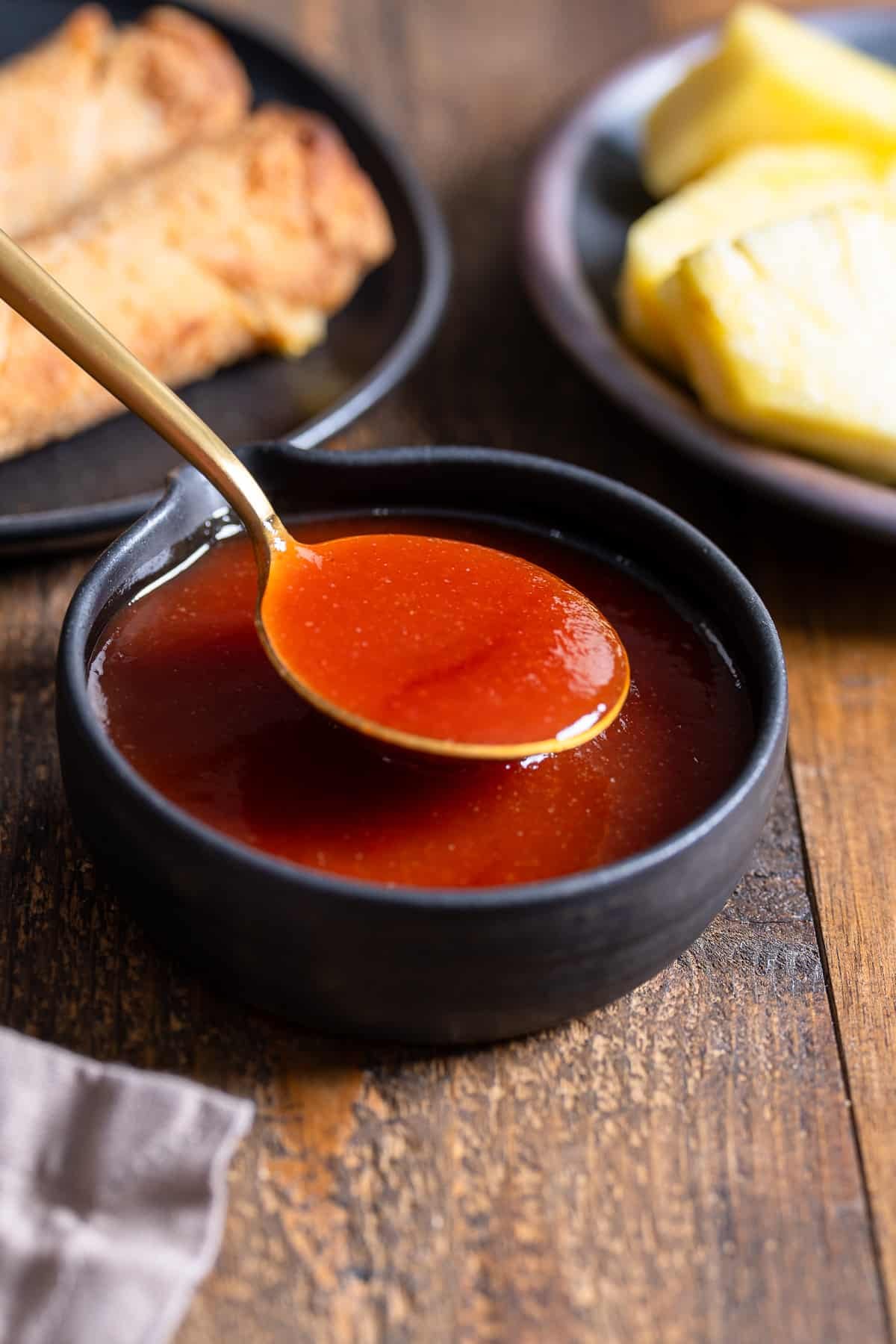
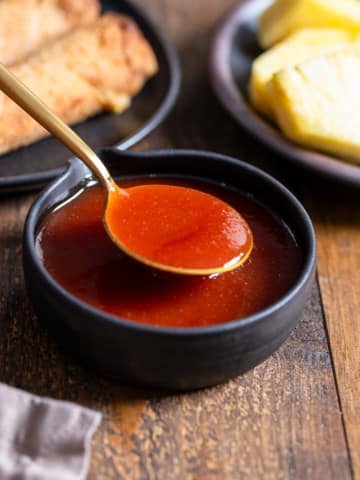
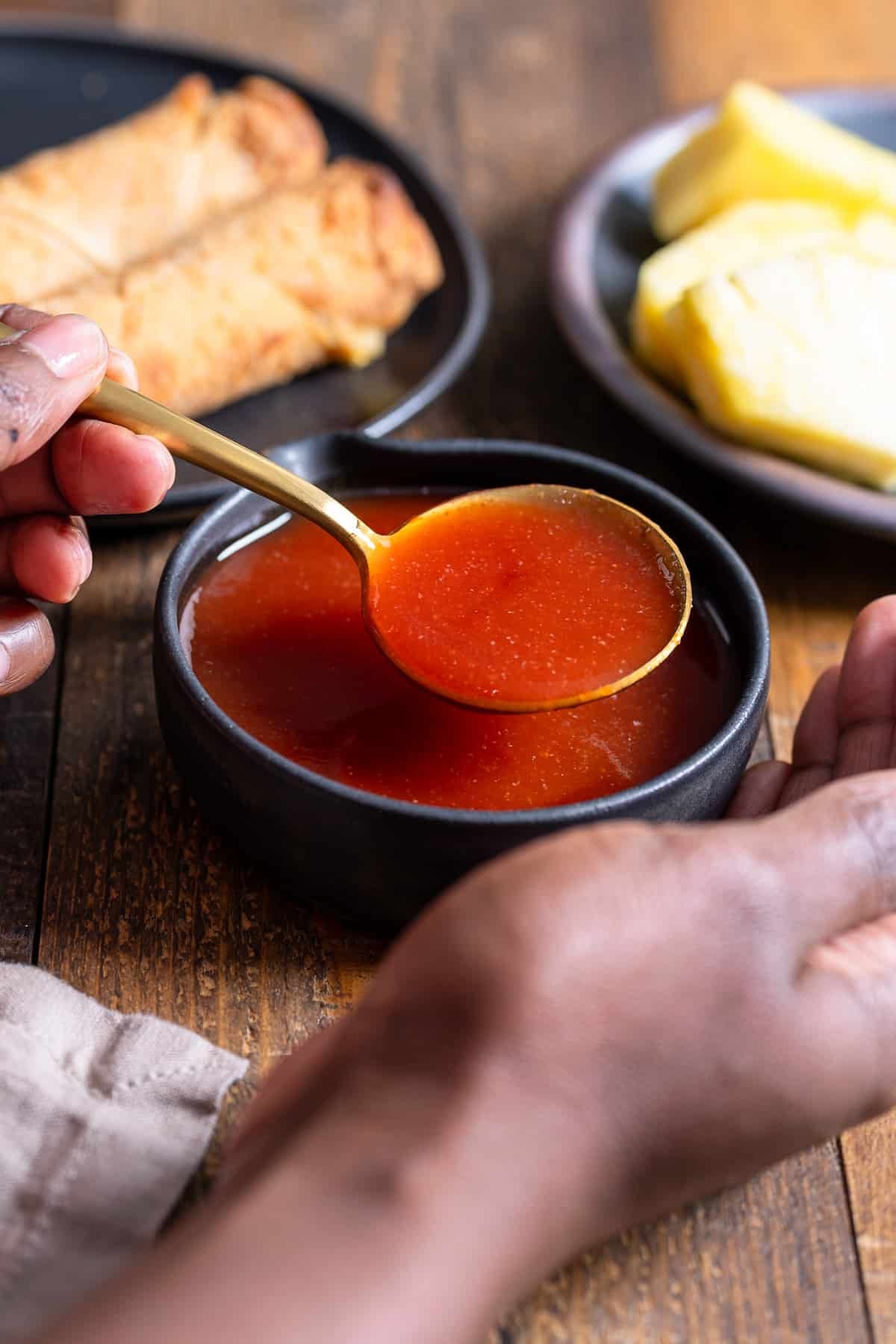
spoon lifting up sweet and sour sauce from a bowl with egg rolls and pineapple in the back

Sweet and Sour Sauce

If you'd like to make just the sauce, then you'll love this sweet and sour sauce. Perfect if you'd like this sauce just for dipping.

Get this Recipe
sweet and sour chicken in skillet with spoon scooping it

Storage, Reheating, and Freezing

Store leftovers in an airtight container in the refrigerator for up to 3 days. To reheat, use an air fryer at 375°F (190°C) for 3-5 minutes for the best texture; the oven works well for larger portions at 350°F (175°C) for 10-15 minutes, while the microwave is fastest but will soften the coating. To freeze, store chicken and sauce separately for up to 2 months. Thaw overnight in the refrigerator, then reheat the chicken and warm the sauce separately before combining.

FAQs

Why is the chicken fried twice?

The first fry cooks the chicken through, and the second fry at a higher temperature crisps up the coating even more. It only adds about a minute per batch, but it helps the chicken hold up much better once tossed in the sauce.

What if my sauce turns out too thin or too thick?

Too thin: Let it simmer a minute longer, or stir in a little extra cornstarch slurry (1 teaspoon cornstarch + 1 teaspoon cold water).
Too thick: Splash in a little water or extra pineapple juice to loosen it up.

Did you try this recipe? If you make this Homemade Sweet and Sour Chicken, let me know in the comments below! Don't forget to star-rate the recipe card so other readers can find it, too. Happy cooking!

swet and sour chicken in bowl next to rice
Print Recipe
No ratings yet

Sweet and Sour Chicken Recipe

Crispy, double-fried chicken tossed in a homemade sweet and sour sauce with bell peppers and pineapple. Better than takeout, and the chicken actually stays crispy under the sauce.
Prep Time20 minutes mins
Cook Time30 minutes mins
Total Time50 minutes mins
Course: Main Course
Cuisine: American, Chinese
Keyword: sweet and sour chicken
Servings: 4 people
Calories: 686kcal
Author: Tanya Harris

Ingredients

For the chicken and batter

  • 1 ½ pounds boneless skinless chicken breast, cut into 1-inch pieces
  • 1 teaspoon table salt
  • ½ teaspoon ground black pepper
  • ½ teaspoon garlic powder
  • ¾ cup all-purpose flour
  • ¼ cup cornstarch
  • ½ teaspoon baking powder
  • 1 large egg beaten
  • ⅔ cup cold water
  • Neutral oil for frying

For the sauce

  • ¼ cup ketchup
  • ⅓ cup granulated sugar
  • ¼ cup rice vinegar or white vinegar
  • ¼ cup reserved pineapple juice
  • 2 tablespoons soy sauce
  • ½ teaspoon garlic powder
  • ¼ teaspoon ginger powder
  • ½ tablespoon cornstarch
  • 2 tablespoons cold water

For the stir-fry

  • 1 tablespoon neutral oil
  • 1 medium onion cut into 1-inch pieces
  • 1 red bell pepper cut into 1-inch pieces
  • 1 green bell pepper cut into 1-inch pieces
  • 1 8-ounce can pineapple chunks in juice, drained, juice reserved

Instructions

  • Season the chicken with salt, black pepper, and garlic powder. Toss to coat and set aside.
  • In a separate large bowl, whisk together the flour, cornstarch, and baking powder. Add the beaten egg and cold water and whisk until you have a smooth batter that coats the back of a spoon.
  • Add 1 ½ to 2 inches of neutral oil to a Dutch oven or deep skillet, then heat to 350°F (177°C).
  • While the oil heats, fold the seasoned chicken pieces into the batter until fully coated.
  • Remove the chicken pieces from the batter and set them on a cutting board or plate. Let them rest while the oil finishes heating, about 5 minutes. This helps the batter set and stick to the chicken.
  • Working in batches, add the chicken to the hot oil one piece at a time so the pieces don't stick together. Fry for 4 to 6 minutes, turning occasionally, until golden and cooked through. Transfer to a wire rack.
  • Increase the oil temperature to 375 to 380°F (191 to 193°C). Fry the chicken a second time in batches for 30 to 60 seconds until extra crispy. Return to the wire rack.
  • In a small bowl, stir together the ketchup, sugar, vinegar, reserved pineapple juice, soy sauce, garlic powder, and ginger powder. Set aside. In a separate small bowl, stir the cornstarch and cold water to make a slurry, then set aside.
  • Heat the neutral oil in a clean large skillet or wok over medium-high heat. Add the onion and cook for 1 to 2 minutes until it starts to soften. Add the red and green bell peppers and cook for an additional 3 to 4 minutes until crisp-tender.
  • Add the pineapple chunks and cook for about 1 minute.
  • Pour the sauce over the vegetables and bring to a simmer, about 1 to 2 minutes.
  • Give the slurry a quick stir, then drizzle it into the simmering sauce while stirring. Cook for about 1 minute until the sauce is glossy and thickened.
  • Add the fried chicken to the skillet and toss until everything is coated in the sauce. Serve immediately over rice.

Notes

Store leftovers in an airtight container in the fridge for up to 3 days. Reheat in the air fryer for the best texture. The chicken and sauce freeze well separately for up to 2 months.

Nutrition

Calories: 686kcal | Carbohydrates: 63g | Protein: 34g | Fat: 33g | Saturated Fat: 8g | Polyunsaturated Fat: 7g | Monounsaturated Fat: 14g | Trans Fat: 0.2g | Cholesterol: 208mg | Sodium: 794mg | Potassium: 741mg | Fiber: 3g | Sugar: 31g | Vitamin A: 1341IU | Vitamin C: 70mg | Calcium: 73mg | Iron: 3mg

Easy Dirty Rice Recipe

July 29, 2026 by Tanya Harris 4 Comments

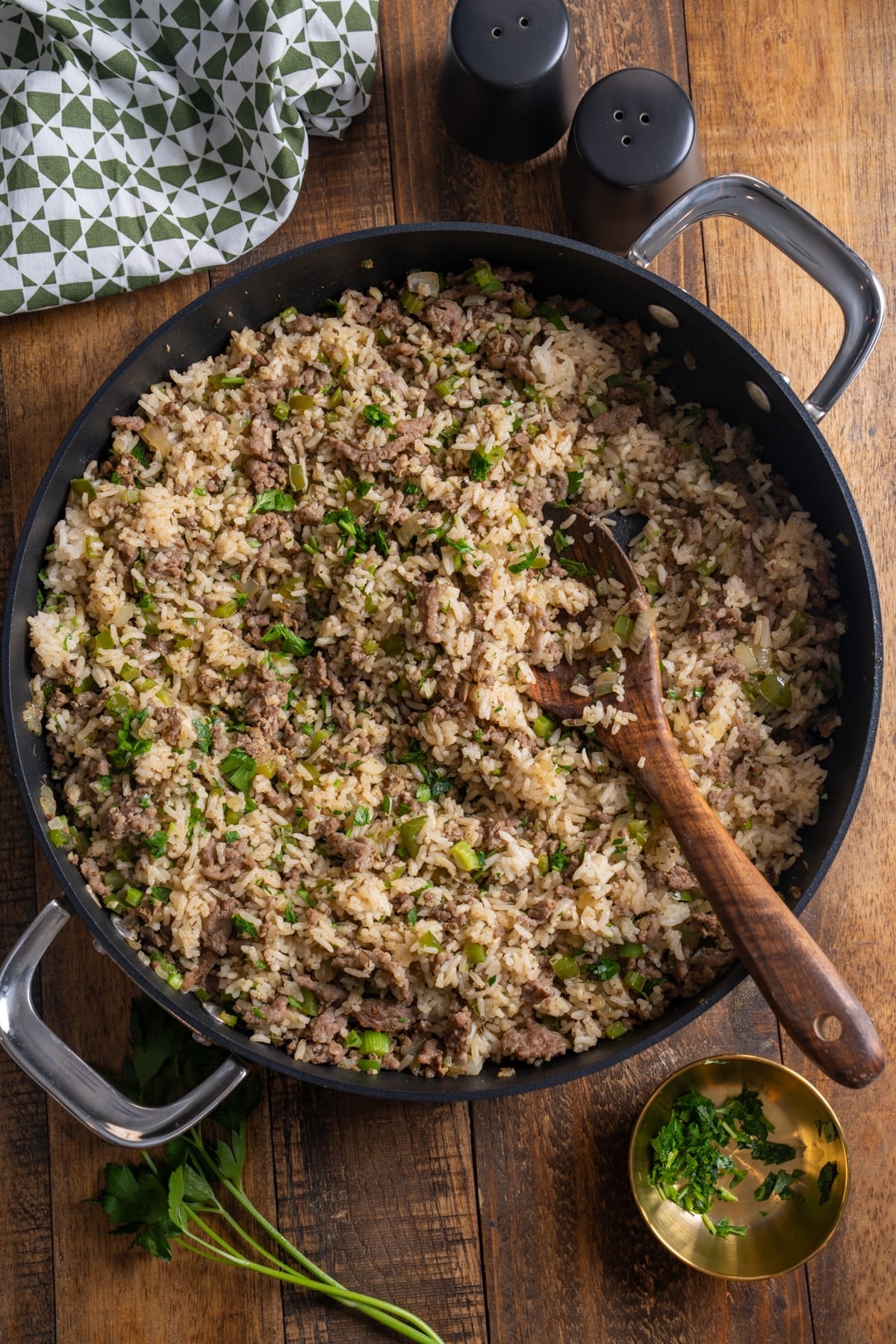
Overhead view of dirty rice with ground sausage, parsley, and the holy trinity in a black skillet with a wooden spoon

Dirty rice is one of those Southern dishes that looks humble and tastes like so much more. This version keeps that classic Cajun flavor front and center.

Overhead view of dirty rice with ground sausage, parsley, and the holy trinity in a black skillet with a wooden spoon

You’ll find the full recipe with ingredient amounts and instructions in the recipe card at the bottom of this post. Be sure to check out the blog post itself for extra tips and tricks!

close up Tanya holding bowl

I love just about any rice dish, and dirty rice has some of the best flavor of the bunch. I have been making this one for years, and it stays close to traditional.

The chicken livers are what set it apart. If you have made my Instant Pot Cajun Dirty Rice, you already know I am a fan of this dish, but this stovetop version is the one I come back to most.

If you want a fun spin, my Ground Chicken and Rice is my Caribbean take on dirty rice, and my Cajun Jambalaya hits a similar note when I want everything cooked in one pot.

Happy Cooking,

Tanya

Overhead view of dirty rice with ground sausage, parsley, and the holy trinity in a black skillet with a wooden spoon

Dirty Rice at a Glance

  • Best for: a flavor-packed side or an easy, hearty main
  • Prep time: 15 minutes
  • Cook time: 30 minutes
  • Total time: 45 minutes
  • Servings: 6
  • Good to know: freezer-friendly, one-skillet finish, and the chicken livers are easy to leave out

Ingredient Notes

Ingredient amounts and full recipe instructions are on the printable recipe card at the bottom of the post.

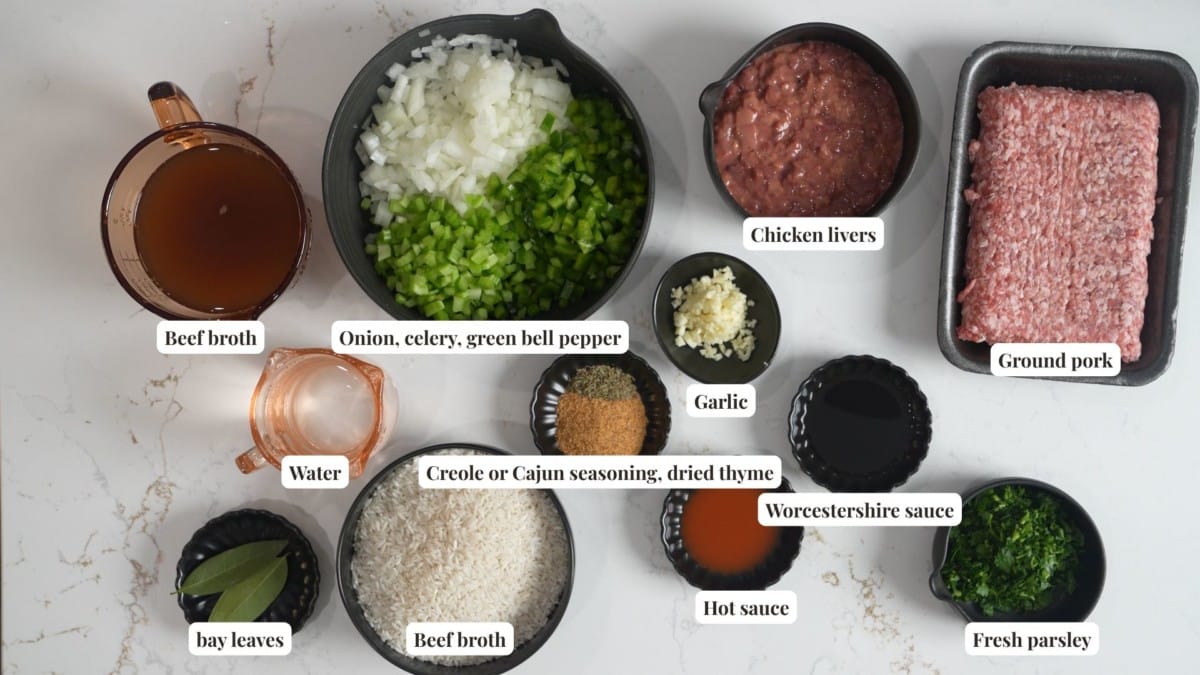
  • Ground pork sausage is the savory, seasoned base of the dish. Use your favorite brand, mild or hot. You can also use ground beef or chicken if you prefer.
  • Chicken livers are the heart of dirty rice. Chop them fine so they cook down and blend right into the sausage. You will find them at the meat counter or in the freezer section near the poultry. They are optional, but they are where that real dirty flavor comes from.
  • Long grain white rice keeps the grains separate and distinct, which is exactly what you want here. Give it a rinse before cooking to wash off the extra starch.
  • The trinity (onion, celery, and green bell pepper) is the aromatic base of Cajun cooking. I also add a bit of garlic.
  • Creole seasoning is the backbone. Creole or Cajun both work, and my Homemade Cajun Seasoning is great if you want to make your own. Blends vary in salt, so taste before adding any extra. I also add dried thyme.
  • Beef broth cooks the rice with more savory depth than plain water. It is a small thing that makes a difference.
  • Worcestershire sauce and hot sauce bring the umami and a little background heat. Add more hot sauce if you like it spicy.
  • Fresh parsley goes in at the very end to brighten everything up.
  • Bay leaves are optional, but great to add to the rice to add some flavor.
ingredients for the dirty rice on counter

How to make this Dirty Rice Recipe

Please see the recipe card below for the full printable recipe, ingredients, and instructions. Here you will find step-by-step photos of how to make this recipe.

Cook the rice

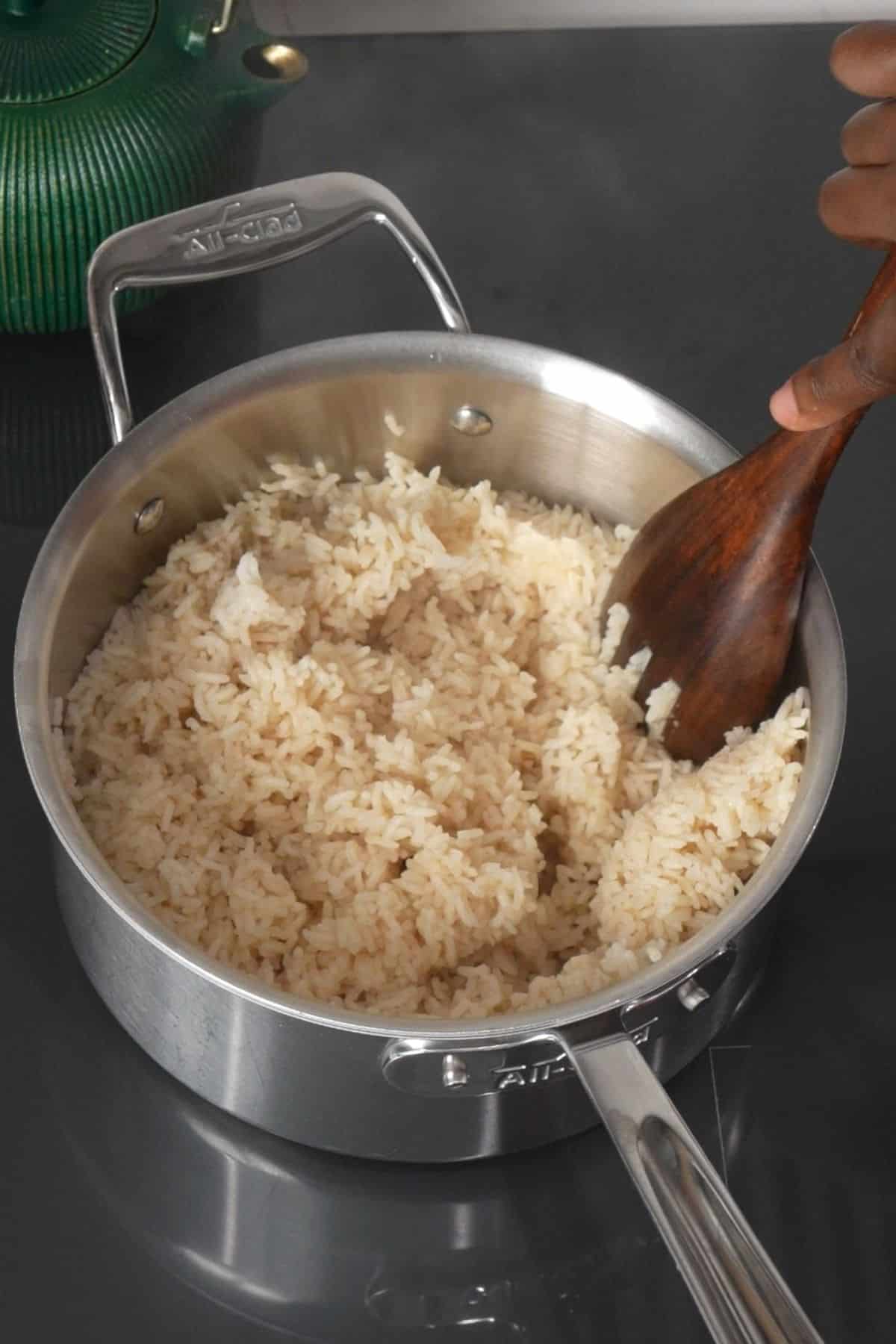
Add the rice, beef broth, water, and bay leaf, if using, to a medium saucepan and bring it to a boil. Cover, reduce the heat to low, and cook for 18 minutes, until the liquid is absorbed and the rice is tender. Discard the bay leaf and set the rice aside.

cooked rice being fluffed in pot

Brown the sausage and livers

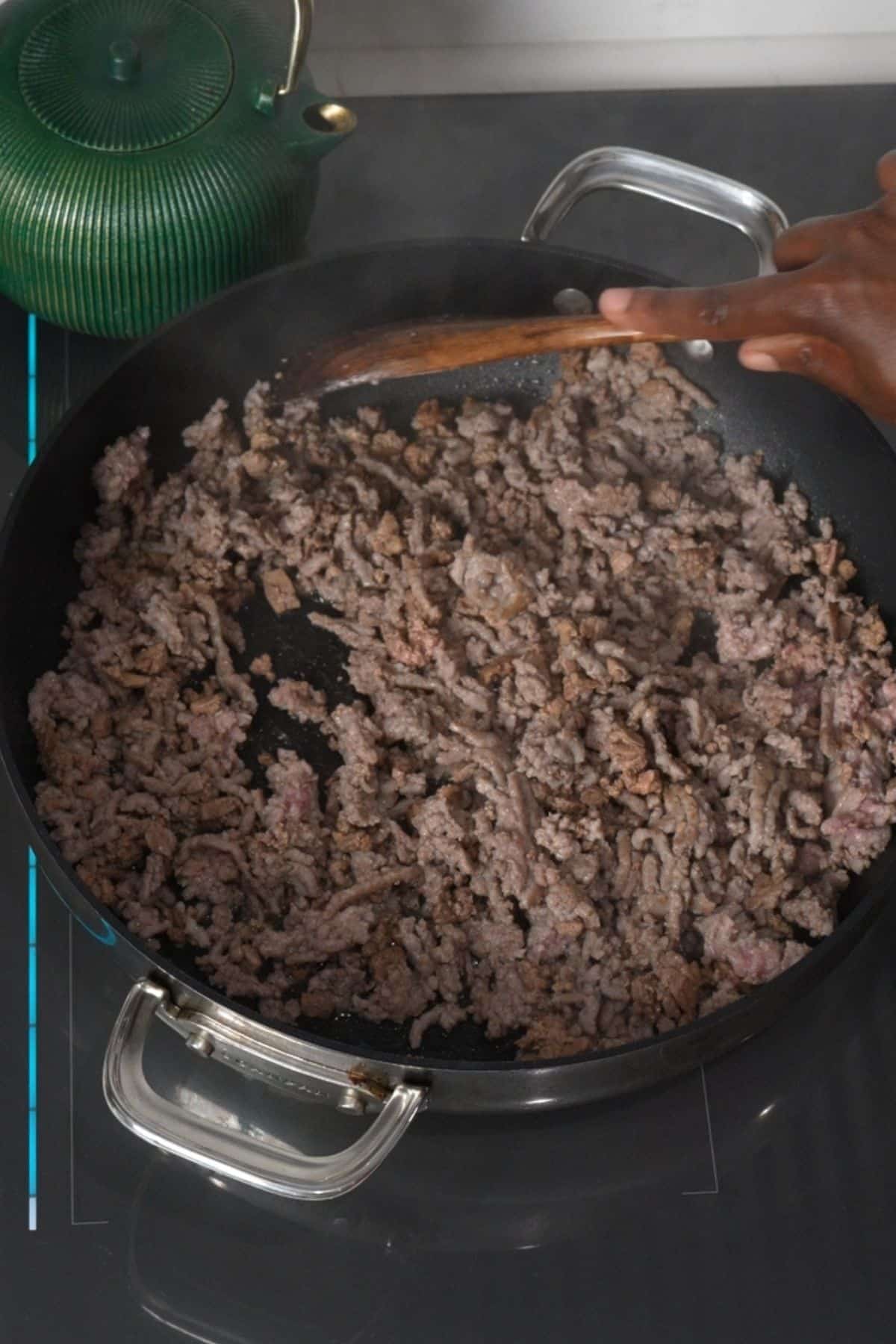
In a large skillet over medium-high heat, brown the sausage and chicken livers together. Break the sausage into fine crumbles as it cooks and mash the livers in until they blend into the meat and no pink remains.

brown sausage and livers in skillet

Add the trinity

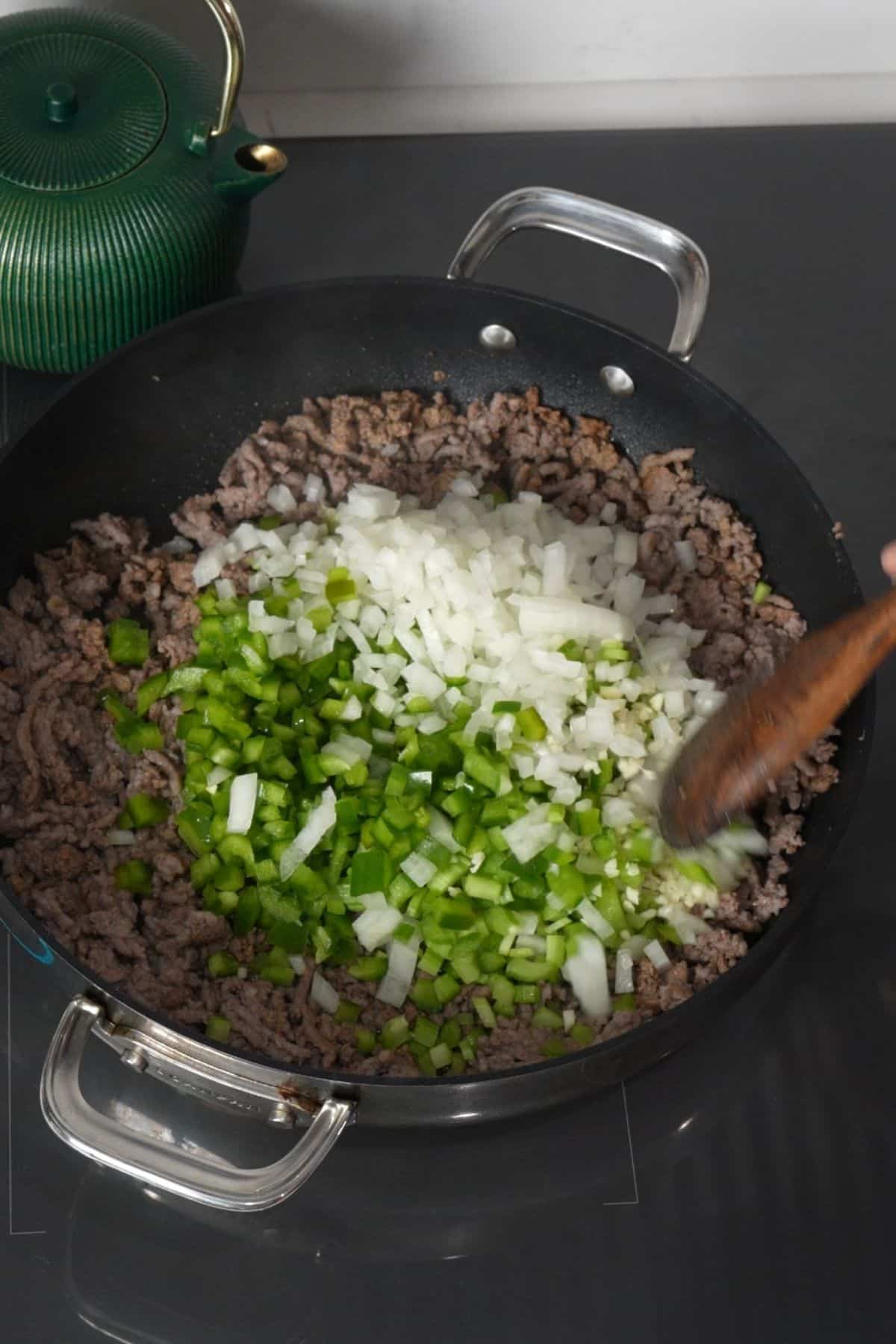
Stir in the onion, celery, bell pepper, and garlic. Cook until the vegetables have softened, about 3 to 4 minutes.

Chopped onion, celery, green bell pepper, and garlic added to browned sausage in a skillet

Add the seasonings and rice

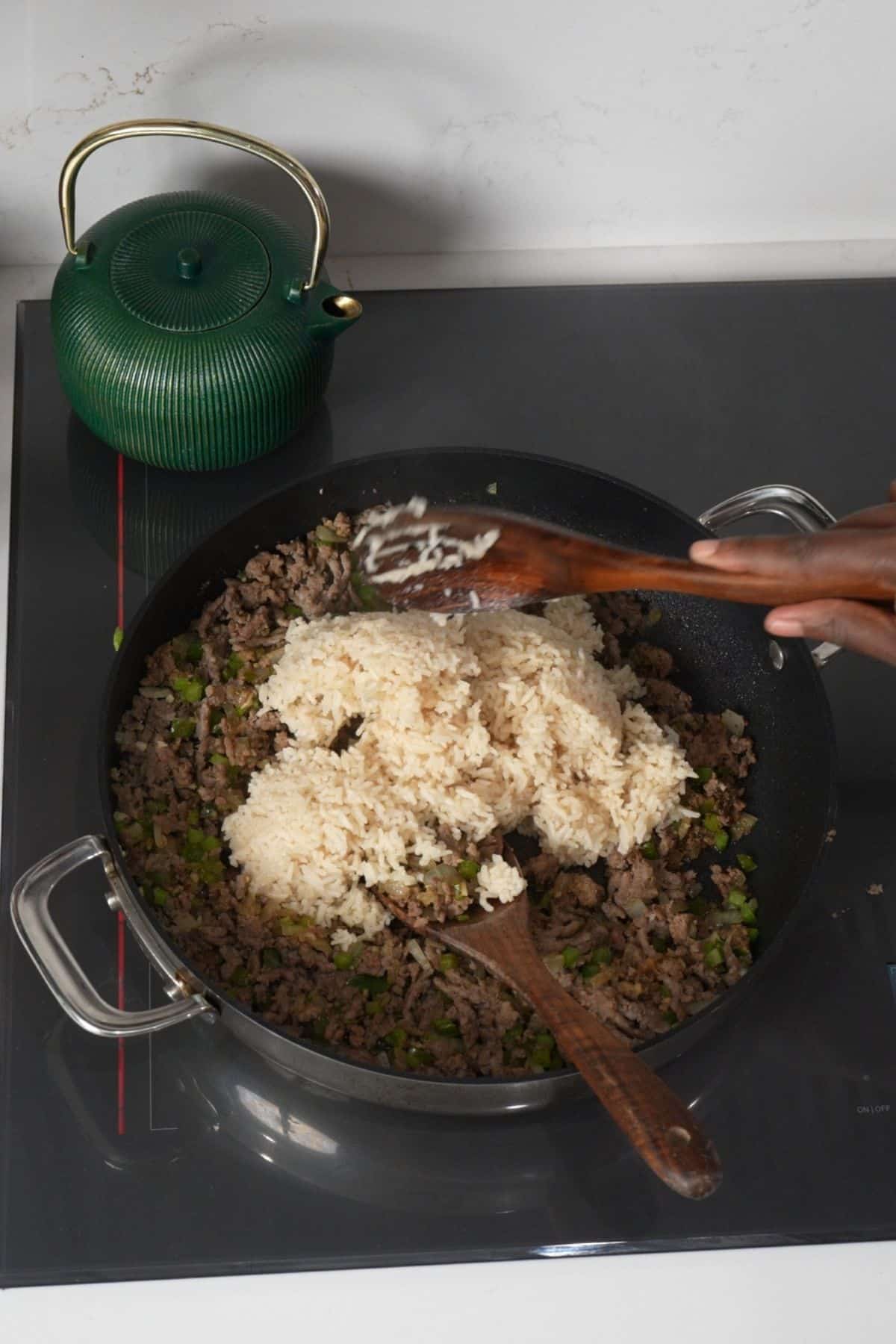
Add the Creole seasoning and thyme and stir until combined. Pour in the Worcestershire sauce and hot sauce and stir until everything is combined. Add the cooked rice and toss until every grain is coated and stained with the seasoning.

Cooked white rice being folded into seasoned sausage and vegetables in a skillet

Finish with parsley

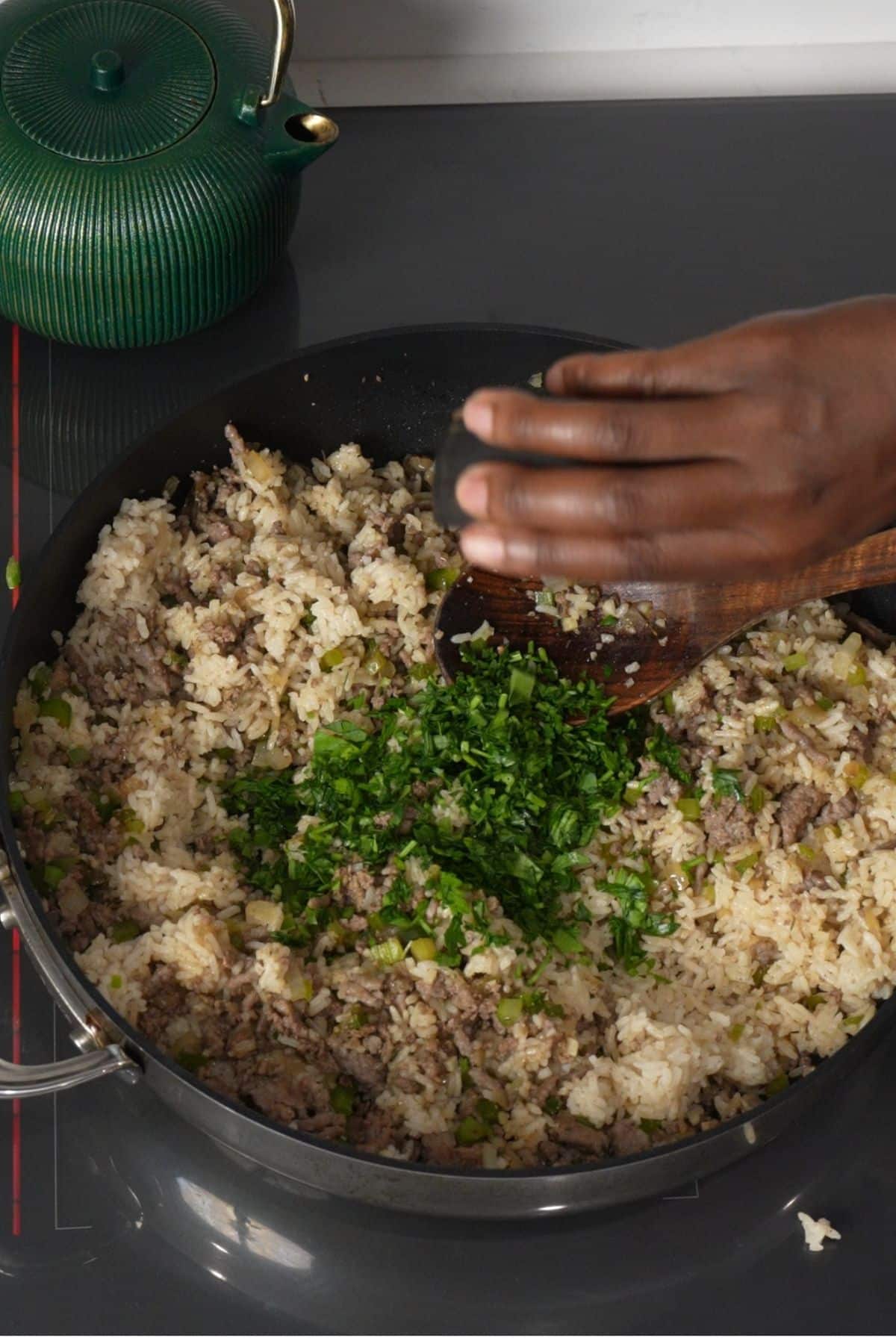
Fold in the fresh parsley. Taste, adjust the seasoning, and serve.

parsley being added to the brown meat in skillet

What to serve with Dirty Rice

  • Classic Southern Cornbread Recipe
  • Juicy Air Fryer Turkey Thighs
  • Southern Green Beans

How to store leftover Dirty Rice

Store leftovers in an airtight container in the refrigerator for up to 4 days. Reheat with a splash of broth or water to loosen the rice, either covered on the stove over low heat or in the microwave.

This dirty rice also freezes well for up to 3 months. Thaw it overnight in the refrigerator before reheating.

You can also turn leftover dirty rice into stuffed peppers! Hollow out bell peppers, cut them in half, and fill them with 1 cup of dirty rice. Sprinkle some cheese on top and bake at 350 for 20-30 minutes until the peppers have softened and the cheese is melty.

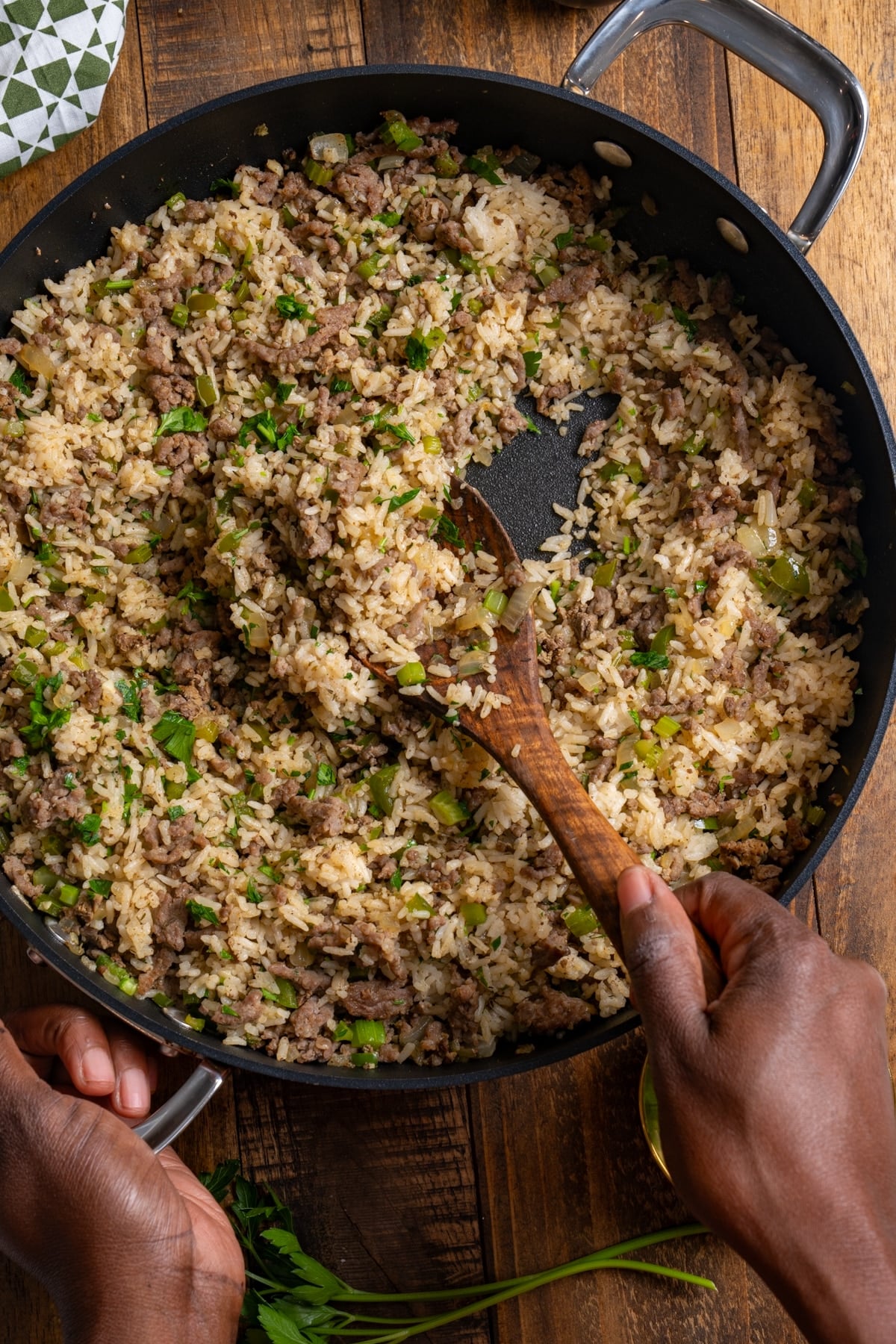
dirty rice in skillet with hands holding wooden spoon

Why do they call it Dirty Rice?

Dirty rice, Cajun rice, and rice dressing are all variations of the same rice dish. The dirty name comes from the rice's color when paired with finely ground meat.

Rice dressing is usually made with ground beef, pork, or venison, while dirty rice typically includes organ meats such as chicken livers or gizzards.

Tanya's Recipe Notes

  • If you’re not a fan of livers, feel free to replace them with ground beef or ground turkey. Please note that chicken livers give dirty rice an authentic taste. 
  • If you're looking for a healthier version, replace the ground pork with ground turkey, and swap out white rice for brown rice.

Looking for more rice recipes? Try these out:

  • Yellow Rice
  • Jambalaya
  • Pressure Cooker (Instant Pot) Brown Rice
  • Instant Pot Cajun Dirty Rice

If you have tried this or any other recipe on my blog, please rate it and let me know how it turned out in the comments below!

Overhead view of dirty rice with ground sausage, parsley, and the holy trinity in a black skillet with a wooden spoon
Print Recipe
5 from 2 votes

Easy Dirty Rice Recipe

A classic Cajun dirty rice made with ground pork sausage, chicken livers, and the trinity, all folded into seasoned rice for big Southern flavor. Serve it as a side or a hearty main.
Prep Time15 minutes mins
Cook Time30 minutes mins
Total Time45 minutes mins
Course: Main Course, Side Dish
Cuisine: Southern
Keyword: Dirty Rice
Servings: 6 servings
Calories: 525kcal
Author: Tanya Harris

Ingredients

  • 2 cups long grain white rice rinsed
  • 1 ¼ cup beef broth
  • 1 bay leaf optional
  • 1 cup water
  • 1 pound ground pork sausage
  • ½ pound chicken livers finely chopped
  • 1 large yellow onion chopped
  • 2 stalks celery chopped
  • ½ medium green bell pepper chopped
  • 1 tablespoon garlic minced
  • 1 tablespoon creole seasoning
  • 1 teaspoon thyme dried
  • 1 tablespoon Worcestershire sauce
  • 1 tablespoon hot sauce
  • ¼ cup chopped fresh parsley

Instructions

  • Add the rice, beef broth, water, and bay leaf, if using, to a medium saucepan and bring to a boil. Cover, reduce the heat to low, and cook for 18 minutes. Discard the bay leaf and set the rice aside.
  • Brown the sausage and chicken livers in a large skillet over medium-high heat, breaking the sausage into fine crumbles and mashing in the livers until they blend in and no pink remains.
  • Add the onion, celery, bell pepper, and garlic. Cook until softened, about 3 to 4 minutes.
  • Add the Creole seasoning and thyme and stir. Pour in the Worcestershire sauce and hot sauce and stir until combined.
  • Fold in the cooked rice and toss until every grain is coated and stained. Stir in fresh parsley.

Video

Notes

  • Chicken livers are optional. Leave them out or replace them with more sausage, ground beef, or ground turkey. The livers give the most authentic dirty flavor.
  • Store in an airtight container in the refrigerator for up to 4 days. Reheat with a splash of broth or water. Freezes well for up to 3 months. Thaw overnight in the refrigerator before reheating.

Nutrition

Serving: 1cup | Calories: 525kcal | Carbohydrates: 54g | Protein: 23g | Fat: 23g | Saturated Fat: 7g | Polyunsaturated Fat: 3g | Monounsaturated Fat: 10g | Trans Fat: 0.2g | Cholesterol: 185mg | Sodium: 805mg | Potassium: 511mg | Fiber: 2g | Sugar: 2g | Vitamin A: 4711IU | Vitamin C: 21mg | Calcium: 52mg | Iron: 5mg

This post was originally published on July 20, 2022. It has been updated with new information.

How to Make Gravy From Drippings

July 17, 2026 by Tanya Harris 5 Comments

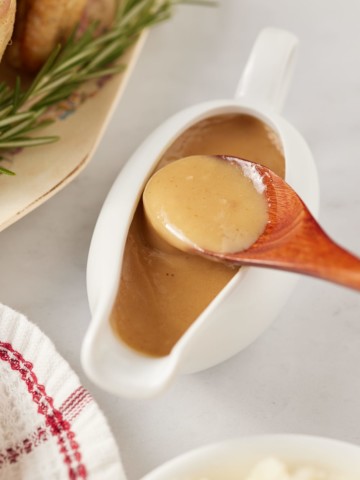
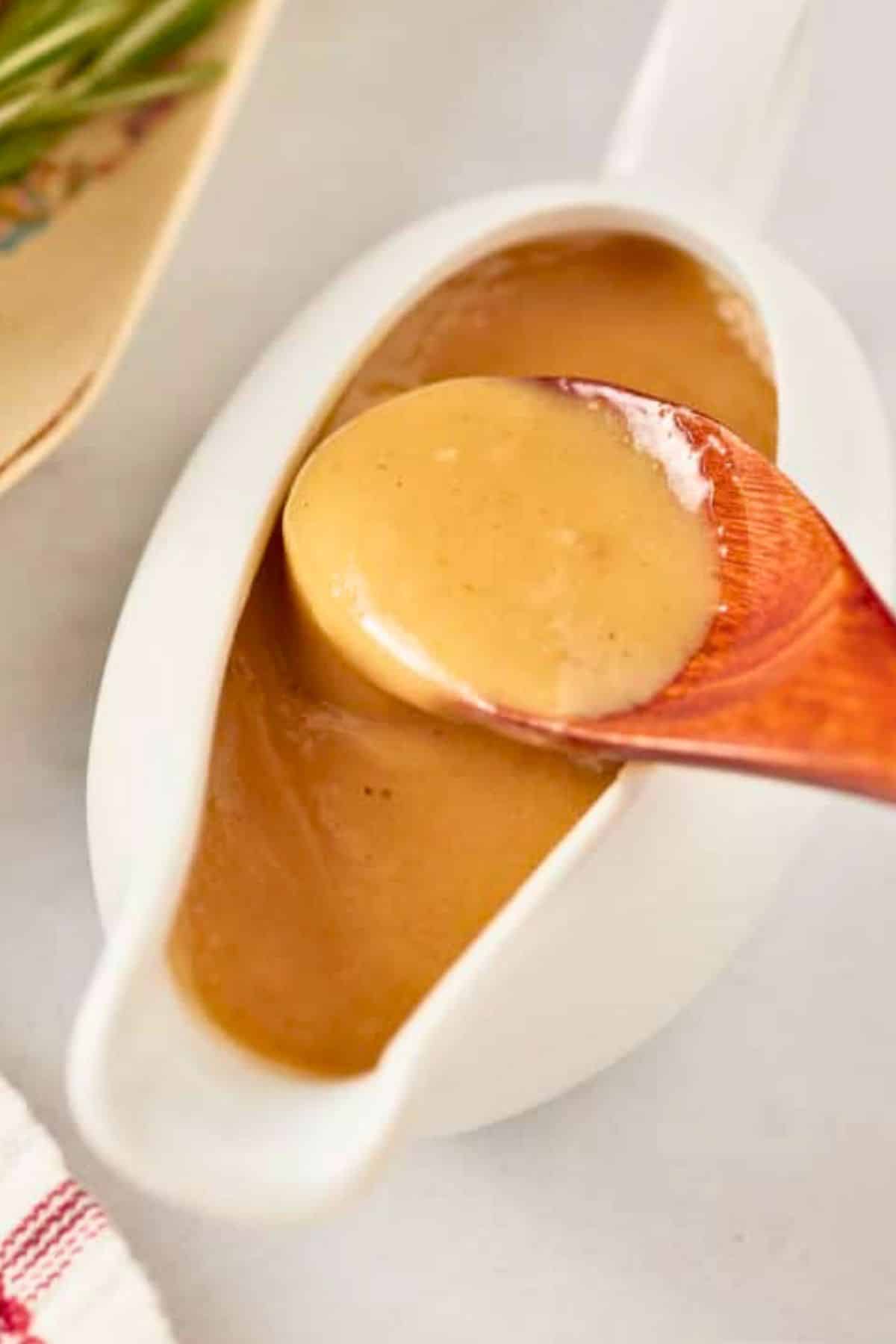
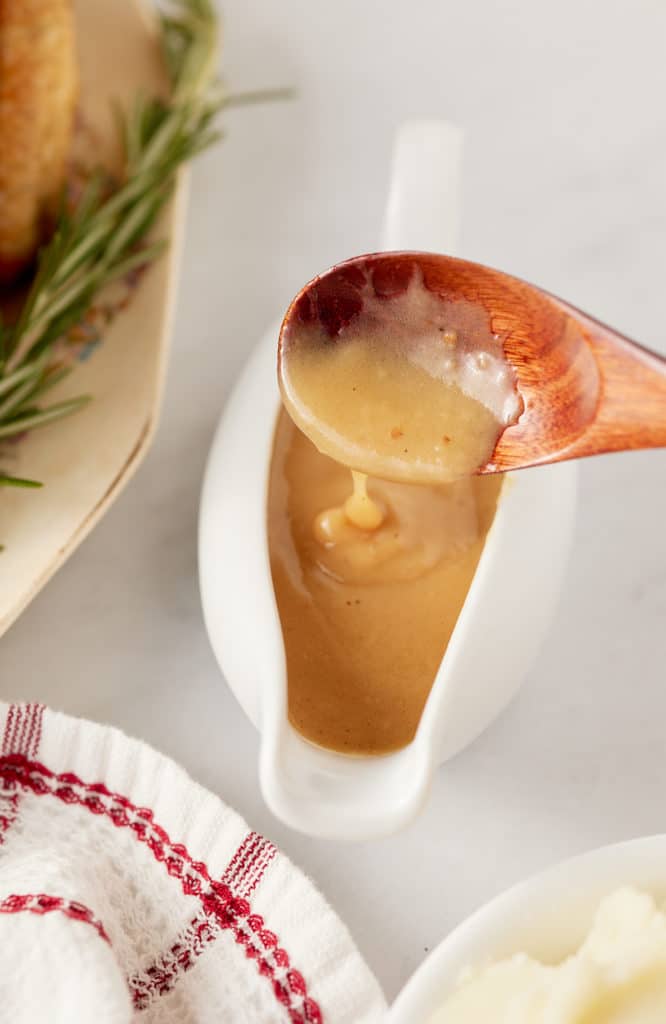
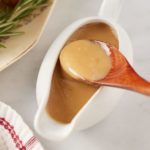
The dripping gravy in a gravy boat with a wooden spoon.

Learn how to make gravy from drippings for an easy way to add a rich flavor to everyone's plate.

gravy in a gravy boat woth spoon picking it up

You’ll find the full recipe with ingredient amounts and instructions in the recipe card at the bottom of this post. Be sure to check out the blog post itself for extra tips and tricks!

close up Tanya holding bowl

Gravy is the sauce that brings your dinner together and is a must-make for Thanksgiving and the holidays. It can seem intimidating, but don't let that stop you from stirring some up before dinner.

I've always loved a good, flavorful gravy, as it's a way to keep the delicious flavor of a roasted chicken and turn it into a pourable sauce that's perfect over mashed potatoes or rice. This method for making gravy is my go-to one whenever I make a large roast.

Be sure to try my Easy Recipe for Gravy without Drippings, for those times you don't have any drippings.

Happy Cooking,

Tanya

gravy in a gravy boat woth spoon picking it up

Gravy at a Glance

  • What it is: Silky homemade gravy built on the flavor-packed drippings left in your roasting pan
  • Time: About 22 minutes, start to finish
  • Works with: Turkey, chicken, beef, pork, or whatever you roasted
  • Skill level: If you can stir, you can make gravy
  • The secret: Those browned bits stuck to the bottom of the pan. Do not toss them. That is pure flavor.

5 Star Reviews

Kerry says, "I am speechless! The absolute BEST gravy I have ever tasted!!!! Thank You!"

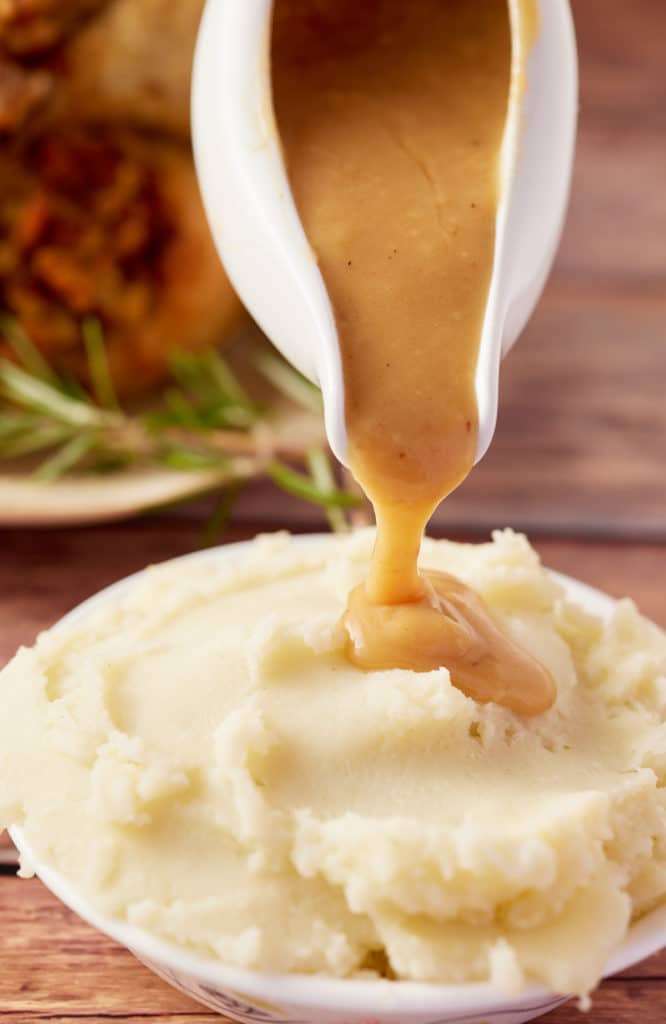
Dripping gravy being poured over mashed potato.

Ingredient Notes

Ingredient amounts and full recipe instructions are on the printable recipe card at the bottom of the post.

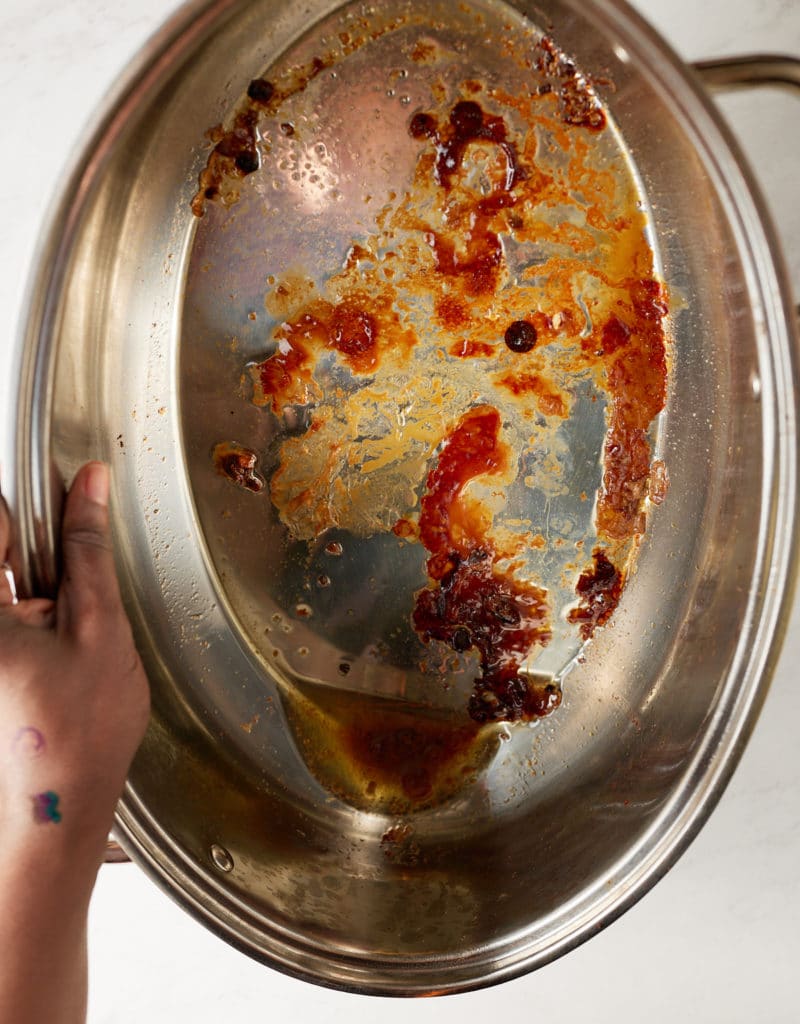
  • Pan drippings: The liquid, fat, and browned bits left in the pan after roasting chicken, turkey, beef, or pork. You need about 2 Tablespoons. If you have a lot more, see the fat-separating tips below.
  • Unsalted butter: Combines with the drippings to build the roux. If your drippings are fatty enough, you can skip the butter and use 2 Tablespoons of skimmed fat instead.
  • All-purpose flour: Thickens the gravy. For a gluten-free option, use the cornstarch slurry method in the notes.
  • Chicken broth: Use unsalted or low-sodium so you can control the seasoning. Turkey stock is great with turkey drippings, and beef broth is the swap for beef drippings.
  • Salt and pepper: Season at the end, after tasting. The drippings and broth already carry salt.
  • Fresh herbs and bay leaves: Optional. Rosemary, thyme, and sage are my favorites here. Add them once the gravy simmers and strain them out before serving.

How to Make Gravy from Drippings (Step-by-Step Photos)

You will find the complete written recipe in the recipe card just below.

Step 1: Collect the drippings. After roasting your chicken or turkey, remove the meat from the roasting pan or baking dish and set it aside. You'll notice some liquid, fat, and brown bits stuck to the bottom. This is flavor, do not toss it out. Make sure you've got about 2 Tablespoons of liquid in the roasting pan.

Drippings in a pan.

Step 2: Make the roux. Place your roasting pan over medium heat if it is stovetop safe. If it will not fit your burners, or you roasted in a baking dish, scrape the drippings and browned bits into a large skillet instead.

Add the butter and let it melt, whisking to loosen the drippings. Sprinkle the flour over the pan and stir until fully incorporated, then keep stirring for about 1 to 2 minutes, until the mixture is golden and smells a little nutty.

Butter added to the drippings.
Whisking together the butter and the drippings.
Flour being whisked in.

Step 3: Add the broth and simmer. Slowly pour in the broth, about ½ cup at a time, whisking constantly. Bring it to a simmer and let it cook for about 15 to 20 minutes, until thickened. Season with salt and pepper to taste.

Broth added to the pot.
The gravy simmering.
The gravy ready to serve.

Step 4: Strain the gravy: Remove from the stove and strain through a fine-mesh strainer for a smooth gravy. Serve your gravy.

gravy being strained

How long does it keep?

If you have any leftovers, this gravy will keep well in the fridge for up to 4 days. You can also freeze it for up to 4 months and defrost it in the fridge before reheating.

To reheat, add the gravy to a saucepan with a splash of broth or water to loosen it up. Warm it over medium-low heat, whisking often so it does not scorch on the bottom, until it is steaming hot throughout, at least 165 degrees Fahrenheit.

Making gravy from beef, pork, or roast drippings

This same method works with beef and pork. A pot roast, a beef roast, or a roasted pork loin all leave behind drippings that make deep, savory gravy.

A few adjustments:

  • Beef drippings: Swap the chicken broth for beef broth. Beef gravy will be darker and richer than poultry gravy, which is exactly what you want over mashed potatoes or roast beef.
  • Pork drippings: A roasted pork loin or pork chops leave lighter drippings. Chicken stock works well here.
  • Roast drippings with liquid: If you cooked a pot roast with broth or braising liquid in the pan, skim the fat off the top, use 2 Tablespoons of that fat as your roux fat, and use the remaining braising liquid to make stock. It is already loaded with flavor.

Roasts tend to render more fat than chicken, so plan to separate the fat first using the method above.

Can I make this gravy without a roasting pan?

Yes! If you're roasting your chicken or turkey in a baking dish that cannot be placed on the stovetop, just transfer the drippings and bits stuck to the pan into a large skillet on the stovetop before following the remaining instructions.

Can I make gravy without flour?

Yes! If you want to keep your gravy gluten-free, you can thicken it with cornstarch instead of flour. To thicken the gravy with cornstarch, you'll omit the flour and stir the broth into the melted butter and drippings over medium heat. Allow the broth to simmer for about 5-10 minutes.

In a separate bowl, whisk together 2 Tablespoons of cornstarch and ¼ cup of water to make a slurry. Pour the slurry into the simmering liquid while whisking to combine. Allow it to simmer for an additional 1-2 minutes before removing from the heat.

Spooning the dripping gravy into a gravy boat.

Tanya's Top Tips

  • I’ll occasionally add fresh or dried herbs to the gravy, such as rosemary, basil leaves, and thyme. If adding herbs, add them once your gravy begins to simmer. Make sure to drain the gravy when it’s done cooking.
  • Your gravy may be a little salty depending on the broth you use. Add a squeeze of lemon juice to fix a salty gravy.
  • Add only 2 cups of broth for a thicker gravy and 3 cups for a thinner gravy.
  • This recipe is based on 2 Tablespoons of drippings, which is the amount common for 5-pound chickens. If you happen to have more drippings, add more flour and liquid to accommodate the increase. For example, if you end up with 6 Tablespoons of drippings, add 6 Tablespoons of flour and 3-4 cups of broth.

My Gravy Ratio

Equal parts fat and flour, then broth. This recipe uses ¼ cup of fat (drippings plus butter), ¼ cup of flour, and 2 to 3 cups of broth. Scale it up or down, the method never changes.

More Recipes to Pour This Over

  • Seasoned Air Fryer Turkey Wings
  • Honey Whole Wheat Dinner Rolls
  • Microwave Mashed Potatoes
The dripping gravy in a gravy boat with a wooden spoon.
Print Recipe
4.50 from 10 votes

How to make Gravy from Drippings

Learn how to make easy homemade gravy from drippings in about 20 minutes. Works with turkey, chicken, beef, or pork, plus fixes for lumpy or thin gravy.
Prep Time2 minutes mins
Cook Time20 minutes mins
Total Time22 minutes mins
Course: Condiment
Cuisine: American
Keyword: gravy with turkey drippings, Thanksgiving gravy recipe, traditional gravy recipe
Servings: 4 servings
Calories: 160kcal
Author: Tanya Harris

Ingredients

  • Pan drippings from roasted chicken/turkey about 2 Tablespoons of liquid and bits in the pan
  • 2 Tablespoons unsalted butter
  • ¼ cup all-purpose flour
  • 2-3 cups unsalted or low-sodium chicken broth
  • Salt and pepper to taste
  • Fresh herbs and dried bay leaves optional

Instructions

  • After roasting your chicken or turkey, remove the meat from the roasting pan or baking dish and set it aside. If your roasting pan is stove-top safe, place it over medium heat. If it will not fit your burners, or you roasted it in a baking dish, scrape the drippings and brown bits into a large skillet over medium heat instead. Add the butter. ce the roasting pan on the stove over medium heat and add butter.
  • Melt the butter and use a wooden spoon or whisk to melt the butter and lift some of the drippings.
  • Sprinkle flour in the roasting pan and stir until the flour is incorporated. Continue stirring for about 1-2 minutes.
  • Slowly stir in the broth and continue stirring. Allow the broth to come to a simmer and simmer for about 15-20 minutes. Season with salt and pepper to taste. Remove from the stove and strain the gravy through a fine mesh strainer for a smooth gravy.

Notes

  • Use 2 cups of broth for a thicker gravy and 3 cups for a thinner gravy.
  • If you have more drippings, scale up. For every 2 Tablespoons of drippings, use 2 Tablespoons of flour and 1 to 1½ cups of broth.
  • Store leftovers in an airtight container in the fridge for 3 to 4 days, or freeze for up to 4 months. To reheat, add the gravy to a saucepan with a splash of broth, then warm over medium-low heat, whisking often, until steaming hot all the way through.

Nutrition

Calories: 160kcal | Carbohydrates: 7g | Protein: 3g | Fat: 13g | Saturated Fat: 7g | Polyunsaturated Fat: 1g | Monounsaturated Fat: 5g | Trans Fat: 1g | Cholesterol: 22mg | Sodium: 54mg | Potassium: 112mg | Fiber: 1g | Sugar: 1g | Vitamin A: 175IU | Calcium: 8mg | Iron: 1mg

This post was originally published on September 23, 2021. It has been updated with new information.

Fried Plantains (Sweet, Caramelized, and Easy)

July 14, 2026 by Tanya Harris 10 Comments

fried plantains on blue plate with plantains in rack in back

These fried plantains come out sweet, golden, and caramelized around the edges with just two ingredients. 

fried plantains on blue plate with plantains in rack in back

You’ll find the full recipe with ingredient amounts and instructions in the recipe card at the bottom of this post. Be sure to check out the blog post itself for extra tips and tricks!

fried plantains on blue plate

Fried Plantains at a Glance

Enjoy these sweet, caramelized fried plantains as an easy side dish or snack, perfect with your favorite Caribbean meals or a simple breakfast plate.

Tip: For the sweetest flavor, use plantains that are mostly black or heavily speckled yellow with black spots.

close up Tanya holding bowl

If there is a plate of Caribbean or Jamaican food in front of me, then I want some fried plantains on it. It's the one side I order with every single meal if I can get it. Brown stew, oxtail, rice and peas, whatever the main is, the plantains are just so good on the side.

My favorite way to eat them is for breakfast. I love them layered in a sandwich with a fried egg on top, all tucked between two slices of bread. And on days when I don't feel like dealing with a skillet of oil, I make my air fryer plantains instead. Frying plantains is a bit of an art, to ensure they don't burn. Here I'm sharing everything you need to know to fry them right.

Happy Cooking,

Tanya

Ingredient Notes

Ingredient amounts and full recipe instructions are on the printable recipe card at the bottom of the post.

  • Ripe plantains. This is the whole recipe, so choose well. You want plantains that are mostly black, or yellow with lots of black spots. The riper the plantain, the sweeter the result. Look for them near the bananas at your grocery store, or check an international market if your regular store doesn't carry them. I tend to purchase them yellow, and allow them to ripen at home on the countertop.
  • Neutral oil. Vegetable, avocado, or canola oil all work. You want a neutral flavor so the plantains stay the star, and these oils handle frying heat without smoking.
ingredients for fried plantains

How to make Fried Plantains

Please see the recipe card below for the full printable recipe, ingredients, and instructions. Here you will find step-by-step photos of how to make this recipe.

Peel and Slice the Plantains

Cut the ends off the plantains, cut each one in half, and slice a shallow line down the peel. The peel on a ripe plantain comes away easily once you get under that line. Slice the plantains diagonally into ½-inch-thick pieces.

Four step by step photos to show how to peel and cut the plantains.

Heat the Oil and Fry the Plantains

Heat the oil in a large nonstick skillet over medium heat. You want about ¼ inch of oil, enough to cover the plantain slices halfway. The oil should reach a temperature of 325°F to 350°F (160°C to 180°C). If you don't have a thermometer, drop in one slice. It should bubble gently around the edges right away, not sit still or sputter violently.

Carefully place the plantains in the oil in a single layer. Don't crowd them. Let them fry for about 3 to 4 minutes on each side, flipping when the bottom begins to caramelize.

collage of plantains frying in skillet

Drain and Serve

Transfer the plantains to a wire rack to drain any excess oil and cool for a couple of minutes. Then serve them warm.

fried plantains on wire rack

Tanya's Top Tips

  • Squeeze before you slice. Your plantains should feel soft before frying. Hard plantains going in means hard plantains coming out, no matter how long you cook them. I've also had plantains that look ripe, but feel hard. This is rare, but possible. Avoid frying these plantains.
  • Watch your oil temperature. If your oil temp is too high, you risk burning your plantains. Aim for a temperature of 325°F to 350°F (160°C to 180°C). I like to heat my oil over medium heat to ensure it doesn't get too hot.
  • Flip gently, especially with very ripe plantains. The riper the plantain, the softer and more delicate it is in the pan. Use a thin spatula or tongs to turn each piece with a little care so they don't break apart.
  • Keep them in a single layer. Crowding the pan drops the oil temperature, and the plantains steam instead of caramelizing. Fry in batches if you need to.
  • Drain on a wire rack, not paper towels. A rack keeps the air moving so the bottoms don't feel greasy.
fried plantains on blue plate

Variations

  • Salted. A small sprinkle of kosher salt right after frying plays up the sweetness. This is how many households serve them.
  • Cinnamon sugar. Toss the hot plantains with a little cinnamon sugar for a dessert-style plate.
  • Air fryer. Want the same result with a fraction of the oil? Use my air fryer plantains method.

What to Serve With Fried Plantains

Fried plantains might be the most flexible side dish I make. My favorite combination is fried plantains with coconut rice and black beans. The sweet plantains against the creamy rice and savory beans is so delicious.

They also pair well with any Caribbean main you love, like picadillo or your protein of choice. And don't sleep on breakfast. A fried egg on top of warm plantains, sandwiched between two slices of bread, is my personal favorite way to eat them.

tongs picking up fried plantains

FAQs

How long does it take for plantains to ripen?

Roughly 1-2 weeks from green to mostly black on the counter. To speed it up, put them in a loosely closed paper bag with a banana or apple.

Are fried plantains the same as maduros?

Yes. Maduros, platanos maduros, and sweet plantains are all names for the same dish of ripe plantains fried until caramelized. The name just depends on the culture serving them.

Can I make fried plantains with green plantains?

Not for this recipe. Green plantains are starchy, not sweet, and they'll stay firm no matter how long you fry them. Green plantains are what you'd use for tostones, which is a completely different dish. For sweet fried plantains, wait until they're mostly black and soft.

Are plantains the same as bananas?

No. They're in the same family, but plantains are larger, starchier, and have a thicker skin. Unlike bananas, plantains are meant to be cooked before eating.

I hope you love these fried plantains as much as we do. If you've made this recipe, please leave a comment below. We love to hear your feedback.

Other Recipes you May Like

  • fried plantains on blue plate with plantains in rack in back
    Fried Plantains (Sweet, Caramelized, and Easy)
  • Jamaican coco bread on baking sheet
    Jamaican Coco Bread
  • Tanya holding Jamaican hardough bread
    Classic Jamaican Hard Dough Bread (Hardo Bread Recipe)
  • saltfish fritters on plate
    Jamaican Saltfish Fritters (Stamp and Go)
fried plantains on blue plate with plantains in rack in back
Print Recipe
5 from 2 votes

Fried Plantains Recipe

Sweet, caramelized fried plantains made with just ripe plantains and oil. The riper the plantain, the sweeter the bite.
Prep Time10 minutes mins
Cook Time8 minutes mins
Total Time18 minutes mins
Course: Side Dish
Cuisine: Caribbean
Keyword: fried plantains, sweet fried plantains
Servings: 4
Calories: 180kcal
Author: Tanya Harris

Ingredients

  • 2-3 ripe plantains yellow with lots of black spots or mostly black
  • ¾ - 1 cup neutral oil vegetable, avocado, or canola

Instructions

  • Cut the ends of the plantains, cut it in half, and then slice a shallow line down the peel. Remove the peel and slice the plantains diagonally into ½ inch-thick pieces.
  • Heat the oil in a large nonstick skillet over medium heat. You want about ¼ inch of oil, enough to come halfway up the plantain slices. The oil should reach a temperature of 325°F to 350°F (160°C to 180°C).
  • Carefully place the plantains in the oil in the skillet in a single layer. Allow the plantains to fry for about 3-4 minutes on each side, flipping when the bottom gets a little caramelization.
  • Transfer the plantains to a wire rack to drain any excess oil and cool. Serve and enjoy.

Notes

  • Storage: Store leftovers in an airtight container in the refrigerator for up to 3 days. 
  • Ripeness matters: The riper the plantain, the sweeter the result. Use plantains that are mostly black or yellow, with many black spots.

Nutrition

Calories: 180kcal | Carbohydrates: 32g | Fat: 6g

Jamaican Coco Bread

July 5, 2026 by Tanya Harris 6 Comments

Jamaican coco bread on baking sheet

This Jamaican coco bread is soft, a little sweet, and folds open like a pocket, which makes it the classic partner for a hot beef patty.

Jamaican coco bread on baking sheet

You’ll find the full recipe with ingredient amounts and instructions in the recipe card at the bottom of this post. Be sure to check out the blog post itself for extra tips and tricks!

close up Tanya holding bowl

Growing up in a Jamaican household, a beef patty tucked into coco bread was one of my favorite bakery treats, and it’s a combo I still come back to in my own kitchen. Coco bread was never just bread on the side; it was the wrapper. You get a hot Jamaican beef patty, split the coco bread open while it’s still warm, tuck the patty inside, and press so the flaky crust meets the soft bread

My daughter loves this bread on its own. It's so soft and fluffy, it's like eating a cloud. It's the same dough I use for my Jamaican meatloaf, where instead of folding it empty, I wrap it around seasoned ground beef before baking. This coco bread is a recipe you'll for sure be making on repeat.

Happy Baking,

Tanya

Coco bread on sheetpan

What to Know about this Coco Bread

  • Best for: wrapping beef patties. The dough also shapes into dinner rolls, or eat it warm on its own
  • Prep time: about 20 to 25 minutes active (mixing, kneading, shaping)
  • Rise time: 1 to 1.5 hours first rise, plus 30 minutes second rise
  • Cook time: 17 to 20 minutes
  • Total time: roughly 2 to 2.5 hours, most of it hands-off rise time
  • Yield: 8 coco breads
  • Good to know: shaped dough can be refrigerated overnight and baked the next day, and baked coco bread freezes well

Ingredient Notes

Ingredient amounts and full recipe instructions are on the printable recipe card at the bottom of the post.

  • Warm water. You want it between 100°F and 110°F (38°C to 43°C). Any hotter and you risk destroying the yeast before it even gets going. If you don't have a thermometer, aim for water that feels like a warm bath, not hot to the touch.
  • Instant dry yeast. This recipe uses 2¼ teaspoons, which is one standard packet. Instant yeast can go straight into the flour without blooming first. If all you have is active dry yeast, whisk it into the warm water used in this recipe and let it sit for 5-10 minutes, until it looks foamy, before mixing it into the flour. If it never foams, your yeast won't work and you'll want a fresh packet before going any further.
  • All-purpose flour. I prefer using all-purpose flour for coco bread. If you want a slightly chewier, sturdier bread, you can swap in bread flour. You may need to adjust the amount of liquid used.
  • Salt. I use table salt for this recipe.
  • White granulated sugar. Sugar gives the coco bread its light sweetness, the kind that reminds people of Hawaiian rolls. It also helps the tops brown up in the oven.
  • Unsweetened coconut milk. Use 1 cup of canned unsweetened coconut milk, and shake or stir the can well before measuring so the fat isn't separated out. This is where the "coco" in coco bread comes from, and it's what makes the crumb so tender. Skip the light or "lite" versions of coconut milk. You can sub coconut milk with whole milk, although you will lose that coco flavor.
  • Unsalted butter. I use softened butter in this recipe. 2 Tablespoons go into the dough itself, and the rest is for brushing the dough before folding and again after baking. Don't skip that final brush, it's what gives coco bread its shiny, buttery top.
ingredients for coco bread with labels

How to make Jamaican Coco Bread

Mix and Knead the Dough

In the bowl of a stand mixer, or a large mixing bowl if you're doing this by hand, combine the flour, instant yeast, salt, and granulated sugar. Give it a quick stir so everything is evenly distributed before adding any liquid. Then add the warm water and coconut milk, and stir the mixture. Mix in the 2 tablespoons of unsalted softened butter. You should have a shaggy dough at this stage.

If you're using a stand mixer, mix until everything is incorporated, then switch to the dough hook and knead on low speed for 7 to 8 minutes. By hand, mix with a wooden spoon or spatula until a shaggy dough comes together, then turn it out onto a lightly floured surface and knead for 8 to 10 minutes.

Either way, you're looking for a dough that's smooth and still slightly sticky to the touch, not dry.

Collage of dough in KitchenAid bowl as well as hand holding combined dough ball

Let the Dough Rise

Shape the dough into a ball and set it in a greased bowl or container. Cover it and let it proof somewhere warm until it has nearly doubled in size, which usually takes 1 to 1.5 hours.

collage before of coco bread dough in plastic bucket and after in plastic bucket

Divide the Dough

Turn the risen dough out onto a lightly floured surface and divide it into 8 equal pieces. They don't have to be exact, but the closer they are in size, the more evenly they'll bake.

Hands cutting coco bread dough on the left, as well as dough broken up into eight pieces on the right.

Roll, Butter, and Fold

Roll each piece into a circle, about 6-inches. Spread the softened butter on one half of the dough, then fold it in half so it looks like a half moon.

That butter in the middle is important; it keeps the two layers from fully sealing together as they bake, which is what creates the pocket you'll later split open for a patty.

collage on left hand spreading butter on side of coco bread dough, on right, hand folding the dough

Second Rise

Place the folded pieces on a lined baking sheet as you go. A standard half sheet pan, will comfortably fit all 8 pieces with a little room between them to expand.

Cover the shaped pieces and let them rise for another 30 to 40 minutes. They won't puff up dramatically like the first rise, but they should look slightly softer and puffier than when you first folded them.

collage of coco bread dough on sheet pan on write, on left coco bread dough after second rise

Bake and Brush with Butter

While the dough has its second rise, preheat your oven to 350°F (175°C). Bake for 17-20 minutes, until the tops are golden. Every oven runs a little differently, so start checking at the 15-minute mark. As soon as they come out of the oven, brush the coco bread all over with the remaining butter. This is what gives them that soft, glossy top, and it soaks in best while they're still hot.

Collage of baked coco bread dough on the left and right hand opening baked coco bread

Tanya's Top Tips

  • Keep the dough slightly sticky while kneading. The dough should be sticky, but not stick onto your fingers.
  • Depending on how thick your coconut milk is, you may need more or less flour. If you find your dough too wet, add a little flour a tablespoon at a time.
  • Spread butter generously, both in the center before folding and on top after baking. I make sure my butter is very softened, making it easier to spread.
  • Let coco bread cool for a few minutes before splitting it open for a patty. Straight out of the oven, it can tear instead of opening into a clean pocket.
hand holding coco bread

Variations

Since this bread is usually headed toward a beef patty anyway, try stirring a little chopped scallion, fresh thyme, and a pinch of allspice into the butter you brush on after baking. It adds a savory Caribbean note without changing the dough itself.

This dough shapes into more than the folded pocket. Roll it into balls and bake them as soft dinner rolls when you want a side for the table instead of a sandwich pocket.

tanya holding beef patty in hand with coco bread

Storage, Reheating, and Freezing

Let coco bread cool completely before storing. At room temperature in an airtight container or bag, it keeps for 2 to 3 days.

Keep baked Jamaican coco bread in an airtight container in the fridge for up to 3 days. Let them cool completely before covering, so excess steam doesn’t make the bread soggy. To reheat, wrap the bread loosely in foil and warm it in a 325°F to 350°F (160°C to 175°C) oven for about 7 to 10 minutes, until soft and warmed through. A toaster oven or air fryer works too, just use a shorter time and keep the foil on so the tops don't over brown. You can also microwave in 10 to 20 second bursts with a damp paper towel over the bread, though microwaved bread can turn a little tough once it cools, so the oven is the better bet when you have the time.

To freeze coco bread, cool the baked coco bread completely, then place the pieces on a baking sheet and freeze just until firm, 1 to 2 hours. Wrap each one tightly in plastic wrap or foil, then place in a freezer bag or airtight container and freeze for up to 2 to 3 months. Reheat straight from frozen on a baking sheet in a 350°F (175°C) oven until hot warm, about 8-10 minutes.

FAQs

Can I use regular milk instead of coconut milk?

Yes, you can substitute the same amount of whole milk if that's what you have. The bread will still be soft, but you'll lose the coconut aroma and subtle sweetness that gives coco bread its name.

Can I make this ahead of time?

Yes. Shape the coco bread, place it on a lined tray, cover tightly, and refrigerate overnight instead of doing the second rise right away. The next day, let the pieces come to room temperature before baking as directed.

What else can I stuff coco bread with besides a beef patty?

Anything with a bit of sauce or substance works: jerk chicken, brown stew chicken, callaloo for a vegetarian option, fried fish, or just butter and jam for breakfast. And nothing at all is a valid answer too, that's how my daughter prefers hers.

Jamaican coco bread on baking sheet
Print Recipe
5 from 2 votes

Jamaican Coco Bread Recipe

Soft, buttery Jamaican coco bread made with coconut milk and folded into tender pockets. Perfect with beef patties, jerk chicken, or warm on its own.
Prep Time25 minutes mins
Cook Time20 minutes mins
Rise Times1 hour hr 30 minutes mins
Total Time2 hours hrs 15 minutes mins
Course: Bread
Cuisine: Caribbean, Jamaican
Keyword: Best Jamaican ginger beer, Jamaican coco bread recipe
Servings: 8
Calories: 318kcal
Author: Tanya Harris

Ingredients

  • ¼ cup warm water 100°F to 110°F / 38°C to 43°C
  • 2 ¼ teaspoons instant dry yeast 1 packet
  • 3 ¼ cups all-purpose flour 420 grams
  • ¼ cup granulated sugar
  • 1 ½ teaspoons salt
  • 1 cup unsweetned coconut milk coconut milk from a can that has been mixed is best
  • 4 tablespoons unsalted butter softened, divided

Instructions

  • In the bowl of a stand mixer, or in a large mixing bowl if making by hand, combine the flour, instant yeast, salt, and sugar.
  • Add the warm water and coconut milk, and stir the mixture. Mix in the 2 tablespoons of unsalted softened butter. You should have a shaggy dough at this stage.
  • For a stand mixer: Mix until incorporated, then switch to the dough hook and knead on low speed for 7 to 8 minutes. By hand: Mix with a wooden spoon or spatula until a shaggy dough forms, then knead on a lightly floured surface for 8 to 10 minutes; the dough should be slightly sticky.
  • Shape the dough into a ball and place it in a greased bowl. Cover and let it proof in a warm spot until it has nearly doubled in size, 1 to 1 ½ hours.
  • Turn the dough out onto a lightly floured surface and divide it into 8 equal pieces. Roll each piece into a circle, about 6-inches. Spread some of the remaining softened butter on one half of the dough, then fold it in half so it looks like a half moon.
  • Place the pieces on a lined baking sheet, cover, and let rise for 30-40 minutes.
  • Meanwhile, preheat the oven to 350°F (175°C). Bake for 17-20 minutes, until the tops are golden.
  • Remove from the oven and brush the coco bread with the remaining butter.

Video

Notes

  • Sub whole milk for the coconut milk if needed, but you'll lose the coco flavor.
  • Dough can be shaped, covered, and refrigerated overnight. Bring to room temperature before baking.
  • Store airtight at room temperature for 2 to 3 days, or freeze wrapped for up to 3 months. Reheat frozen at 350°F (175°C) for 8 to 10 minutes.

Nutrition

Calories: 318kcal | Carbohydrates: 46g | Protein: 6g | Fat: 12g | Saturated Fat: 9g | Polyunsaturated Fat: 0.5g | Monounsaturated Fat: 2g | Trans Fat: 0.2g | Cholesterol: 15mg | Sodium: 442mg | Potassium: 127mg | Fiber: 2g | Sugar: 6g | Vitamin A: 175IU | Vitamin C: 0.3mg | Calcium: 15mg | Iron: 3mg

Jamaican Beef Patties (Flaky Homemade Pastry)

July 4, 2026 by Tanya Harris 4 Comments

jamaican beef patties on plate, one open to see the inside

Jamaican beef patties are flaky, golden pastries wrapped around a juicy, well-seasoned beef filling. This is the beef patty I grew up on, made from scratch at home.

jamaican beef patties on plate, one open to see the inside

You’ll find the full recipe with ingredient amounts and instructions in the recipe card at the bottom of this post. Be sure to check out the blog post itself for extra tips and tricks!

tanya holding bowl and mixing

Beef patties have been part of my life since I can remember. My mom grew up eating them straight from the bakery in Jamaica (Tastee is her favorite), and that love got passed straight down to me.

Making beef patties from scratch is a labor of love, and I mean that. The best patties come from bakeries where someone took the time to laminate that dough properly and let the filling simmer until it is thick and full of flavor.

I have broken this recipe down step by step so you can get that same result in your own kitchen. If you love this one, you will probably also love my Jamaican meatloaf, which is the same seasoned beef filling tucked into soft coco bread instead of pastry.

Happy Baking,

Tanya

jamaican beef patties on baking sheet

Jamaican Beef Patties at a Glance

  • Best for: snacks, lunch, freezer stash, parties
  • Total Time: 3 hours
  • Yield: 8 patties

Ingredient Notes

Ingredient amounts and full recipe instructions are on the printable recipe card at the bottom of the post.

For the filling

  • Yellow onion, green onion, and garlic are all blended into a smooth paste with the Scotch bonnet peppers. Blending instead of dicing means the aromatics melt right into the filling instead of leaving big chunks, so every bite gets the flavor.
  • Scotch bonnet peppers give the filling its real Jamaican heat and fruity flavor. Remove the stem, seeds, and membrane to keep the heat manageable, or swap in habanero if you cannot find Scotch bonnet. You could also use a scotch bonnet pepper sauce instead. These patties are on the mild side, but for a spicier patty, add more peppers.
  • Fresh thyme leaves are worth seeking out here over dried ones. If you only have dried thyme on hand, use about a third of the amount, since dried thyme is more concentrated.
  • All-purpose seasoning is a blended seasoning salt found at most Caribbean grocers. If you cannot find it, you can make your own homemade all-purpose seasoning.
  • Allspice, also called pimento in Jamaica, is one of the backbone flavors of Jamaican cooking. I prefer using ground allspice in this recipe.
  • Nutmeg and granulated sugar round out the flavors in this filling.
  • Beef broth carries much of the seasoning into the filling as it simmers. A low-sodium broth gives you more control over the final saltiness, since there is already salt and all-purpose seasoning going in.
  • Ketchup and browning work together for color and a rounded, savory depth. Browning is a Caribbean seasoning sauce, not a cooking step, and you will find it in the international aisle or at a Caribbean grocery store. If you can't find browning, you can also make a homemade browning sauce.
  • Plain breadcrumbs bind the filling and soak up excess liquid, keeping it thick rather than runny. When mixed with water, they create a panade that gives the filling a silky, cohesive consistency.
  • Lean ground beef/ground sirloin keeps the filling from turning greasy once it simmers down. I do not recommend going much fattier than lean here (93/7 or 90/10), since the filling already carries a good amount of moisture from the broth.
ingredients for filling of Jamaican beef patty

For the pastry

  • All-purpose flour measured by scooping and leveling is roughly 500 grams for the 4 cups here. If you have a kitchen scale, weighing your flour will get you the most consistent dough from batch to batch.
  • Ground Annatto and turmeric are what give my dough its golden color. Traditional patties often get their color from egg powder.
  • Cold unsalted butter, grated, is the key to a flaky, laminated dough. Grating it keeps it cold and helps it work into the flour quickly, and keeping it cold throughout the whole lamination process is what gives you those flaky layers. Many traditional recipes use beef suet, which is beef fat and can usually be found at a local butcher. I use butter here because it is easier to find and still gives the pastry flaky layers. I like to freeze my butter first, then grate it.
  • Ice cold water and egg yolk go into the dough itself, not on top as a wash. The egg yolk adds richness and a touch more color, and keeping the water ice-cold helps keep the butter from softening too soon while you bring the dough together.
ingredients for Jamaican beef patty pastry

How to make Jamaican Beef Patties

I like to break this recipe down into 2 sections: the filling and the pastry. Full recipe instructions are in the printable recipe card below.

Make the filling

Step 1: Blend the Aromatics and combine with the beef. Blend the yellow onion, green onion, garlic, and Scotch bonnet peppers in a mini processor until smooth.

Add that paste to a medium saucepan with the ground beef and beef broth, then break up the beef right in the liquid before you turn on the heat. Starting it cold like this, without a browning step, keeps the beef loose and fine rather than clumping. Place the saucepan over medium-high heat, stirring occasionally, until it starts to simmer.

collage of onions and peppers in mini food processor and beef in pot

Step 2: Simmer the Filling. Stir in the thyme, all-purpose seasoning, sugar, salt, allspice, nutmeg, and ketchup, then reduce the heat to medium to bring everything to a gentle simmer. Let it simmer for 20 minutes, stirring now and then, until the beef is fine and tender. Add the browning and stir until it incorporates into the mixture.

seasoning going into pot and beef mixture simmering with browning

Step 3: Thicken and Cool. Stir the breadcrumbs and water into a paste, then mix it into the filling. Simmer for another minute or two until everything is thick and silky, then let it cool completely and refrigerate before you fill your patties.

I like to spread my filling on a small sheet pan, so it cools more quickly. Cold filling is a must here, so it does not melt your dough while you are assembling.

breadcrumbs and water going into beef filling and beef filling being spread on sheet pan

Make the Dough

Step 4: Mix the Dry Ingredients and Butter. Whisk together the flour, salt, sugar, annatto, and turmeric in a large bowl. Add 4 ounces of the grated butter and toss it through the flour until it looks like coarse crumbs. Reserve the other 4 ounces for later, keeping it in the refrigerator.

Collage of flour ingredients in a bowl being mixed, as well as hands mixing butter into the flour mixture

Step 5: Add the Liquid. Whisk the egg yolk into your ice-cold water, then drizzle it into the flour a little at a time, stirring with a fork. You may not need all the liquid, so stop as soon as the dough comes together. Bring the dough together into a rough ball, wrap it with plastic wrap, and refrigerate for 30 minutes.

Collage of liquid being poured into flour mixture and dough ball being created

Step 6: Laminate the Dough. On a lightly floured surface, roll the chilled dough into a rectangle about ¼ inch thick. Scatter some of the reserved grated butter over the bottom two-thirds of the dough, leaving the top third bare.

Fold the bottom of the dough over the center, then add butter to the top third, and fold the dough onto that. Use a rolling pin to flatten it out.

Lodge of grated butter being placed onto flattened dough and dough being folded over

Step 7: Finish Laminating and Chill the Dough. Scatter more reserved butter over the bottom two-thirds of the dough and repeat the same fold. Continue rolling, adding butter, and folding 1 to 2 more times, until all the reserved butter has been used.

Shape the dough into a ball or rectangle, wrap it tightly in plastic wrap, and refrigerate for another 30 minutes before rolling and filling the patties.

Collage of dough being folded and rolled into a ball.

Assemble and Bake

Step 8: Roll and Fill. Divide the chilled dough into 8 equal portions and roll each one into a ball, then roll each ball out into a 7-inch round, about ⅛ inch thick. Spoon about ¼ cup of the cooled filling onto one half of each round, leaving a clean border around the edge.

hand rolling a beef patty up. a collage showing these steps

Step 9: Seal and Chill. Fold the dough over into a half-moon and press the edges together, then crimp the sealed edge with a fork to lock it shut. Remove any excess dough with a paring knife or dough cutter.

Line two baking sheets with parchment paper and place the patties on them. Refrigerate them for 30 minutes until firm. This chill keeps the shape and the layers intact in the oven.

collage of patty being crimped with fork and beef patties on sheet pan

Step 10: Bake. While the patties chill, preheat your oven to 375°F (190°C). Bake for 25 to 30 minutes, until the crust is deep golden and flaky. Let the patties cool for a few minutes before you dig in.

collage of baked beef patties being held in hand and a beef patty being held after being broken in half

Tanya's Top Tips

  • Keep everything cold. Cold butter, cold dough, cold filling, and even chilling the shaped patties before they go in the oven. Warm dough is soft dough, and soft dough will not hold those flaky layers.
  • Taste your filling before it cools. Once it is refrigerated, it is harder to adjust the salt and heat, so taste it while it is still warm on the stove and fix it then.
  • Do not overfill your patties. Leave that border around the edge so you can get a good seal. An overfilled patty is a patty that bursts open in the oven.

Variations

  • Beef and cheese: Lay a slice of cheddar over the filling before folding for a patty shop classic.
  • Chicken patties: swap the ground beef for ground chicken or turkey and season the same way.
  • Vegetable patties: these same wrappers hold a seasoned callaloo or vegetable filling beautifully if you want a meatless version.
  • Milder heat: remove the seeds and membrane from the Scotch bonnet, or leave one pepper out entirely, if you want less heat without losing the flavor.
jamaican beef patties on baking sheet

What to Serve With Jamaican Beef Patties

The classic way to eat a beef patty is to tuck it into coco bread, the soft, slightly sweet bread that Jamaican bakeries pair with patties. Split it open, slide your patty in, and you've got yourself a real meal. Beef patties are usually served as an appetizer or snack.

tanya holding beef patty in hand with coco bread

Storage, Reheating, and Freezing

Fridge: Store baked patties in an airtight container in the refrigerator for 3 to 4 days.

Reheating: Warm them in a 350°F (175°C) oven or air fryer until the filling is hot and the crust crisps back up. I would steer clear of the microwave alone, since it tends to leave the crust soft.

Freezing unbaked patties: freeze the assembled, unbaked patties in a single layer on a baking sheet until firm, then transfer to a freezer bag. They will keep for 2 to 3 months. Bake straight from frozen, adding about 5 to 10 minutes to the bake time.

Freezing baked patties: cool completely, wrap tightly, and freeze. Reheat from frozen in the oven or air fryer for the best texture. This will take about 25-30 minutes to reheat at 350°F (175°C).

FAQs

Can I make the dough and filling ahead of time?

Yes. The filling keeps in the fridge for up to 2 days, and the dough can be made a day or two in advance as well.

What if I cannot find Scotch bonnet peppers?

Habanero is the closest substitute for heat and flavor. You can also use a milder chili to reduce the spice level.

If you're a fan of Jamaican baked goods, don't forget to check these popular recipes out:

  • Jamaican Coco Bread - This soft, slightly sweet Jamaican bread is perfect for serving with beef patties or enjoying on its own.
  • Jamaican Black Cake - A rich, moist Caribbean fruit cake made with rum-soaked dried fruit and warm spices, perfect for holidays and celebrations.
  • Sweet Potato Pudding - This classic Jamaican dessert is dense, spiced, and full of sweet potato flavor with a deliciously tender texture.
  • Hard Dough Bread - This traditional Jamaican white bread is soft, yet dense, and perfect for spreading softened butter.
jamaican beef patties on plate, one open to see the inside
Print Recipe
5 from 2 votes

Jamaican Beef Patties Recipe

These Jamaican beef patties have a flaky crust and are filled with juicy, spiced ground beef filling. A homemade version of the classic Jamaican bakery patty.
Prep Time45 minutes mins
Cook Time50 minutes mins
Chilling Time1 hour hr 30 minutes mins
Total Time3 hours hrs 5 minutes mins
Course: Appetizer
Cuisine: Caribbean, Jamaican
Keyword: Jamaican beef patties
Servings: 8
Calories: 566kcal
Author: Tanya Harris

Ingredients

Beef Patty Filling

  • ½ medium yellow onion roughly chopped
  • 3 green onions roughly chopped
  • 3 garlic cloves
  • 2 scotch bonnet peppers stem, seeds and membrane removed
  • 1 lb lean ground beef
  • 1 tablespoon fresh thyme leaves
  • 1 tablespoon all purpose seasoning
  • 1 teaspoon granulated sugar
  • 1 teaspoon salt
  • ½ teaspoon ground allspice
  • ¼ teaspoon ground nutmeg
  • 1 ½ cups beef broth
  • 1 tablespoon ketchup
  • 1 teaspoon browning
  • ⅓ cup plain breadcrumbs
  • ⅓ cup water

Pastry Dough

  • 4 cups all-purpose flour 500 grams
  • 1 teaspoon table salt
  • 2 tablespoons granulated sugar
  • ½ teaspoon ground annatto for color
  • ¼ teaspoon ground turmeric
  • 8 ounces unsalted butter cold, grated and divided (2 sticks)
  • 1 cup ice cold water
  • 1 large egg yolk

Instructions

Beef Patty Filling Instructions

  • Add the onion, green onion, garlic, and scotch bonnet peppers to a mini food processor and blend into a smooth paste.
  • In a 2-quart pan, combine the ground beef, blended aromatics, and beef broth. Break up and stir the beef until it is fully loose in the liquid with no clumps, before turning on the heat. Place the saucepan over medium-high heat, stirring occasionally, until it starts to simmer and turn brown.
  • Stir in the thyme leaves, all-purpose seasoning, sugar, salt, allspice, nutmeg, ketchup.
  • Reduce the heat to medium and allow it to gently simmer. Simmer for 20 minutes, stirring now and then. Add the browning and stir.
  • In a small bowl, stir the breadcrumbs and water into a paste. Stir the paste into the beef. Simmer for an additional 1-2 minutes, until the mixture is thick and silky.
  • Let the filling cool and then refrigerate before filling the patties.

Pastry Dough Instructions

  • In a large bowl, whisk together the flour, salt, sugar, annatto powder, and turmeric.
  • Add 4 ounces of the grated butter and toss through the flour until the mixture looks like coarse crumbs. Reserve the remaining 4 ounces of grated butter for laminating.
  • In a small bowl, whisk the egg yolk into the ice cold water. Drizzle into the flour a little at a time, stirring with a fork, until the dough just comes together. You may not need all the liquid.
  • Flatten into a rough rectangle, wrap, and refrigerate 30 minutes.
  • On a lightly floured surface, roll the chilled dough into a rectangle about ¼ inch thick. Scatter some of the reserved grated butter over the bottom two-thirds of the dough, leaving the top third bare.
    Fold the bottom of the dough over the center, then add butter to the top third, and fold the dough onto that. Use a rolling pin to flatten it out.
    Scatter more reserved butter over the bottom two-thirds of the dough and repeat the same fold. Continue rolling, adding butter, and folding 1 to 2 more times, until all the reserved butter has been used.
    Shape the dough into a ball or rectangle, wrap it tightly in plastic wrap, and refrigerate for another 30 minutes before rolling and filling the patties.

Assemble and Bake Instructions

  • Remove dough from fridge and divide into 8 equal portions and roll into balls. Roll out balls into 7-inch rounds, ⅛ inch thick.
  • Spoon about ¼ cup of cooled filling onto one half of each round, leaving a border around the edge.
  • Fold the dough over into a half-moon, and press the edges together. Crimp the sealed edge with a fork to lock it shut. Remove any excess dough with a pastry cutter or paring knife. Line two baking sheets with parchment paper. Place the patties on the lined baking sheets.
  • Refrigerate the assembled patties for 30 minutes, until firm. Meanwhile, preheat the oven to 375°F (190°C).
  • Bake in the preheated oven for 25 to 30 minutes, until the crust is golden and flaky.
  • Let cool a few minutes before serving.

Video

Notes

  • Keep the filling, dough, and assembled patties cold for the flakiest pastry.
  • The filling can be made up to 2 days ahead and refrigerated.
  • Store baked patties in the fridge for 3 to 4 days. Reheat in the oven or air fryer until hot and crisp.
  • Freeze unbaked patties for 2 to 3 months and bake from frozen, adding 5 to 10 minutes.

Nutrition

Calories: 566kcal | Carbohydrates: 58g | Protein: 21g | Fat: 28g | Saturated Fat: 16g | Polyunsaturated Fat: 2g | Monounsaturated Fat: 8g | Trans Fat: 1g | Cholesterol: 119mg | Sodium: 556mg | Potassium: 377mg | Fiber: 3g | Sugar: 5g | Vitamin A: 891IU | Vitamin C: 7mg | Calcium: 78mg | Iron: 6mg

Easy Braised Short Ribs in Red Wine Sauce

June 30, 2026 by Tanya Harris 13 Comments

braised beef short rib served on top of a bowl of creamy polenta

This is the best braised short ribs recipe, and once you cook it I'm sure you'll agree. The beef short ribs are cooked in a delicious gravy until the meat is fork tender and falls away from the bone.

braised beef short rib served on top of a bowl of creamy polenta

You’ll find the full recipe with ingredient amounts and instructions in the recipe card at the bottom of this post. Be sure to check out the blog post itself for extra tips and tricks!

close up Tanya holding bowl

I like cuts of meat that cook low and slow until tender. That's exactly what beef short ribs are. They are full of delicious marbling, making them the ideal cut for braising. Cook them low and slow, and the fat will render down, resulting in the tastiest gravy.

I like to make my red-wine-braised short ribs in the oven. They are the perfect dish for a lazy weekend, when you want something delicious but minimal prep. Similar to my oxtail recipe, these ribs are first seasoned with a delicious spice mixture, then cooked until fork-tender, and finished with a delicious gravy. This goes great over mashed potatoes or polenta.

Happy Cooking,

Tanya

What readers say about this recipe

Soooo tender and flavorful. Loved it.

- Jodi

Ingredients Needed

Ingredient amounts and full recipe instructions are on the printable recipe card at the bottom of the post.

  • Beef short ribs - I use bone-in for the most flavor since the bone adds richness to the gravy, but boneless works too and cooks the same way. Look for ribs trimmed of excess fat and silver skin.
  • Seasoning - Brown sugar, kosher salt, and black pepper. The brown sugar helps the ribs develop a deep brown color and balances the savory gravy.
  • Vegetable oil - For browning the ribs and getting that flavorful sear. You could use any nuetral oil with a high smoke point, like canola, avocado, or olive oil.
  • Aromatics - Yellow onion, celery, carrot, and garlic cloves. This builds the base of the sauce.
  • For the sauce - Tomato paste, red wine, beef broth, red pepper flakes, and fresh rosemary. The red wine adds depth, but you can swap in more beef broth if you'd rather skip it.
braised beef short ribs recipe ingredients

How to make the Best Braised Short Ribs

a plate of raw beef short ribs seasoned with brown sugar, salt and black pepper
Dutch oven with seared beef short ribs

Step 1: Preheat your oven to 275 degrees Fahrenheit (135 degrees Celsius).

Step 2: Season the ribs with brown sugar, kosher salt, and black pepper. Heat oil in a large, heavy-bottom pot over medium heat and brown the short ribs on all sides for about 4-5 minutes. Remove from the pot and set aside. 

Dutch oven filled with sauteed onion, carrot, celery and garlic
Dutch oven with sauteed vegetables with tomato paste and red pepper flakes stirred through

Step 3: Add onions, celery, carrot, and garlic to the pot and sauté for about 5 minutes, until the vegetables soften. Now add the tomato paste and stir for an additional 30 seconds. Add red wine, beef broth, and red pepper flakes and stir.

Dutch oven with sauteed vegetables and red wine and beef broth added topped with springs of fresh rosemary
Dutch oven with sauteed vegetables topped with browned beef short ribs

Step 4: Place the sprigs of fresh rosemary into the pot, then return the browned short ribs to the pot and cover them with a lid. Place the pot into the preheated oven. Bake the short ribs, covered, until tender, about 3.5-4 hours. 

Dutch oven filled with braised beef short ribs
close up image of braised beef short rib

Step 5: Remove the pot from the oven and serve.

Can I make these short ribs in an Instant Pot?

Yes. Use the sauté function to brown the ribs and soften the aromatics, then add your tomato paste, red wine, and beef broth. Return the ribs to the pot, seal, and cook on high pressure for 45 minutes with a natural release. Everything else stays the same.

Can I make these short ribs in a slow cooker?

Yes. Brown the ribs and sauté the aromatics on the stovetop first, then transfer everything to your slow cooker. Cook low and slow until tender. Depending on the size of your ribs, it can take anywhere from 6 to 8 hours on low.

Tanya's Top Tips

  • Trim off most of the excess fat from the short ribs to avoid a greasy sauce. 
  • Sear the meat first to brown it, before braising, as this step will add so much flavor to the finished sauce.
  • When you add the red wine and beef broth, scrape any crispy bits off the bottom of the pot, as they add flavor to the finished sauce.
  • If time permits, prepare your short ribs a day in advance and refrigerate them in a sealed container. The fat from the short ribs will rise to the top (see photographs below). When ready to serve, remove the layer of fat, then reheat the ribs and sauce in a covered pot over low heat on the stovetop.
  • Nothing goes to waste in my kitchen, so freeze any leftover sauce to serve with another roast or steak dinner.
glass dish with cold braised short ribs and a thick layer of solid fat on top
a ladle with sold beef fat being spooned off the braised short ribs

Flavor variations

  • I've used onion, celery, carrot, and garlic to flavor the cooking liquor. You can add in any other veggies, for example, mushrooms, leeks, shallots, or red chili would work with the beef too.
  • Use sprigs of fresh thyme or parsley instead of rosemary.
  • If you prefer to make the braising liquor without red wine, leave it out and add a little more beef broth.

How to serve Braised Beef Short Ribs

Serve red wine-braised short ribs on top of a bowl of my creamy polenta, with a spoonful of the delicious sauce the beef was braised in.

You can serve this dish with potatoes too. Try it with my Creamy Instant Pot Mashed Potatoes, Garlic Mashed Potatoes, or for a great alternative to regular potatoes, try my Mashed Sweet Potatoes.

There's so much flavor in this dish that I keep any additional veggie sides simple. Try my Oven Roasted Broccoli, Fried Cabbage, Instant Pot Buttered Cabbage, or Southern Green Beans.

How to store 

To refrigerate: Leftovers can be stored in an airtight container in the refrigerator for up to 5 days. When ready to enjoy, reheat the ribs and sauce on the stove-top until piping hot.

To freeze: Once cooked and cooled, place the ribs and sauce in an airtight container and freeze for up to 3 months. Defrost in the refrigerator before reheating to piping hot.

fork tender braised short ribs served on top of a bowl of creamy polenta

Other Beef Recipes You May Enjoy

  • Beef Tips with Gravy: Tender, juicy bites of beef simmered in a rich, savory gravy that’s perfect for spooning over mashed potatoes, rice, or egg noodles.
  • Beef Stew: A hearty, comforting classic loaded with melt-in-your-mouth beef, tender potatoes, and vegetables cooked low and slow in a deeply flavorful broth.

If you have tried this Braised Short Ribs recipe, please rate it and let me know how it turned out in the comments below!

braised beef short rib served on top of a bowl of creamy polenta
Print Recipe
4.62 from 13 votes

Braised Beef Short Ribs

This is the best braised short ribs recipe, the ribs are cooked in a delicious gravy until the meat is fork tender and falling away from the bone.
Prep Time10 minutes mins
Cook Time4 hours hrs
Total Time4 hours hrs 10 minutes mins
Course: Main Course
Cuisine: American
Keyword: braised beef short ribs, braised short ribs, braised short ribs in oven, red wine braised short ribs
Servings: 4
Calories: 529kcal
Author: Tanya Harris

Equipment

  • 1 Braiser

Ingredients

  • 2.5 lb short ribs rinsed and patted dry
  • 3 tablespoon brown sugar
  • 1 tablespoon kosher salt
  • ½ teaspoon black pepper
  • 3 tablespoon vegetable oil
  • 1 yellow onion chopped
  • 1 rib celery chopped
  • 1 medium carrot chopped
  • 4 cloves garlic chopped
  • 1 tablespoon tomato paste
  • ¼ cup red wine
  • 1.5 cup beef broth
  • ½ teaspoon red pepper flakes
  • 2 sprigs fresh rosemary

Instructions

  • Preheat your oven to 275 degrees Fahrenheit. Season the ribs with brown sugar, kosher salt, and black pepper. Heat oil in a large, heavy bottom pot over medium heat and brown the short ribs on all sides, about 4-5 minutes. Remove from the pot and set aside.
  • Add onions, celery, carrot, and garlic to the pot and sauté for about 5 minutes, until the vegetables soften. Now add the tomato paste and stir for an additional 30 seconds. Add red wine, beef broth, and red pepper flakes and stir.
  • Place the sprigs of fresh rosemary into the pot, then return the browned short ribs to the pot and cover them with a lid. Place pot in the preheated oven. Bake the short ribs, covered, until tender, about 3.5-4 hours.
  • Remove from the oven and serve.

Notes

  • Trim off most of the excess fat from the short ribs to avoid a greasy sauce. 
  • If time permits, prepare your short ribs a day ahead and refrigerate in a closed container. The fat from the short ribs will rise to the top. When ready to serve, remove the layer of fat and reheat the ribs and the sauce on the stove-top in a covered pot over low heat.

Nutrition

Calories: 529kcal | Carbohydrates: 16g | Protein: 41g | Fat: 32g | Saturated Fat: 11g | Polyunsaturated Fat: 7g | Monounsaturated Fat: 11g | Trans Fat: 0.1g | Cholesterol: 122mg | Sodium: 2272mg | Potassium: 995mg | Fiber: 1g | Sugar: 11g | Vitamin A: 2732IU | Vitamin C: 5mg | Calcium: 56mg | Iron: 5mg

This post was originally published on February 25, 2023. It has been updated with new information.

Shrimp Boil Recipe

June 29, 2026 by Tanya Harris 9 Comments

shrimp boil in pan up close

I love a shrimp boil when I'm gathering with my family. This one has shrimp, potatoes, corn, and smoked sausage, all covered in a rich, buttery garlic-herb sauce, and it all comes together in the oven.

shrimp boil in pan with spoon sticking out

You’ll find the full recipe with ingredient amounts and instructions in the recipe card at the bottom of this post. Be sure to check out the blog post itself for extra tips and tricks!

close up Tanya holding bowl

I've always been a big fan of seafood. I've made shrimp boils for years, but then I had my Aunt Sib's version, and something about it made me want to make all my boils that way. Her version calls for parboiling the potatoes and corn, and making a stovetop garlic-buttery herb sauce. Then this all gets combined with shrimp, Old Bay seasoning, and sausage and baked in the oven.

This is what we make when we want a special night at home, and if we're having people over, I just double it. If you love seafood for a gathering as much as I do, my cold seafood salad is another one I bring out for a crowd.

Happy Cooking,

Tanya

shrimp boil on plate

Shrimp Boil at a Glance

  • Best for: A special night at home, weeknight dinners, or feeding a crowd (it doubles easily).
  • Total time: about 50 minutes
  • Servings: 6

A Quick Look at the Ingredients

Here's what's worth knowing before you shop. Ingredient amounts are in the recipe card below.

For the boil

  • Jumbo shrimp, shell on. I like shell-on shrimp because the shells add a little more flavor to the sauce. You can use pre-peeled shrimp if that's easier. Either way, make sure they're deveined, and use raw shrimp, not pre-cooked.
  • Baby red or Yukon gold potatoes. You want a potato that holds its shape in the boil. I avoid starchy russets, which break down and go mealy.
  • Smoked sausage or andouille. If you can find a spicy smoked sausage, that's my favorite here. Any sausage you like works. Just slice it into half-inch rounds so it heats through.
  • Corn on the cob. Cut into halves or thirds so the pieces cook quickly and fit the pan.
  • Lemon. Sliced for the pan, plus wedges for squeezing at the table.

For the butter sauce

  • Unsalted butter. I use unsalted so I can control the salt myself. Feel free to use salted if that's your preferred choice.
  • Onion and garlic. Finely diced onion and minced garlic build the base of the sauce.
  • Seafood boil seasoning and cayenne. I usually stick with Old Bay, plus cayenne for a little heat. Scale it up or down, or leave the cayenne out if you don't want any spice.
  • Heavy cream. This is what gives the sauce that rich, buttery body.
  • Fresh parsley. I prefer fresh over dried. It gives you a brighter flavor and a little color.
  • Salt to taste. I add this at the end, once I can taste the finished sauce.
ingredients for shrimp boil on table

Equipment You'll Need

You only need a few things, but the pan matters here.

  • A shrimp deveiner for removing the vein from the shrimp.
  • A large pot for parboiling the potatoes and corn.
  • A skillet for the butter sauce.
  • A large baking dish or foil pan, about 15x10-inch (38x25 cm). A 9x13-inch (23x33 cm) dish works too, but with the full batch it gets crowded, so go bigger if you can. A deeper dish or foil pan is easier to cover than a flat sheet pan, and I cover mine while it bakes.

How to Make a Shrimp Boil

Full printable recipe ingredients and instructions are in the recipe card below. Find the visual step-by-step instructions in this section.

Parboil the Potatoes and Corn

Bring a large pot of well-salted water to a boil. Add the potatoes and cook 10 to 12 minutes, until just fork-tender but not falling apart. Add the corn for the last 4 to 5 minutes.

Drain everything well and let it sit a minute so the extra moisture steams off. This head start is how the potatoes and corn finish cooking at the same time as the shrimp, instead of leaving you with crunchy potatoes and overdone shrimp.

potatoes and corn being boiled in pot and colander removing them from water

Make the Garlic Butter Sauce

While the potatoes cook, melt the butter in a skillet over medium heat. Add the onion and cook about 4 minutes, until softened. Stir in the garlic and cook for 1 minute, then add the Old Bay seasoning and cayenne, and cook for about 10 seconds, just until fragrant.

Whisk in the heavy cream and remove from the heat. Stir in the parsley, then taste and adjust with more seasoning, cayenne, or salt.

collage of garlic butter sauce in skillet

Assemble and Bake

Preheat the oven to 425°F (220°C). In your baking dish or foil pan, combine the drained potatoes, corn, sliced sausage, lemon slices, and raw shrimp. Pour the sauce over the top and stir gently until everything is coated.

Cover the pan with foil and bake 15 to 20 minutes, depending on the size of your shrimp. You're looking for shrimp that are pink, opaque, and curled into a loose C shape. That curl is your cue; they're done.

garlic butter sauce collage 2 showing sauce pouring onto ingredients and being placed in oven covered

Finish and Serve

Right out of the oven, give everything a stir so the potatoes, corn, and sausage catch the juices at the bottom of the pan. Salt to taste. Finish with more fresh parsley and serve with lemon wedges.

shrimp boil in pan up close

Tanya's Top Tips

  • Use raw shrimp, not pre-cooked. Pre-cooked shrimp dry out and turn rubbery in the oven. Raw shrimp cook right in the sauce and stay juicy.
  • Thaw frozen shrimp first. I almost always reach for frozen shrimp. Just thaw them fully (overnight in the fridge, or 10 to 15 minutes in a colander under cold water) and pat them dry before they go in the pan.
  • Watch the shrimp, not the clock. Shrimp cook fast. Pull the pan as soon as they're pink and curled into a C, not a tight O. If they need more time in the oven, keep them in until they're cooked.
  • Salt at the end. Between the sausage and the seasoning, there's already salt in play. Taste first, then adjust.

Variations - Make this Shrimp Boil Your Own Creation

  • Make it Cajun. Swap in a Cajun or Creole blend, or add extra cayenne, for a spicier shrimp boil.
  • Turn it into a seafood boil. Add a few crab legs or claws along with the potatoes, so they have time to heat through before the shrimp go in.
  • Lighten it up. Use turkey sausage in place of smoked sausage.
  • Skip the sausage. Leave it out and add a little more shrimp, potatoes, or corn to keep it filling.

What to Serve With Shrimp Boil

This is a full meal on its own, but a few simple sides round it out. A wedge of classic Southern cornbread is perfect for mopping up the garlic butter sauce. A crisp vinegar coleslaw cuts through the richness.

Storage, Reheating, and Freezing

Storage: Cool any leftovers and refrigerate them in an airtight container within 2 hours of cooking. Shrimp is best eaten within 2 to 3 days.

Reheating: Warm gently so the shrimp don't toughen. Cover and reheat in a 425°F (220°C) oven until just heated through, or microwave at 50% power in short bursts. Stop as soon as the shrimp are warm. If you're reheating a big batch, pull the shrimp out early and just warm the potatoes and corn longer.

Freezing: I don't recommend freezing this one. The potatoes and shrimp tend to turn mealy and rubbery once thawed, so it's really best made fresh.

I hope you enjoy this shrimp boil as much as we do. If you've tried this recipe, we'd love to hear your feedback in the comments below 🙂

shrimp boil in pan up close
Print Recipe
5 from 3 votes

Shrimp Boil Recipe

This shrimp boil recipe is seasoned with a garlic butter sauce and has plump, juicy shrimp along with potatoes and corn.
Prep Time15 minutes mins
Cook Time35 minutes mins
Total Time50 minutes mins
Course: entree
Cuisine: American
Keyword: shrimp boil, shrimp boil recipe
Servings: 6
Calories: 607kcal
Author: Tanya Harris

Ingredients

For the boil

  • 16 oz baby red or Yukon gold potatoes halved
  • 3 ears corn cut into halves or thirds
  • 13 oz smoked sausage or andouille sliced into ½‑inch coins
  • 1 lb jumbo shrimp shell-on, deveined
  • 1 Lemon sliced, plus wedges for serving

For the butter sauce

  • 8 tablespoons unsalted butter
  • 1 medium yellow onion finely diced
  • 6 garlic cloves minced
  • 2 tablespoons Old Bay seasoning
  • 1 teaspoon cayenne pepper
  • ¾ cup heavy cream
  • ¼ cup fresh chopped parsley plus more for serving
  • Salt to taste

Instructions

  • Preheat the oven to 425°F (220°C).
  • Bring a large pot of well‑salted water to a boil. Add the potatoes and cook for 10–12 minutes, until just tender but not falling apart. Add the corn for the last 4–5 minutes. Drain very well and let sit a minute so excess moisture steams off.
  • While the potatoes and corn cook, melt the butter in a large skillet over medium heat. Add the onion and cook, stirring, until softened, about 4 minutes. Add the garlic and cook 1 minute. Stir in the Old Bay seasoning and cayenne; cook about 10 seconds until fragrant.
  • Whisk in the heavy cream and remove from the heat. Stir in the parsley.
  • In a large foil pan (about 15x10-inch) or 9×13 baking dish, combine the drained potatoes, corn, sausage, lemon slices, and raw shrimp. Pour the butter sauce over the top.
  • Cover the pan with foil and bake for 15-20 minutes, until the shrimp are pink and opaque and everything is hot and bubbling around the edges.
  • Right out of the oven, stir everything once more so the potatoes, corn, sausage, and shrimp catch the juices at the bottom of the pan.
  • Salt to taste. Finish with more parsley and serve with extra lemon wedges.

Video

Notes

Storage: Refrigerate leftovers in an airtight container within 2 hours of cooking and eat within 2 to 3 days. Reheat gently, covered in a 425°F (220°C) oven or in the microwave at 50% power, just until the shrimp are warm so they don't toughen.
Shrimp: Use raw shrimp, not pre-cooked, so they stay juicy. If using frozen, thaw fully and pat dry before adding.
Pan: A large baking dish or foil pan (about 15x10-inch / 38x25 cm) gives everything room. A 9x13-inch (23x33 cm) dish works but runs crowded with the full batch.

Nutrition

Calories: 607kcal | Carbohydrates: 29g | Protein: 26g | Fat: 44g | Saturated Fat: 22g | Polyunsaturated Fat: 5g | Monounsaturated Fat: 14g | Trans Fat: 1g | Cholesterol: 222mg | Sodium: 951mg | Potassium: 847mg | Fiber: 4g | Sugar: 6g | Vitamin A: 1329IU | Vitamin C: 30mg | Calcium: 109mg | Iron: 2mg

Jamaican Meatloaf

June 21, 2026 by Tanya Harris Leave a Comment

Jamaican meatloaves on baking sheet with one meatloaf broken in half

This Jamaican meatloaf has savory beef filling tucked into soft, slightly sweet coconut bread and baked until golden. They’re cozy, handheld, and so satisfying.

Jamaican meatloaves on baking sheet with one meatloaf broken in half

You’ll find the full recipe with ingredient amounts and instructions in the recipe card at the bottom of this post. Be sure to check out the blog post itself for extra tips and tricks!

close up Tanya holding bowl

I grew up on Jamaican beef patties, the flaky kind you grab two of at the bakery. Then I tried a meatloaf from a Jamaican bakery, and I was so impressed. It's the same Jamaican seasoned beef, baked into a soft pillow of bread rather than a crisp pastry.

It is less intimidating than making patties from scratch. The bread dough is far more hands-off than the pastry dough, so there is no fussing with cold butter or flaky layers. You season and simmer the beef, let a simple dough rise, then wrap and bake. I make a batch on a slow weekend, along with my other favorite Jamaican recipes for a bigger spread.

Happy Baking,

Tanya

Jamaican meatloafs on baking pan

Jamaican Meatloaf at a Glance

Best for a handheld lunch, weekend baking, or a make-ahead batch

  • Prep: 30 minutes active, Rise 1 ½ to 2 ½ hours
  • Bake: about 20 minutes
  • Servings: 8 meatloaves
  • Good to know: Filling can be made a day ahead, and the heat is yours to control with the Scotch bonnet

Ingredient Notes

Ingredient amounts and full recipe instructions are on the printable recipe card at the bottom of the post.

For the filling

  • Onion, green onions, garlic, Scotch bonnet, and thyme. Your fresh seasoning, blitzed into a rough paste so it melts into the beef. Use habanero peppers if you can't find scotch bonnet peppers, or use a little scotch bonnet pepper sauce.
  • Lean ground beef. Go lean, around 90/10, since the fat has nowhere to drain once it is sealed in.
  • All-purpose seasoning, sugar, salt, allspice, and nutmeg. 
  • Beef broth and ketchup. They simmer the beef down into a thick, saucy filling.
  • Browning: A few drops give that deep brown color.
  • Plain dry breadcrumbs. Stirred in at the end to bind the filling so it holds together when you wrap it.

For the bread

  • All-purpose flour. Spoon and level it, or weigh it, so the bread does not bake up dense.
  • Instant dry yeast, salt, and sugar.
  • Unsweetened canned coconut milk. Full-fat from a can.
  • Unsalted butter, divided. Half goes in the dough, half gets rubbed over the loaves hot for a soft, glossy top.

How to Make Jamaican Meatloaf

Make the filling

Blitz the onion, green onions, garlic, and Scotch bonnet until almost a paste. Add the ground beef to a medium-sized saucepan, and stir in the processed vegetables. Simmer for a few minutes, stirring occasionally until the beef turns brown. Add thyme, all-purpose seasoning, sugar, salt, allspice, and nutmeg. Simmer for about 20 minutes, stirring occasionally. Most of your liquid will have evaporated, but some will remain. Stir in the browning.

Add breadcrumbs and water to a bowl and stir. Add this to the beef mixture and quickly stir. Allow to simmer for 1-2 minutes, stirring occasionally. Remove the beef mixture from the heat and cool completely before using. Tip: Allow it to cool for 10 minutes on the counter before transferring it to the refrigerator to cool completely.

process image of meat for jamaican meatloaf being cooked

Make the dough

Stir together the flour, yeast, salt, and sugar. Pour in the water and coconut milk to form a shaggy dough, work in 2 tablespoons of softened butter, then knead until smooth, elastic, and slightly sticky. Let it rise in a greased bowl until doubled, 1 to 2 hours.

a collage of dough being made

Shape and fill

Punch down the risen dough to release the air, then divide it into 8 pieces and roll each into a circle about 7 inches (18 cm) in diameter. Place about ¼ cup of cold filling on one half, leaving a clean border, then fold over into a half-moon and press the edges firmly to seal.

dough being stuffed with meat mixture

Bake and finish

Place the shaped loaves on a baking sheet and let them rise for about 30 minutes, then bake at 350°F (175°C) for 18 to 20 minutes, until lightly golden. Remove from the oven. While still hot, rub the tops with the remaining 2 tablespoons of softened butter for that soft, glossy bakery finish. Serve and enjoy.

baked meatloaves on baking sheet

Tanya's Top Tips

  • Chill the filling until completely chilled. Warm filling tears the soft dough and refuses to seal. I like to spread my filling on a sheet pan, it will cool quicker.
  • Seal those edges. Press firmly all the way around so they do not pop open.
  • Butter while hot. Rubbing it on straight out of the oven softens the tops and gives them that shine.
hand holding meatloaf that has been broken in half

Variations

  • Adjust the Scotch bonnet from one to two peppers, or seed them for a milder bite.
  • Lay a slice of cheese over the filling before folding. The cheese-and-beef combo is a patty shop classic.
  • Use seasoned ground chicken or turkey, or lean the filling toward curry.
  • The same soft bread can also be filled with callaloo, ackee, or a seasoned vegetable mix.

Storage, Reheating, and Freezing

  • Make ahead: The filling can be made up to 1 day in advance. Cover and refrigerate until fully chilled and firm enough to portion.
  • Fridge: Keep baked Jamaican meatloaves in an airtight container in the fridge for up to 3 days. Let them cool completely before covering, so excess steam doesn’t make the bread soggy. When ready to eat, reheat in a 350°F (175°C) oven until warmed through, about 10 to 15 minutes, depending on size.
  • Freeze: Cool the baked meatloaves completely, then place them on a baking sheet and freeze just until firm, 1 to 2 hours. Wrap each one tightly in plastic wrap or foil, then place in a freezer bag or airtight container and freeze for up to 2 to 3 months. Reheat straight from frozen on a baking sheet in a 350°F (175°C) oven until hot in the center, about 30-40 minutes, or thaw overnight in the fridge first for slightly faster, more even reheating.
Why don’t you brown the ground beef separately first?

I skip browning the beef because I want a very soft, finely textured filling instead of chunky crumbles. Cooking the beef from raw in the seasoned mixture lets it stay tender and saucy, so it nestles into the bread instead of turning firm and crumbly.

I hope you enjoy these meatloaves as much as we do.

Jamaican meatloaves on baking sheet with one meatloaf broken in half
Print Recipe
No ratings yet

Jamaican Meatloaf Recipe

Soft coconut bread wrapped around a well-seasoned, saucy ground beef filling and baked until lightly golden.
Prep Time30 minutes mins
Cook Time40 minutes mins
Rising Time1 hour hr 40 minutes mins
Total Time2 hours hrs 50 minutes mins
Course: Appetizer
Cuisine: Caribbean, Jamaican
Keyword: jamaican meatloaf
Servings: 8
Calories: 415kcal
Author: Tanya Harris

Ingredients

For the filling

  • ½ medium yellow onion roughly chopped
  • 2 green onions roughly chopped
  • 3 garlic cloves roughly chopped
  • 1 to 2 Scotch bonnet peppers roughly chopped
  • 1 pound lean ground beef
  • 1 tablespoon fresh thyme leaves
  • 1 tablespoon all-purpose seasoning
  • 1 teaspoon granulated sugar
  • 1 teaspoon salt plus more to taste
  • ½ teaspoon ground allspice
  • ¼ teaspoon ground nutmeg
  • 1 ½ cups beef broth
  • 1 tablespoon ketchup
  • 1 teaspoon browning optional
  • ⅓ cup plain fine dry breadcrumbs
  • ⅓ cup water

For the coco bread

  • 3 cups all-purpose flour 390 grams
  • 2 ¼ teaspoons instant dry yeast 1 packet
  • 1 teaspoon salt
  • 4 tablespoons granulated sugar
  • ¼ cup warm water
  • 1 cup canned unsweetned coconut milk well shaken and stirred
  • 4 tablespoons unsalted butter softened, divided
US Customary - Metric

Instructions

Make the filling

  • Add the onion, green onions, garlic, and Scotch bonnet to a food processor and process until almost a paste. Set aside.
  • Add the ground beef to a medium-sized saucepan, and stir in the vegetable paste, stirring to break up any clumps. Simmer for a few minutes, stirring occasionally until the beef turns brown. Add thyme, all-purpose seasoning, sugar, salt, allspice, and nutmeg. Reduce the heat to medium and simmer for about 20 minutes, stirring occasionally. Most of your liquid will have evaporated, but some will remain. Stir in the browning.
  • Add breadcrumbs and water to a bowl and stir. Add this to the beef mixture and quickly stir. Allow to simmer for 1-2 minutes, stirring occasionally. Remove from the heat, taste and adjust salt if needed, then cool to room temperature and refrigerate until completely cold. The filling should be thick, moist, and hold together when scooped.

Make the bread and assemble

  • In the bowl of a stand mixer or a large mixing bowl, combine the flour, yeast, salt, and sugar and stir to blend. Pour in the water and coconut milk and stir until a shaggy dough forms, then add 2 tablespoons of the softened butter and mix until incorporated.
  • To knead with a stand mixer, switch to the dough hook and knead on low speed for 6 to 8 minutes, until the dough is smooth, elastic, and slightly sticky. To knead by hand, turn the dough out onto a lightly floured surface and knead for 8 to 10 minutes, until smooth, elastic, and slightly sticky.
  • Shape the dough into a ball and place in a lightly greased bowl, turning to coat. Cover and let rise in a warm spot until doubled in size, 1 to 2 hours.
  • Line a baking sheet with parchment paper. Turn the dough out onto a lightly floured surface, gently press out the air, and divide into 8 equal pieces. Shape each piece into a ball, then roll each one into a 7-inch circle.
  • Place about ¼ cup of cold beef filling on one half of each circle, leaving a clean border. Fold the empty half over the filling to form a half-moon and press the edges firmly to seal.
  • Arrange on the prepared baking sheet, cover loosely with plastic wrap or a clean kitchen towel, and let rise for about 30 minutes, until slightly puffed.
  • Bake for 18 to 20 minutes, until lightly golden on top and lightly browned on the bottom. Remove from the oven and, while still hot, rub the tops with the remaining 2 tablespoons softened butter. Let cool slightly before serving warm.

Notes

Make ahead: The filling can be made a day ahead and refrigerated until cold and firm enough to portion.
Storage: Refrigerate leftover meatloaves in an airtight container for up to 3 days. Reheat in a 350°F (175°C) oven until warmed through.

Nutrition

Calories: 415kcal | Carbohydrates: 48g | Protein: 19g | Fat: 16g | Saturated Fat: 11g | Polyunsaturated Fat: 1g | Monounsaturated Fat: 3g | Trans Fat: 0.4g | Cholesterol: 50mg | Sodium: 870mg | Potassium: 430mg | Fiber: 3g | Sugar: 9g | Vitamin A: 300IU | Vitamin C: 6mg | Calcium: 64mg | Iron: 5mg

Easy Air Fryer Asparagus (Ready in 10 Minutes)

June 16, 2026 by Tanya Harris 11 Comments

asparagus in an air fryer basket

This air fryer roasted asparagus is a breeze to make. Seasoned with garlic, lemon pepper, and salt, it's the best way to cook this vegetable, and it's super tasty!

The aspsargus half way through cooking.
close up Tanya holding bowl

As a fan of asparagus, I had to share one of my favorite ways to cook this vegetable...air frying!

Ready in 10 minutes and made with just a few simple ingredients, this vegetable side dish is versatile and pairs well with so many mains.

This air-fried asparagus is low-carb, low-calorie, vegan, and gluten-free.

For more air fryer vegetable recipes, be sure to try my marinated vegetables and air-fried carrots.

Featured Review

So glad we found this recipe.....so simple but so GREAT. 

- Jim

Air Fryer Asparagus at a Glance

  • Best for: a fast, healthy weeknight side that goes with almost any main
  • Prep time: 3 minutes
  • Cook time: 7 minutes
  • Total time: 10 minutes
  • Serves: 4

A Quick Look at the Ingredients

Ingredient amounts and full recipe instructions are on the printable recipe card at the bottom of the post.

  • Asparagus: Reach for spears that are firm and straight, with tightly closed tips and a smooth surface. Skip anything limp or wilted. Medium spears are the easiest to work with. Thin ones cook faster, and thick ones take a little longer (and may need peeling, more on that below).
  • Avocado oil: I like it here because it has a high smoke point and a neutral flavor, so it crisps the spears without overpowering them. Olive oil, canola oil, and vegetable oil all work well, too.
  • Garlic powder: Coats every spear evenly, which fresh garlic doesn't always do in the air fryer.
  • Lemon pepper seasoning: This does a lot of the flavor work. I like my homemade lemon pepper seasoning, but store-bought is fine as well.
  • Fresh lemon: A squeeze right after cooking wakes everything up.
  • Kosher salt: To taste, at the end. If you don't have kosher salt, fine sea or table salt works too, just use a little less.
  • Want it cheesy? Sprinkle freshly grated Parmesan over the spears in the last 2 minutes of cooking. It melts into a crispy, savory finish. (Leave it off to keep things vegan and dairy-free.)
The ingredients to make the recipe.

How to make air fryer asparagus

Prep the asparagus

Rinse the spears and pat them dry. Trim off the woody ends, either by cutting about an inch off the bottom or bending a spear until it snaps at its natural break point. If your spears are thicker than ½ inch (1.3 cm) at the base, peel the lower half with a vegetable peeler so they don't turn out tough. Preheat your air fryer to 380°F (193°C).

How to prepare the asparagus.

Season it

Add the asparagus, avocado oil, garlic powder, and lemon pepper to a bowl and toss until every spear is coated.

Asparagus stems being seasoned in a bowl.

Air Fry

Lay the asparagus in the air fryer basket in a single layer. Cook at 380°F (193°C) for 7 to 9 minutes, tossing halfway through, until the spears are tender-crisp with lightly browned tips. If your basket is on the small side, work in batches, so you don't crowd them.

Squeeze fresh lemon over the top and season with kosher salt to taste. Serve right away while the tips are still crisp.

Asparagus in the air fryer basket ready to be cooked.
The cooked asparagus in the air fryer basket.

Tanya's Top Tips

  • Keep it to a single layer. Crowding the basket steams the asparagus instead of crisping it. Batches are worth the extra couple of minutes.
  • Match the thickness. Try to cook spears of similar size so they finish at the same time. Thinner spears can be done closer to 7 minutes, thicker ones closer to 9.
  • Peel the thick ones. If the base is thicker than ½ inch (1.3 cm), peel the lower half. It makes a real difference in texture.
  • Pat them dry first. Dry spears hold the oil and seasoning better and crisp up faster.
  • Toss halfway. It's the easiest way to get even cooking from tip to base.

How to buy the best asparagus

Your asparagus should be as fresh as possible. The stems should be firm to the touch and stand up straight, not limp or wilted. The tips should be closed tightly to the stem and the surface should be smooth.

What do you serve it with?

This air fryer asparagus is great with so many dishes and it's a great accompaniment to any weeknight meal. It's great to serve with chicken, fish, steak and so many more dishes. try it with:

  • Salmon Wellington
  • Spatchcock Chicken
  • Steak with Garlic Herb Butter
  • Lobster Tail
Asparagus served on a plate with slices of lemon.

Storage, Reheating, and Freezing

  • Storage: Keep leftovers in an airtight container in the fridge for 3 to 4 days.
  • Reheating: The air fryer is your best bet. Reheat at 400°F (204°C) for 2 to 3 minutes, keeping an eye on it since it warms fast. You can also microwave it with a damp paper towel on top for 20 to 30 seconds, though you'll lose some of the crispness.
  • Freezing: I don't recommend freezing cooked asparagus. It holds a lot of water and tends to come out limp and watery once thawed. This one is best made fresh.

FAQs

Do you have to peel asparagus?

Only the thick ones. If a spear is thicker than ½ inch (1.3 cm) at the base, peeling the lower half keeps it from being tough and stringy. Thin and medium spears don't need it.

Can I use frozen asparagus?

I haven't tested it myself, so I can't promise the result. The flavor should be similar, but my guess is the texture would come out softer and a little mushier than fresh.

More Easy Side Dishes

  • Sautéed Shredded Brussels Sprouts
  • Sautéed Yellow Squash
  • Homemade Baked Beans
  • Sautéed Beet Greens
Asparagus in the air fryer basket ready to be cooked.
Print Recipe
4.72 from 7 votes

Easy Air Fryer Asparagus Recipe

Delicious and healthy, this simple roasted asparagus side dish is a breeze to make in your air fryer. Seasoned with garlic, lemon and salt.
Prep Time3 minutes mins
Cook Time7 minutes mins
Total Time10 minutes mins
Course: Side Dish
Cuisine: American
Keyword: air fried asparagus, air fryer asparagus recipe, best way to cook asparagus
Servings: 4 servings
Calories: 86kcal
Author: Tanya Harris

Ingredients

  • 1 lb asparagus cut and peeled if necessary
  • 2 Tablespoon avocado oil
  • ½ teaspoon garlic powder
  • ¼ teaspoon lemon pepper seasoning
  • Squeeze of lemon juice
  • Kosher Salt to taste

Instructions

  • Preheat the air fryer to 380 degrees Fahrenheit.
  • Place asparagus, avocado oil, garlic powder, lemon pepper seasoning in a bowl and toss to combine.
  • Place in the preheated basket and cook for 7-9 minutes, until tender and tossing halfway.
  • Squeeze with lemon and season with additional salt to taste

Video

Notes

  • You’ll want to cut the woody ends of the asparagus. I suggest peeling larger asparagus as they can be tough on the ends. If the asparagus bottom is ½ inch or larger, I cut and peel it.
  • Thinner asparagus will cook quicker than thicker asparagus. 

Nutrition

Calories: 86kcal | Carbohydrates: 5g | Protein: 3g | Fat: 7g | Saturated Fat: 1g | Sodium: 3mg | Potassium: 235mg | Fiber: 2g | Sugar: 2g | Vitamin A: 858IU | Vitamin C: 6mg | Calcium: 28mg | Iron: 2mg

This post was originally published on January 26, 2021. It has been updated with new information.

Easy Homemade Sweet and Sour Sauce

June 11, 2026 by Tanya Harris Leave a Comment

spoon lifting up sweet and sour sauce from a bowl with egg rolls and pineapple in the back

This homemade sweet and sour sauce comes together in a single small saucepan using pantry staples. It's glossy, tangy, just sweet enough, and ready in about ten minutes.

spoon lifting up sweet and sour sauce from a bowl with egg rolls and pineapple in the back

You’ll find the full recipe with ingredient amounts and instructions in the recipe card at the bottom of this post. Be sure to check out the blog post itself for extra tips and tricks!

close up Tanya holding bowl

I started making sweet and sour sauce at home for one simple reason, I wanted something to dunk my egg rolls. This was the sauce I made as a kid, but back then, it was just ketchup, sugar, and vinegar. It was aight. This version is so much better.

Both of my kids gave this recipe a thumbs up, which almost never happens at the same time. Now it shows up on takeout night next to General Tso's shrimp and a big bowl of crab fried rice, and it gets used up every single time. And if you want this sauce on chicken, you'll love my sweet and sour chicken.

Happy Cooking,

Tanya

Sweet and Sour Sauce at a Glance

  • Best for: dipping, glazing, takeout nights
  • Yield: about 1½ cups
  • Prep: 5 min 
  • Cook: 8 to 10 min
  • Total: 15 min
  • Texture: smooth and pourable, no chunks
  • Easily doubled, and it keeps in the fridge so you can make it ahead.

A Quick Look at The Ingredients

Ingredient amounts and full recipe instructions are on the printable recipe card at the bottom of the post.

Ingredients for sweet and sour sauce on table.
  • Ketchup: This is the base, and where most of the color and body come from.
  • Granulated sugar. The sweet side of sweet and sour. You can scale it back a touch if you like it tangier.
  • White vinegar. The sour side and the tang that makes it taste like takeout. Rice vinegar or apple cider vinegar will also work and give a slightly softer bite.
  • Pineapple juice. A little goes a long way and gives that subtle fruity note you get from the restaurant version. The juice from a can of pineapple is perfect for this.
  • Garlic powder and ginger powder. Warmth and a little savory depth in the background.
  • Cornstarch and cold water. Whisked together into a slurry, this is what thickens the sauce to that glossy, spoon-coating finish.

How to Make Sweet and Sour Sauce

Whisk together the base and simmer

Add the ketchup, sugar, garlic powder, ginger powder, white vinegar, and pineapple juice to a small saucepan. Whisk until the sugar starts to dissolve and everything looks evenly combined.

Set the pan over medium heat and bring the mixture up to a gentle simmer.

whisk stirring ingredients in pot
sauce simmering on stove

Thicken the sauce

In a separate small bowl, whisk the cornstarch with the cold water until completely smooth, with no lumps.

Once the sauce is gently simmering, slowly drizzle in the slurry while whisking constantly. Keep cooking and stirring until the sauce looks glossy and just thick enough to lightly coat the back of a spoon while still pouring easily, usually only a minute or two.

spoon holding up sweet and sour sauce

Taste and adjust

Take the pan off the heat and taste. If it leans too sweet for you, whisk in a little more vinegar. It will thicken just slightly more as it cools.

hand holding up sweet and sour sauce with spoon

Tanya's Top Tips

  • Go by look, not the timer. The sauce is done when it turns glossy and coats the back of a spoon. That cue matters more than an exact number of minutes.
  • Keep the slurry lump free. Whisk the cornstarch and cold water until totally smooth before it goes in, and drizzle it in slowly while whisking.
  • It firms up as it cools. Pull it off the heat while it is still a touch looser than you want. A splash of water or pineapple juice brings it right back if it sets up too thick.
  • Adjust to your taste. More vinegar for tang, a little more sugar for sweet. Balance it to the way your family likes it.
spoon lifting out sweet and sour sauce out of serving dish

Variations

  • Make it spicy. A pinch of red pepper flakes, or a little of the scotch bonnet I keep on hand, adds heat without changing the base.
  • More tang, less sweet. Cut the sugar slightly and lean on the vinegar for a sharper, brighter sauce.
  • Swap the juice. Out of pineapple juice? Orange juice will get you a similar fruity note, though the flavor will shift a little.

What to Serve With Sweet and Sour Sauce

This is a dip and a glaze, so it stretches across a whole table. A few of my favorite ways to use it:

  • As a dip for air fryer egg rolls
  • Spooned over General Tso's shrimp or a chicken and green bean stir fry
  • Alongside crab fried rice for a full takeout night at home
  • Brushed onto baked chicken wings as a sticky glaze

Storage, Reheating, and Freezing

  • To store, let the sauce cool, then keep it in an airtight jar or container in the fridge for up to two weeks.
  • To reheat, warm it gently on the stovetop or in short bursts in the microwave. It will be thick straight from the fridge, so whisk in a splash of water or pineapple juice to bring it back to a pourable sauce.
  • To freeze, I do not recommend it. Cornstarch-thickened sauces can turn watery or separate after thawing, so this one is best made fresh and kept in the fridge.

FAQs

Why is mine not bright red like the restaurant version?

The color here comes entirely from ketchup, so it lands as a natural deep red rather than the neon shade some takeout spots use. If you want that classic takeout red, stir in a drop or two of red food coloring off the heat. It changes the look, not the taste.

Can I make it without cornstarch?

Cornstarch is the easiest thickener, but arrowroot or potato starch work the same way as a slurry in equal amounts. I would skip flour here, since it can leave the sauce cloudy.

I hope you like this sweet and sour sauce recipe as much as we do. If you've made this recipe or any other recipe on my website, please leave a comment below. We greatly appreciate it.

spoon lifting up sweet and sour sauce from a bowl with egg rolls and pineapple in the back
Print Recipe
No ratings yet

Sweet and Sour Sauce Recipe

A quick homemade sweet and sour sauce that tastes like takeout. Glossy, tangy, and just sweet enough for dipping or glazing.
Prep Time5 minutes mins
Cook Time10 minutes mins
Total Time15 minutes mins
Course: Sauce
Cuisine: Chinese
Keyword: sweet and sour sauce, sweet and sour sauce recipe
Servings: 12 servings
Calories: 49kcal
Author: Tanya Harris

Ingredients

  • ½ cup ketchup
  • ½ cup granulated sugar
  • ½ teaspoon garlic powder
  • ½ teaspoon ginger powder
  • ½ cup white vinegar
  • ¼ cup pineapple juice
  • 2 teaspoons cornstarch
  • 2 tablespoons cold water

Instructions

  • Whisk the ketchup, sugar, garlic powder, ginger powder, white vinegar, and pineapple juice together in a small saucepan until the sugar starts to dissolve.
  • Set the pan over medium heat and bring to a gentle simmer, stirring occasionally so nothing sticks to the bottom.
  • In a separate small bowl, whisk the cornstarch and cold water until completely smooth with no lumps.
  • Slowly drizzle the slurry into the simmering sauce while whisking constantly. Cook, stirring, until the sauce turns glossy and lightly coats the back of a spoon but still pours easily, about 1 to 2 minutes. If it tightens too much, whisk in a splash of water or pineapple juice.
  • Remove from the heat and taste. If it is too sweet, whisk in a little more vinegar. The sauce thickens slightly more as it cools but should stay pourable.

Notes

  • The sauce is ready when it turns glossy and coats the back of a spoon. Go by the look more than the time.
  • Store cooled sauce in an airtight container in the fridge and loosen with a splash of water when reheating.
  • This yields about 1 ½ cups of sauce. 

Nutrition

Calories: 49kcal | Carbohydrates: 12g | Protein: 0.2g | Fat: 0.05g | Saturated Fat: 0.004g | Polyunsaturated Fat: 0.01g | Monounsaturated Fat: 0.003g | Sodium: 91mg | Potassium: 37mg | Fiber: 0.1g | Sugar: 11g | Vitamin A: 52IU | Vitamin C: 1mg | Calcium: 3mg | Iron: 0.1mg

Classic Jamaican Hard Dough Bread (Hardo Bread Recipe)

June 9, 2026 by Tanya Harris 4 Comments

Tanya holding Jamaican hardough bread

Jamaican hard dough bread, also called hardo bread, is dense, tight-crumbed, and perfect for slathering with butter. It's a Caribbean staple.

Tanya holding Jamaican hardough bread

You’ll find the full recipe with ingredient amounts and instructions in the recipe card at the bottom of this post. Be sure to check out the blog post itself for extra tips and tricks!

Tanya holding hardo bread.

Growing up, hard dough bread was always in our house. We never baked it ourselves back then; it was a ritual to get it fresh from the local bakery, always bringing home a single, heavy loaf that we’d have to carefully slice up ourselves at the counter.

If you've never had true hard dough bread, you should know it is much denser than regular sandwich bread. Because it has that tight, sturdy crumb, it is absolutely perfect for slathering with plenty of butter, even when it's completely untoasted, and nothing beats using a thick slice to soak up every last drop of rich curry or brown stew gravy from your plate.

Happy Baking,

Tanya

Hard Dough Bread at a Glance

  • Prep Time: 20 minutes
  • Bake Time: 30 minutes
  • Additional Time (Rising/Cooling): 2 hours
  • Servings: 1 large loaf
  • What This Is Good For: Slathering with room-temperature butter, making robust breakfast sandwiches, or wiping your plate clean of savory stews and gravies.

A Quick Look at the Ingredients

Ingredient amounts and full recipe instructions are on the printable recipe card at the bottom of the post.

  • Bread Flour: Bread flour is essential for this recipe because its higher protein content develops the strong gluten network that gives the loaf its traditional heavy, chewy texture. If you don't have bread flour, you can use all-purpose flour. However, because it has less protein, your loaf will turn out noticeably lighter and softer, moving away from that classic, tight, hard dough style. But it'll still be delicious.
  • Instant Yeast & Sugar: A single packet of instant yeast gets things moving, while a couple of tablespoons of granulated sugar add just a hint of that subtle background sweetness the bread is famous for.
  • Unsalted Butter: Use softened butter in the dough, so it incorporates smoothly without leaving large streaks or lumps. We also reserve a tablespoon of butter to brush over the hot crust right out of the oven for that classic bakery finish.
  • Warm Water: You want this comfortably warm, not hot. If it’s too hot, you’ll kill the yeast, and if it’s too cold, you’ll be waiting all day for that bread to rise. Getting the temperature right from the start means the yeast can just do its thing.

How to make Hard Dough Bread

Mix the Dry Ingredients and Hydrate

In a large mixing bowl, combine the bread flour, granulated sugar, salt, and instant yeast. Add the 2 tablespoons of softened unsalted butter. Use a wooden spoon to work the butter directly into the dry flour mixture, stirring and pressing it against the sides of the bowl until it breaks down into small, even bits and the flour looks slightly clumpy.

Pour in the water and stir with your wooden spoon until a shaggy dough forms and no dry patches of flour remain. The dough will still look shaggy and unformed before it goes into the mixer.

shaggy dough in bowl

Knead Until Supple and Smooth

You can knead the dough by hand or with a stand mixer. A stand mixer is my preferred method, but with a strong arm and patience, you can knead it by hand.

To Use a Stand Mixer: Transfer the shaggy dough to a mixer bowl fitted with a dough hook. Mix on low speed for 6 to 8 minutes until the dough pulls away from the sides and forms a smooth, cohesive ball.

To Knead by Hand: Turn the shaggy dough out onto a lightly floured surface and knead vigorously for 8 to 10 minutes until it forms a smooth, elastic ball that is supple and offers resistance when pressed.

hand holding dough after mixing in bowl

The First Rise

Place the dough ball into a lightly oiled bowl, turning it over once to ensure the top is coated. Cover the bowl with a clean kitchen towel or plastic wrap and let it rise at warm room temperature until it is close to doubled in size, about 1 to 1 ½ hours. Gently deflate the risen dough and turn it back out onto a lightly floured surface.

dough being placed on counter after first rise

Roll and Shape Tightly

Using a rolling pin or your hands, pat and roll the dough into a neat rectangle. To get that classic, tight, hard dough crumb, roll the dough up as tightly as possible from the long side into a snug, dense log. Pinch the long seam and both ends firmly closed to keep the shape taut.

rolling pin rolling out dough
hand rolling dough into log

The Second Rise

Place the shaped log seam-side down into a greased 9x5-inch loaf pan. Cover it lightly and let it rise a second time, about 45 to 75 minutes. Because this bread is so heavy and dense, do not expect it to crown high above the pan. You are ready to bake when the dough fills out the corners of the pan, rises just to or slightly below the rim, and springs back slowly when poked gently.

dough in bread pan
bread after rising in pan

Bake Until Golden

Preheat your oven to 350°F (175°C). Bake the loaf for 30 to 35 minutes until the top is a beautiful pale golden color. If the top is browning too quickly during the last few minutes, tent it loosely with aluminum foil. Bread should reach an internal temperature of 190°F to 200°F (88°C to 93°C).

baked hard dough bread on cutting board

Butter the Crust and Cool Completely

Remove the hot loaf from the oven and immediately take it out of the pan, placing it onto a wire cooling rack. While it is piping hot, take the remaining 1 tablespoon of butter and brush it generously over the top and sides of the loaf. Let the bread cool completely on the rack before slicing so the dense crumb has time to set properly without getting gummy.

hardough bread cooling on rack with melted butter on top

Tanya's Top Baker Tips for Perfect Hard Dough Bread

  • Use bread flour for the best results. Bread flour has a higher protein content, which results in a tighter crumb. If using all-purpose flour, keep in mind that you may need to use a little less water, as bread flour absorbs more liquid.
  • Traditional doneness cues include an evenly golden-brown crust and a hollow sound when the bottom is tapped.

How to Store Hard Dough Bread

Hard dough bread keeps well thanks to its fat and sugar content, but proper storage is key to maintaining that perfect, dense texture. One classic trick my mom taught me: keep the end crusts attached to the loaf as you slice it. Leaving those ends pushed tightly against the cut side of the bread blocks the airflow and keeps the inside soft. If you throw those ends away, the exposed bread will turn rock-hard.

On the Counter: Wrap the cooled loaf tightly in plastic wrap or a bread bag and store at room temperature for 3 to 4 days away from direct sunlight.

In the Freezer: Wrap tightly in plastic, then in aluminum foil or a freezer bag, and freeze for up to 2 to 3 months.

To Thaw: Defrost at room temperature, right inside the wrapping, to keep it from drying out, then toast or warm the slices in the oven to refresh them.

hard dough bread on cutting board with slices cuts

FAQ

What is hard dough bread?

Hard dough bread is a Caribbean loaf known for its firm dough, dense texture, and tight crumb. The name refers to its sturdier structure compared with softer sandwich breads.

I hope you enjoy this hard dough bread recipe as much as we do. For more Jamaican baked goods, check these out.

  • Jamaican Spiced Bun
  • Jamaican Sweet Potato Pudding
  • Jamaican Coco Bread
Tanya holding Jamaican hardough bread
Print Recipe
No ratings yet

Hard Dough Bread Recipe

Jamaican hardough bread is dense, slightly sweet, with a tight, chewy crumb. A Caribbean bakery classic from simple pantry ingredients.
Prep Time20 minutes mins
Cook Time30 minutes mins
Rising Time2 hours hrs
Total Time2 hours hrs 50 minutes mins
Course: Bread
Cuisine: Caribbean
Keyword: hard do bread, hardough bread
Servings: 8 people
Calories: 221kcal
Author: Tanya Harris

Equipment

  • 1 bread bags
  • 1 9x5 loaf pan

Ingredients

  • 3 cups bread flour 420 grams
  • 1 ⅛ cup warm water this equals 1 cup + 2 tablespoons of water
  • 1 packet instant yeast 2 ¼ teaspoons or 7 grams
  • 2 tablespoons granulated sugar
  • 2 teaspoons salt
  • 3 tablespoons unsalted butter divided

Instructions

  • In a large mixing bowl, combine the bread flour, granulated sugar, salt, and instant yeast. Add the 2 tablespoons of softened unsalted butter. Use a wooden spoon to work the butter directly into the dry flour mixture, stirring and pressing it against the sides of the bowl until it breaks down into small, even bits and the flour looks slightly clumpy.
  • Pour in the water and stir with your wooden spoon until a shaggy dough forms and no dry patches of flour remain. The dough will still look shaggy and unformed before it goes into the mixer.
  • To Use a Stand Mixer: Transfer the shaggy dough to a mixer bowl fitted with a dough hook. Mix on low speed for 6 to 8 minutes until the dough pulls away from the sides and forms a smooth, cohesive ball that holds its shape cleanly. To Knead by Hand: Turn the shaggy dough out onto a lightly floured surface and knead vigorously for 8 to 10 minutes until it forms a smooth, elastic ball that is supple and offers resistance when pressed.
  • Shape the dough into a smooth ball and place it in a lightly oiled bowl, turning once to coat. Cover and let rise at warm room temperature until close to doubled in size, about 1 to 1 ½ hours. Gently deflate the risen dough and turn it back out onto a lightly floured surface.
  • Using a rolling pin or your hands, pat and roll the dough into a neat rectangle. To get that classic, tight, hard dough crumb, roll the dough up as tightly as possible from the long side into a snug, dense log. Pinch the long seam and both ends firmly closed to keep the shape taut.
  • Place the log seam-side down in a greased 9x5-inch loaf pan. Cover lightly and let rise a second time, about 45 to 75 minutes, until the dough fills out the pan, rises just to or slightly below the rim, and springs back slowly when gently pressed.
  • Preheat your oven to 350°F (175°C). Bake the loaf for 30 to 35 minutes until pale golden and the loaf sounds hollow when tapped on the bottom. If the top browns too quickly, tent it loosely with aluminum foil. Bread should reach an internal temperature of 190°F to 200°F (88°C to 93°C).
  • ​Remove the loaf from the pan immediately and place it on a wire cooling rack. While piping hot, brush the top and sides generously with the remaining 1 tablespoon of butter. Let the bread cool completely before slicing so the dense crumb sets properly.

Video

Notes

  • If using all-purpose flour instead of bread flour, use a little less water to start, since all-purpose flour absorbs less liquid. The loaf will bake up softer and lighter, with a less chewy, less traditional hard dough texture, but it will still be delicious.
  • Store the cooled, sliced loaf in an airtight bag at room temperature for 3-4 days. For longer storage, wrap the slices tightly and freeze them for up to 3 months; they can be pulled straight from the freezer and popped into the toaster.

Nutrition

Calories: 221kcal | Carbohydrates: 37g | Protein: 6g | Fat: 5g | Saturated Fat: 3g | Polyunsaturated Fat: 1g | Monounsaturated Fat: 1g | Trans Fat: 0.2g | Cholesterol: 11mg | Sodium: 585mg | Potassium: 57mg | Fiber: 1g | Sugar: 3g | Vitamin A: 132IU | Vitamin C: 0.003mg | Calcium: 10mg | Iron: 0.4mg

Vinegar BBQ Sauce (North Carolina Style)

June 8, 2026 by Tanya Harris 9 Comments

Vinegar BBQ sauce on a spoon.

How about:

This is the most delicious condiment for any BBQ! Easy to make and originating in North Carolina, this vinegar-based BBQ sauce is a delicious addition to any cookout table.

Vinegar BBQ sauce on a spoon.

You’ll find the full recipe with ingredient amounts and instructions in the recipe card at the bottom of this post. Be sure to check out the blog post itself for extra tips and tricks!

close up Tanya holding bowl

If you love pulled pork, this vinegar-based BBQ sauce needs to be in your fridge. It’s tangy, a little sweet, and ready in 15 minutes with pantry staples.

In North Carolina, BBQ is a big deal, and your sauce loyalty often depends on where you live. I’ve lived all over the state and tried it all, but vinegar-based sauces are still my favorite.

Eastern NC keeps it simple with vinegar, spices, and heat, with little to no sweetness. In the Piedmont, also known as the Lexington or Western North Carolina style, the sauce adds ketchup and a bit of sugar for a richer, more complex flavor. That’s the style this recipe follows. It’s still tangy, just with a little more depth.

Make it once, and you’ll never buy bottled again. Also, if you love BBQ, try my Jerk BBQ Sauce and Homemade BBQ Sauce!

Happy Cooking,

Tanya

A Quick Look at the Ingredients

Ingredient amounts and full recipe instructions are on the printable recipe card at the bottom of the post.

  • Apple cider vinegar — the backbone of this sauce. ACV gives it that signature tangy flavor and a slight natural sweetness that white vinegar doesn't have. However, if all you have is white vinegar, use it.
  • Water — thins it out to that classic pourable, mop-ready consistency.
  • Ketchup — this is what makes it Western NC style. It adds depth, a little sweetness, and body without making it thick and heavy.
  • Light Brown sugar — balances the acid.
  • Red pepper flakes — the heat. You control how much kick you want (more on that below).
  • Salt and black pepper — seasoning that ties everything together.
Ingredients to make the recipe.

How to make vinegar BBQ sauce

Add ingredients to a pot

Add ingredients to a medium-sized pot and place over medium heat. Bring to a simmer and allow to simmer over medium heat for 10-15 minutes.

The ingredients for the BBQ sauce in a pot.

Remove from heat

Remove from heat and allow to cool. Serve and enjoy or store in air tight container until ready to use.

Vinegar BBQ sauce on a spoon.

Can you make it ahead of time?

This vinegar BBQ sauce is best made at least a day ahead, and if you can, 3 to 4 days ahead. It can be used right away, but letting it sit will allow the flavors to develop further.

How do you store it?

Once made, let your sauce cool before transferring it to a sealable bottle or jar. It will keep well in the fridge for up to 3 weeks. It's best not to freeze and defrost it. The sauce can be used straight out of the fridge, or you can reheat it gently on the stovetop if you prefer.

Vinegar BBQ sauce in a glass jar.

Is it spicy?

This North Carolina-style BBQ sauce has a bit of a kick from the red pepper flakes, but it's not overly spicy. If you prefer it spicier, you can add a pinch of cayenne or add some hot sauce. If you don't like spice, reduce the amount of red pepper flakes or don't use them.

Serving Suggestions

This is delicious when poured onto cooked pulled pork and then served in a bun. You can also use it as a mop sauce while barbecuing. You could also pour it over some grilled chicken pieces. Serve it alongside your favorite sides like:

  • Vinegar Coleslaw
  • Air Fryer Fried Pickles
  • Easy Air Fryer Baked Potatoes
  • Southern Potato Salad
BBQ sauce in a glass jar.

Tanya's Top Tips

  • Simmer the sauce, but don't boil it.
  • If making ahead of time, let the sauce cool completely before storing.
  • The spices will settle to the bottom as it sits. You should shake it up every time you use it.

More Sauce Recipes

  • Homemade Horseradish Sauce
  • Chimichurri Sauce
  • Cocktail Sauce
  • Homemade Remoulade Sauce
  • Carolina Gold BBQ Sauce
Vinegar BBQ sauce on a spoon.
Print Recipe
4.86 from 7 votes

Vinegar BBQ Sauce (North Carolina Style) Recipe

This North Carolina vinegar based BBQ sauce is tangy, bold, and ready in 25 minutes. Made with pantry staples like apple cider vinegar, ketchup, and brown sugar, it's the perfect sauce for pulled pork, grilled chicken, and more.
Prep Time15 minutes mins
Cook Time10 minutes mins
Total Time25 minutes mins
Course: Condiment
Cuisine: American
Keyword: BBQ sauce with vinegar, North Carolina BBQ sauce, tangy homemade bbq sauce
Servings: 3 cups
Calories: 157kcal
Author: Tanya Harris

Ingredients

  • 2 cups apple cider vinegar
  • 1 ½ cup water
  • ½ cup ketchup
  • ⅓ cup brown sugar
  • 1 ½ teaspoon salt
  • 1 Tablespoon red pepper flakes
  • 1 teaspoon black pepper

Instructions

  • Add ingredients to a medium-sized pot and place over medium heat. Bring to a simmer and allow to simmer over medium heat for 10-15 minutes. Remove from heat and allow to cool.
  • Serve and enjoy.

Notes

  • Simmer the sauce, but don't boil it.
  • If making ahead of time, let the sauce cool completely before storing.
  • The spices will settle to the bottom as it sits. You should shake it up every time you use it.

Nutrition

Calories: 157kcal | Carbohydrates: 32g | Protein: 1g | Fat: 1g | Saturated Fat: 1g | Polyunsaturated Fat: 1g | Monounsaturated Fat: 1g | Sodium: 1588mg | Potassium: 328mg | Fiber: 1g | Sugar: 27g | Vitamin A: 1000IU | Vitamin C: 2mg | Calcium: 49mg | Iron: 1mg

This post was originally published on November 11th, 2021. It has been updated with new information.

Easy Peach Cobbler Recipe

June 5, 2026 by Tanya Harris Leave a Comment

peach cobbler in a bowl with vanilla ice cream on the side

This peach cobbler has a crispy biscuit topping over a thick, syrupy peach filling. It's made with canned peaches and pantry staples, and comes together with minimal effort.

peach cobbler in a bowl with vanilla ice cream on the side

You’ll find the full recipe with ingredient amounts and instructions in the recipe card at the bottom of this post. Be sure to check out the blog post itself for extra tips and tricks!

tanya holding bowl and mixing

I've made a lot of cobblers over the years, and I can say with full confidence that this is the best peach cobbler I've ever had. The biscuit topping comes out crispy on top, soft underneath where it meets the peaches, and the filling's juices thicken and turn syrupy as it bakes. It's exactly what a cobbler should be.

I use canned peaches because they work year-round, and the quality is consistent. You can use fresh or frozen peaches as well.

If you love this kind of Southern dessert, check out my Slow Cooker Peach Cobbler for a hands-off version.

Happy Baking,

Tanya

Peach Cobbler at a Glance

  • Prep Time: 15 minutes
  • Bake Time: 40–50 minutes
  • Total Time: About 1 hour and 10 minutes (including cooling)
  • Serves: 6
  • Best For: Weeknight desserts, potlucks, year-round baking

A Quick Look at the Ingredients

Ingredient amounts and full recipe instructions are on the printable recipe card at the bottom of the post.

For the Peach Filling

  • Canned peaches (2 cans, 15 oz each) — one can drained, one undrained. That second can of juice is what gives the filling its syrupy texture.
  • Unsalted butter — melted in the baking dish first to coat the bottom.
  • Light brown sugar — adds a deeper sweetness than granulated and works well with the peach juice.
  • Vanilla extract — just enough to round out the flavor.
  • Ground cinnamon and nutmeg — warm spice that goes well with peaches.
  • Salt — just a pinch to balance the sweetness.

For the Biscuit Topping

  • All-purpose flour — the base of the topping.
  • Granulated sugar — sweetens the biscuit and helps it get golden on top.
  • Baking powder — gives the topping lift.
  • Salt — a little to balance the sugar.
  • Cold unsalted butter (cut into cubes) — this is key. Very cold butter is what creates that flaky, crumbly texture. If your butter gets warm, pop it back in the freezer for a few minutes before using.
  • Milk — brings the batter together.
Ingredients for Peach Cobbler on tray

How to Make Peach Cobbler

This is a straightforward bake. Mix the filling, make the topping, layer, and bake. Here's how it goes. Full directions can also be found in the recipe card below.

Prep the Baking Dish

Preheat your oven to 350°F (175°C). Lightly grease a 2-quart baking dish (an 8×8-inch works great).

Add the 3 tablespoons of butter directly to the dish and place it in the oven for a few minutes until melted. Remove and tilt the pan so the bottom is fully coated.

melted butter in baking dish

 Season the Peaches

In a large bowl, combine the peaches (1 can drained, 1 can with its juice), brown sugar, vanilla, cinnamon, nutmeg, and salt. Stir until the peaches are well coated.

Pour the peach mixture into the buttered baking dish and spread it into an even layer.

peaches  in bowl being mixed with spices and sugar
peaches in baking dish in single layer

Make the Biscuit Topping

In a separate bowl, whisk together the flour, granulated sugar, baking powder, and salt. Add the cold cubed butter and work it into the dry ingredients with a pastry cutter or your fingertips until the mixture resembles coarse crumbs.

Pour in the milk and stir just until a thick batter forms. Do not overmix; a few lumps are fine.

Milk being poured into flour
Mixing biscuit dough in glass bowl

Top and Bake

Drop the biscuit mixture in large spoonfuls over the peaches. Spread gently, leaving some gaps so the filling can bubble through. The batter will not cover the entire baking dish. Focus on covering the middle, and leave the edges exposed.

Bake for 40–50 minutes, until the topping is golden brown and set in the center and the filling is bubbling around the edges.

Putting wet biscuit dough on top of peaches in baking dish
Finished peach cobbler in baking dish

Cool and Serve

Let the cobbler cool for at least 15–20 minutes before serving. This gives the juices time to thicken up. Serve warm, ideally with a scoop of vanilla ice cream.

Peach cobbler in baking dish with peaches

Variations

  • Fresh peaches: If you want to use fresh peaches when they're in season, use about 4–5 medium peaches, peeled and sliced. Toss them with a little sugar and let them sit for 10 minutes to release their juices before using.
  • Frozen peaches: Thaw completely and drain some of the liquid before using.
  • Peach and blueberry: Add a handful of fresh or frozen blueberries to the peach filling for a fun variation.
  • Spice it up: Add a pinch of ground ginger or cardamom alongside the cinnamon for a more complex spice profile.

Serving Suggestions

  • Serve warm with a big scoop of vanilla ice cream.
  • A dollop of whipped cream also works well if you want something lighter. Try pairing it with my Rum Raisin Ice Cream for a fun twist.
  • This cobbler is good enough to eat on its own, but if you're serving a crowd, it pairs well alongside other Southern desserts.
Spoon picking up peach cobbler

Make Ahead and Storage

Storage: Let the cobbler cool completely, then cover the dish or transfer to an airtight container. It keeps in the refrigerator for up to 4 days. The topping will soften a bit over time, but the flavor is still great.

Freezing: You can freeze peach cobbler for up to 3 months. Cover tightly with plastic wrap and foil. Keep in mind that both refrigerating and freezing will soften the biscuit topping over time as it absorbs moisture from the filling. To get the best texture back, reheat in a 325°F (160°C) oven rather than the microwave. It won't fully crisp up again, but it helps. If the crispy topping matters to you, another option is to freeze just the peach filling and make a fresh biscuit topping when you're ready to bake.
Reheating: Reheat individual portions in the microwave for 60–90 seconds, or warm the whole dish in a 325°F (160°C) oven for about 15 minutes. To help crisp the topping back up, use the oven instead of the microwave.
Spoon picking up peach cobbler

Tanya's Top Tips

  • Keep your butter for the biscuits very cold. Cold butter is what gives the biscuit topping its texture. If your kitchen is warm and the butter starts to soften while you're working, pop the cubed butter in the freezer for 5–10 minutes before adding it to the flour.
  • A 2-quart baking dish (8×8-inch) is ideal. You can use a 9×9-inch dish, but the filling will be a little shallower. I wouldn't go smaller than that, or you risk overflow.
  • You can test the cobbler for doneness by sticking a toothpick into the biscuit topping. It should come out clean.

Related Recipes

I hope you love this peach cobbler as much as we do. If you're looking for more dessert recipes, try these:

  • Slow Cooker Peach Cobbler — a hands-off version that's great for days when you want dessert without babysitting the oven.
  • Easy Southern Peach Cobbler Cake — a cake spin on the classic cobbler, perfect for feeding a crowd.
  • Homestyle Apple Crisp Recipe — if you love this cobbler, the apple crisp is another easy fruit dessert worth making.
peach cobbler in a bowl with vanilla ice cream on the side
Print Recipe
No ratings yet

Peach Cobbler Recipe

This peach cobbler has a buttery biscuit topping that bakes up crispy on top and tender underneath, with a thick, syrupy peach filling that bubbles up from below.
Prep Time15 minutes mins
Cook Time40 minutes mins
Resting Time15 minutes mins
Total Time1 hour hr 10 minutes mins
Course: Dessert
Cuisine: American
Keyword: peach cobbler, peach cobbler recipe
Servings: 6
Calories: 386kcal
Author: Tanya Harris

Ingredients

Peach Filling

  • 3 tablespoons unsalted butter
  • 2 (15 ounce) cans of peaches in fruit juice 1 can drained, 1 can undrained
  • ⅓ cup packed light brown sugar
  • 1½ teaspoons vanilla extract
  • ½ teaspoon ground cinnamon
  • ¼ teaspoon ground nutmeg
  • ⅛ teaspoon salt

Biscuit Topping

  • 1 cup all-purpose flour
  • 1 cup granulated sugar
  • 2 teaspoons baking powder
  • ½ teaspoon salt
  • ¼ cup cold unsalted butter cut into cubes
  • ½ cup milk

Instructions

  • Preheat oven to 350°F (175°C). Lightly grease a 2-quart baking dish (8×8-inch). Add butter to the dish and place in the oven for a few minutes until melted. Tilt to coat the bottom evenly.
  • Meanwhile, in a large bowl, combine peaches (1 drained, 1 with juice), light brown sugar, vanilla extract, cinnamon, nutmeg, and salt. Stir until the peaches are well coated.
  • Carefully remove the baking dish from the oven. Pour peach mixture into the buttered baking dish and spread evenly.
  • In a separate bowl, whisk together all-purpose flour, granulated sugar, baking powder, and salt. Add cold cubed butter and work in with a pastry cutter or fingertips until the mixture resembles coarse crumbs.
  • Pour in milk and stir just until a thick batter forms.
  • Drop biscuit mixture in large spoonfuls over the peaches. Gently spread over the peaches. The batter will not cover the entire baking dish. Focus on covering the middle, and leave the edges exposed.
  • Bake for about 40-50 minutes, until topping is golden brown and set and filling is bubbling around the edges.
  • Let cool for 15–20 minutes before serving. Serve warm, ideally with vanilla ice cream.

Video

Notes

  • Very cold butter makes a big difference in the topping texture. If your butter starts to soften, freeze it for a few minutes before using.
  • Do not drain both cans of peaches. The juice from one undrained can creates the syrupy filling.
  • Allow resting time before serving. The juices thicken as the cobbler cools.
  • Storage: refrigerate for up to 4 days; freeze for up to 3 months.

Nutrition

Calories: 386kcal | Carbohydrates: 63g | Protein: 3g | Fat: 14g | Saturated Fat: 9g | Polyunsaturated Fat: 1g | Monounsaturated Fat: 4g | Trans Fat: 1g | Cholesterol: 38mg | Sodium: 257mg | Potassium: 211mg | Fiber: 1g | Sugar: 46g | Vitamin A: 446IU | Vitamin C: 0.02mg | Calcium: 102mg | Iron: 1mg

Juicy Turkey Burgers Recipe 

June 2, 2026 by Tanya Harris 10 Comments

This turkey burger recipe delivers everything you want in a burger: juicy patties, a golden crust, and bold seasoning in every bite.

turkey burgers on plate
Tanya holding two turkey burgers

I love a good burger. But sometimes I want to switch things up, and a turkey burger is my go-to.

The secret to these juicy turkey burgers is two things: the right fat ratio and grated onion. I use 85/15 ground turkey, which has enough fat to keep the patties moist. And I grate my onion so it melts right into the meat.

I love serving these with my Spicy Mayonnaise or Big Mac Sauce for a little extra something.

Happy Cooking,

Tanya

TURKEY BURGERS AT A GLANCE

  • Prep Time: 25 minutes
  • Cook Time: 10 minutes
  • Total Time: About 35-40 minutes
  • Serves: 4
  • Best For: Weeknight dinners, meal prep, backyard cookouts


A Quick Look at The Ingredients

Ingredient amounts and full recipe instructions are on the printable recipe card at the bottom of the post.

  • Ground Turkey - I use an 85/15 fat ratio when it comes to turkey burgers. You could go for leaner turkey if you prefer.
  • Finely Grated Onion - Grating the onion instead of chopping it means it blends into the meat and keeps the patty moist without any big chunks. You'll need about ¼ cup, which is roughly half a medium onion.
  • Plain Breadcrumbs - Acts as a binder to help the patties hold together.
  • Olive Oil - Added directly to the meat mixture for moisture and to help brown.
  • Ketchup - Adds a touch of sweetness and keeps the patties moist.
  • Seasonings - Worcestershire Sauce, garlic powder, onion powder, smoked paprika, kosher salt, and black pepper.
  • For Serving (optional): Burger buns, lettuce, tomato, red onion, ketchup, Spicy Mayonnaise, Big Mac Sauce
ingredients for turkey burgers

Add the ingredients to a bowl


Add the ground turkey, grated onion, breadcrumbs, olive oil, ketchup, Worcestershire sauce, garlic powder, onion powder, smoked paprika, salt, and pepper to a large bowl.

ground turkey with seasoning in bowl

Mix


Gently mix until just combined. Do not overmix - overworking the meat will make the patties tough.

mixed turkey meat in bowl with seasonings and breadcrumbs

Make the patties


Divide the mixture into 4 equal portions and shape into patties about ½ inch thick. Press a slight dimple into the center of each patty. This prevents the burger from puffing up while it cooks. Place the patties on a plate or baking sheet lined with parchment and refrigerate for 15-20 minutes. This step makes them easier to handle.

turkey burgers formed into patties

Cook the patties


Heat a large nonstick skillet over medium heat. Add a little oil to the pan if you prefer. Cook the patties 4-5 minutes per side, until browned, and the internal temperature reaches 165°F (74°C). Let rest 3-5 minutes before serving.

raw turkey burger patties in skillet
flipped and cooked turkey burgers in basket

Serve and Enjoy

Place your burger on burger buns (or lettuce wraps) and top with your favorite toppings. Serve and enjoy.

turkey burgers on plate

Tanya's Top Tips for the Best Turkey Burgers

  • Use 85/15 ground turkey. I know it's tempting to go extra lean, but the fat content is what keeps the patty from drying out. This isn't the place to skimp.
  • Don't skip the chill time. Refrigerating the patties before cooking helps them hold their shape, especially on the grill.
  • Use a meat thermometer. Turkey needs to reach an internal temperature of 165°F. There's no guessing with poultry.
  • You could also use the grill. Grill these burgers over medium heat for about 4-5 minutes per side, until the internal temperature reaches 165°F (74°C). Make sure your grill grates are clean and oiled before you put the patties on. Turkey sticks more than beef, and a stuck patty will fall apart when you flip it.

Serving Suggestions

On the side, Air Fryer French Fries or coleslaw are both great options. You can also swap the bun for a lettuce wrap to keep it lighter.

Make Ahead and Storage

  • Refrigerator: Cooked turkey burgers will keep in an airtight container in the fridge for up to 4 days.
  • Freezer: You can freeze uncooked patties for up to 3 months. Place them on a parchment-lined baking sheet to freeze until solid, then transfer to a freezer bag. Thaw overnight in the refrigerator before cooking for best results.
  • Reheating: Reheat in a skillet over medium-low heat, adding a splash of water and a lid to steam. This helps keep them from drying out.
turkey burgers on plate
Print Recipe
5 from 3 votes

Turkey Burgers Recipe

These turkey burgers are juicy, well-seasoned, and easy to make in a skillet. Grated onion is the secret ingredient that keeps every patty moist.
Prep Time25 minutes mins
Cook Time10 minutes mins
Total Time35 minutes mins
Course: Main Course
Cuisine: American
Keyword: turkey burgers, turkey burgers recipe
Servings: 4
Calories: 339kcal
Author: Tanya Harris

Ingredients

  • 1 lb ground turkey 85/15
  • ¼ cup finely grated yellow onion about ½ medium onion
  • 2 tablespoons plain breadcrumbs
  • 2 tablespoons olive oil
  • 1 tablespoon ketchup
  • 2 teaspoons Worcestershire sauce
  • 1 teaspoon kosher salt
  • 1 teaspoon garlic powder
  • ½ teaspoon onion powder
  • ½ teaspoon smoked paprika
  • ½ teaspoon black pepper

For Serving

  • 4 burger buns
  • Burger toppings tomato, red onion (optional), mayonnaise, pickles, etc.

Instructions

  • Add the ground turkey, grated onion, breadcrumbs, olive oil, ketchup, Worcestershire sauce, salt, garlic powder, onion powder, smoked paprika, and black pepper to a large bowl.
  • Gently mix until just combined. Do not overmix.
  • Divide into 4 equal portions and shape into patties about ½ inch thick, pressing a slight dimple in the center. Place on a plate or parchment-lined baking sheet and refrigerate for 15-20 minutes.
  • Heat a large nonstick skillet over medium heat. Add a little oil if needed. Cook patties 4-5 minutes per side, until browned and the internal temperature reaches 165°F (74°C). Rest 3-5 minutes before serving.
  • Serve on burger buns with your favorite toppings.

Notes

  • Use 85/15 ground turkey for the juiciest results. 
  • Store cooked burgers in an airtight container in the fridge for up to 4 days. Freeze uncooked patties for up to 3 months.
  • You could also use the grill. Grill these burgers over medium heat for about 4-5 minutes per side, until the internal temperature reaches 165°F (74°C).  Make sure your grill grates are clean and oiled before you put the patties on. Turkey sticks more than beef, and a stuck patty will fall apart when you flip it.

Nutrition

Calories: 339kcal | Carbohydrates: 28g | Protein: 32g | Fat: 11g | Saturated Fat: 2g | Polyunsaturated Fat: 2g | Monounsaturated Fat: 6g | Trans Fat: 0.02g | Cholesterol: 62mg | Sodium: 962mg | Potassium: 452mg | Fiber: 1g | Sugar: 5g | Vitamin A: 175IU | Vitamin C: 1mg | Calcium: 82mg | Iron: 3mg

Jamaican Saltfish Fritters (Stamp and Go)

May 24, 2026 by Tanya Harris 5 Comments

saltfish fritters on plate

Crispy on the outside, soft and savory in the middle. These Jamaican saltfish fritters, also called stamp and go, come straight from my mom's kitchen.

saltfish fritters on plate

You’ll find the full recipe with ingredient amounts and instructions in the recipe card at the bottom of this post. Be sure to check out the blog post itself for extra tips and tricks!

Tanya holding a plate of saltfish fritters

We never called them "stamp-and-go" growing up. They were just frittas, and we usually had them for breakfast. I got my mom to actually write down her steps so I could share the recipe with you here.

Like my banana fritters, it comes together with a loose batter that fries up fast on the stovetop.

If you like cooking with saltfish, try my ackee and saltfish and callaloo and saltfish too.

Happy Cooking,

Tanya

Jamaican Saltfish Fritters at a Glance

  • Prep Time: 15 minutes
  • Cook Time: 10 minutes
  • Total Time: 25 minutes
  • Serves: 6
  • Best For: Breakfast, snacks, appetizers, Caribbean spreads

Ingredients Needed for Saltfish Fritters

Ingredient amounts and full recipe instructions are on the printable recipe card at the bottom of the post.

  • Salted Fish (Cod) - Saltfish, also known as salted cod or salt cod, is a type of preserved fish that has been dried and cured. If you can't find salted cod, you can use fresh cod fish that has been cooked and flaked.
  • Flour - all-purpose flour is the base of the fritter.
  • Cold water - helps create the loose batter.
  • Fresh seasoning - green onions, tomato, and fresh thyme.
  • Scotch bonnet pepper - A popular ingredient found in many Jamaican recipes. It's optional if you want a little spice.
  • Seasoning - all-purpose seasoning and black pepper.
  • Oil - for frying. Use a high-heat oil like canola, vegetable, or avocado oil.
ingredients for saltfish fritters on white background

    How to make Saltfish Fritters

    Full recipe instructions with exact measurements are on the printable recipe card at the bottom of the post.

    Prepare the Salted Codfish

    Salted cod needs to be prepped before it goes into the batter. Rinse the saltfish, then place it in a large pot, cover with about 2 inches of water, and bring to a boil. Boil for 10-12 minutes, then drain to remove excess salt. Foam will rise to the top while it boils, so watch the pot so it doesn't boil over. Once the salt is out, flake the fish, and you're ready to go.

    You can also soak the salt cod in water for 24 hours, changing the water a few times. Once it's tender, boil for 4-5 minutes, drain, and flake.

    Fresh cod works too. Just season and bake the codfish, let it cool, then flake it into the batter.

    tongs lifting codfish out of boiling water in pot
    fritters shredded in bowl

    Prepare the fritter batter

    Chop your green onions, tomato, scotch bonnet pepper, and thyme, and place them in a large bowl along with the prepared codfish. Add the all-purpose seasoning and black pepper and stir until combined. Add all-purpose flour and stir.

    Slowly pour in the cold water and mix. The batter should easily slide off a spoon.

    saltfish batter pouring off spoon

    Fry the fritters

    Heat 1 ½ cups of oil in a large non-stick skillet over medium heat, to about 350°F. To test it, drop in a little batter. If it sizzles and rises right away, the oil's ready. Add the batter by spoonfuls, about ¼ of a cup per fritter. Once bubbles start to appear on the top and the bottom is golden brown, flip the fritter. This should take about 3-4 minutes per side.

    Remove the fritters from the skillet with tongs or a slotted spoon. Drain them on a wire rack. Serve them as is or serve them with a dipping sauce. I like to eat them as is.

    saltfish frying on stove in oil
    fried saltfish being picked up out of oil in skillet
    hand holding up saltfish fritter

    Frequently Asked Questions

    What to serve with saltfish fritters?

    This popular Jamaican appetizer is usually served as part of breakfast or a snack. You could serve them as part of a larger feast for friends and family. Serve them along with jerk chicken, jerk pork, cornmeal porridge, and more.

    Can these be made in an air fryer?

    To make these in an air fryer, reduce the liquid to thicken the batter a bit. It won't have the exact taste or texture of the fritters fried in oil.

    What is saltfish?

    Salted codfish, or salt fish, is a type of preserved seafood made by salting and then drying fish. The salt draws moisture from the fish, creating a firm texture that lasts for months or even years when stored properly.

    Saltfish can be found in International markets or online.

    Tanya's Notes on Saltfish Fritters

    • I use half a Scotch bonnet pepper in this recipe, which adds a little spice. Habanero pepper can be substituted for Scotch bonnet pepper, or simply left out. You can also use a hot pepper sauce.
    • The amount of water used will depend on the fritters' final results. Less water will yield a thicker, denser fritter, while more water will yield a thinner, crisper fritter.
    • The amount of salt added to this recipe will depend on how much salt was removed from the salted cod. Do not add additional salt until after you have fried and tasted one fritter.
    • I use a large 12-inch skillet for frying these fritters. If using a smaller skillet, like a 10-inch, you can use less oil, about 1 cup.

    A Likkle History of Saltfish Fritters

    Saltfish fritters, also known in Jamaica as stamp and go, are rooted in the long history of salted cod in the Caribbean. Many food writers connect them to older Spanish and Portuguese bacalao fritters that traveled across the Atlantic with the cod trade. The name “stamp and go” is widely believed to echo a British naval order to act fast, which suits a quick, hot snack you can eat on the move.

    hand breaking saltfish fritters apart

    I hope you enjoy these fritters as much as we do 🙂

    Other Jamaican Snacks

    • Jamaican festival
    saltfish fritters on plate
    Print Recipe
    5 from 4 votes

    Jamaican Saltfish Fritters Recipes

    If you're looking for a delicious and authentic Jamaican dish, look no further than these saltfish fritters. These golden fried fritters are savory and full of delicious Caribbean flavor.
    Prep Time15 minutes mins
    Cook Time10 minutes mins
    Total Time25 minutes mins
    Course: Breakfast
    Cuisine: Caribbean
    Keyword: codfish fritters, jamaican saltfish fritters, saltfish fritters
    Servings: 6 people
    Calories: 335kcal
    Author: Tanya Harris

    Ingredients

    • 12 oz dried salted fish
    • 3 green onions finely chopped
    • 1 large Roma tomato finely chopped
    • 1 teaspoon fresh thyme leaves removed from stem and chopped
    • ½ scotch bonnet pepper seeds removed and chopped (optional)
    • ¾ teaspoon black pepper
    • ¼ teaspoon all-purpose seasoning
    • 2 cups all-purpose flour
    • 1 ¼ - 1 ½ cup cold water*
    • Oil for frying about 1 ½ cup

    Instructions

    Prepare the saltfish

    • Rinse the saltfish. Place the salt fish in a large pot and cover with about 2 inches of water and bring it to a boil. Allow the saltfish to boil in the water for 10-12 minutes and then drain the water to remove excess salt.
    • You can also soak the salt cod in water for 24 hours, changing the water several times. Once it is fully soaked and tender, boil the codfish for 4-5 minutes, drain the cod, flake it into small pieces, and use it in your fritter batter.

    Prepare the fritter batter

    • Add prepared saltfish, green onions, roma tomato, thyme, scotch bonnet pepper, black pepper, and all-purpose seasoning to a bowl and mix until combined. Add all-purpose flour and stir until combined.
    • Slowly add water and stir until combined. The batter should easily slide off a spoon.

    Fry the fritter batter

    • Heat 1 ½ cups of oil in a large non-stick skillet over medium heat, to about 350°F. To test it, drop in a little batter. If it sizzles and rises right away, the oil's ready. Add batter by the spoonful, about ¼ cup each. Once bubbles start to appear on the top and the bottom is golden brown, flip the fritter. This should take about 3-4 minutes per side. Remove and serve.

    Notes

    • The amount of water used will depend on the fritters' final results. Less water will give a thicker, denser fritter while more water will give a thin, crispy fritter.
    • While boiling the saltfish, foam will form on the surface of the water. Watch closely to make sure the foam does not boil over the top of the pot.
    • To sub fresh fish in this recipe, season and bake the fresh codfish before using it in the fritter batter. If using fresh cod, you may need to add a little salt to the batter, about ½ teaspoon.
    • I use half a Scotch bonnet pepper in this recipe, which adds a little spice. Habanero pepper can be subbed for scotch bonnet pepper or simply leave it out. You can also use a hot pepper sauce.
    • The amount of salt added to this recipe will depend on how much salt was removed from the salted cod. Do not add additional salt until after you have fried and tasted one fritter.

    Nutrition

    Calories: 335kcal

    This post was originally published on May 1, 2022. It has been updated with new information and photos.

    Black-Eyed Pea Salad

    May 22, 2026 by Tanya Harris 10 Comments

    Like a pea salad in a bowl with a spoon lifting it up

    Made from scratch and tossed in an irresistible vinaigrette dressing, this black-eyed pea salad is all sorts of delicious. Simple to make, it's a side dish that is a real crowd pleaser!

    Like a pea salad in a bowl with a spoon lifting it up

    You’ll find the full recipe with ingredient amounts and instructions in the recipe card at the bottom of this post. Be sure to check out the blog post itself for extra tips and tricks!

    Tanya holding a bowl of black eyed peas, smiling

    I first had black-eyed pea salad on a trip to Nashville, TN, at Hattie B's restaurant, and I was hooked. I loved it so much that making it at home was a must.

    My recipe is adapted from the restaurant's version, but it differs slightly. I quickly soak my beans in water and smoked paprika, then combine them with a vinaigrette made with two kinds of vinegar, jalapeños, scallions, and herbs.

    In the South, black-eyed peas are part of the culture, especially on New Year's Day, for a little luck and prosperity. But this salad is too good to save for one day a year. I make it all spring and summer for cookouts and potlucks. If it doesn't bring you wealth, at least it tastes really, really good.

    As someone who loves black-eyed peas, I have a few other recipes for you to try, like my Black-Eyed Pea Recipe and BBQ Black-Eyed Pea Dip.

    Happy Cooking,

    Tanya

    Black-Eyed Pea Salad at a Glance

    • Prep Time: 10 minutes
    • Cook Time: 1 hour 45 minutes (includes the quick soak)
    • Total Time: 1 hour 55 minutes
    • Serves: 8
    • Best For: Cookouts, potlucks, New Year's Day, make-ahead sides

    A Quick Look at the Ingredients

    Ingredient amounts and full recipe instructions are on the printable recipe card at the bottom of the post.

    For the Vinaigrette

    • Extra virgin olive oil - The base of the dressing.
    • White distilled vinegar and malt vinegar - Two vinegars give the dressing more depth than one. Malt vinegar brings a little something extra. If you don't have malt vinegar, apple cider vinegar works as a substitute.
    • Fresh thyme and parsley, red bell pepper, jalapeño, green onions, and garlic.
    • Black pepper and kosher salt

    For the Black-Eyed Peas

    • Dried black-eyed peas - I cook these from scratch. It's worth it. If you prefer a quicker version, you can use canned beans. I'd suggest 2 15-oz cans, drained.
    • Smoked paprika - Cooked right into the peas so they have flavor before they ever hit the dressing. Smoked paprika adds a touch of smokiness to our beans.
    • Water or stock - Stock if you want a little more flavor in the peas, but honestly, for this recipe, water works just fine.
    Ingredients for black eyed pea salad on table.

    How to make black-eyed pea salad

    Make the vinaigrette

    Combine the olive oil, white vinegar, malt vinegar, thyme, parsley, black pepper, and salt in a large bowl and whisk. Stir in the diced red bell pepper, jalapeño, green onions, and garlic. Cover and refrigerate while you cook the peas.

    vinaigrette for the black eyed pea salad in bowl

    Cook the black-eyed peas

    Place the peas, smoked paprika, and water in a large pot and bring to a boil over high heat. Let them boil hard for 2 minutes, then remove from heat, cover, and let sit for 1 hour.

    Set the pot back over medium heat, bring to a simmer, and cover. Cook for 20 to 45 minutes, stirring occasionally, until the peas are tender but not mushy. Drain and add to a large bowl.

    Spoon lifting cooked black eyed peas out of the pot.
    cooked black eyed peas in collander being drained by Tanya

    Combine

    Pour the vinaigrette over the hot peas and stir. Serve right away or chill first. Taste and add salt and pepper if needed.

    spoon holding black eye pea salad

    Serving Suggestions

    This is a great side for almost any main. It's right at home next to collard greens and cornbread, and it goes with grilled chicken, ham, steak, or fish. You can also turn it into a light meal on its own by stirring in leftover chopped chicken or ham.

    Can you make it ahead of time?

    Yes, and you should. Toss the peas with the dressing, let them cool, then cover and refrigerate. It keeps well for 3 to 5 days, and the flavor only gets better as it sits. You can also make just the vinaigrette up to 5 days ahead and keep it in the fridge until you're ready.

    Tanya's Top Tips

    • Toss the peas while they're hot. Hot peas soak up the dressing better than cold ones. Don't wait.
    • Don't overcook the peas. Pull them while they're tender but still hold their shape. Mushy peas make a sad salad.
    • Make it ahead. This is one of those dishes that's better on day two, so it's perfect for prepping before a cookout.
    • Taste at the end. Salt depends on whether you used water or stock. Always taste before serving.
    Tanya holding a spoon with the peas on it

    More Side Dishes You Might Like

    • Southern Style Macaroni Salad - Creamy, mayo-based, with bacon and a diced apple that ties it all together.
    • Potato Salad - The classic cookout side.
    black eyed pea salad in bowl
    Print Recipe
    5 from 3 votes

    Black-Eyed Pea Salad Recipe

    Made from scratch and tossed in a tangy vinaigrette dressing, this black eyed pea salad is all sorts of delicious. Simple to make, it's a delicious side dish that is a real crowd pleaser!
    Prep Time10 minutes mins
    Cook Time1 hour hr 45 minutes mins
    Total Time1 hour hr 55 minutes mins
    Course: Side Dish
    Cuisine: American
    Keyword: black eyed pea salad dressing, black eyed pea salad from scratch, how to make black eyed pea salad
    Servings: 8 servings
    Calories: 274kcal
    Author: Tanya Harris

    Ingredients

    For the Vinaigrette:

    • ½ cup extra virgin olive oil
    • ¼ cup white distilled Vinegar
    • ¼ cup malt vinegar
    • 1 teaspoon fresh thyme minced
    • 1 teaspoon fresh parsley minced
    • 2 teaspoons ground black pepper
    • 2 teaspoons kosher salt
    • 1 red bell pepper diced
    • 2 jalapeno peppers stems and seeds removed, and diced
    • 2 green onions finely chopped
    • 1 garlic clove minced

    For the Black Eyed Peas:

    • 2 cups dried Black-eye peas
    • 1 tablespoon smoked paprika
    • 6 cups water or stock

    Instructions

    Create the vinaigrette

    • Create the vinaigrette by combining extra virgin olive oil, white vinegar, malt vinegar, thyme, parsley, black pepper, and salt in a large bowl and whisk to combine. Stir in red bell pepper, jalapeno peppers, green onions, and garlic clove. Cover and place in the refrigerator.

    Cook the black-eye peas

    • Place peas, smoked paprika, and water in a large pot and bring to a boil over high heat. Allow the peas to rigorously boil for 2 minutes. Then remove from heat and cover the pot. Allow it to sit for 1 hour.
    • When ready to cook, place the pot over medium-heat and bring the pot of beans water to a simmer and cover. Cook covered for 20-45 minutes, stirring occasionally until the beans are tender, but not mushy. Remove from heat and drain the liquid from the beans. Place beans in a large bowl.

    Combine

    • Pour the vinaigrette over the hot beans and stir to combine. You can serve as is or allow to cool in the fridge before serving. Add additional salt and pepper to taste if needed. Serve and enjoy.

    Video

    Notes

    • You can make the vinaigrette 3 to 5 days ahead of time and keep it refrigerated.
    • If you don't like spicy foods, you can omit the jalapeno. Add in more if you like it a bit spicier!
    • Take care not to overcook the black eyed peas or they will become very soft and mushy.

    Nutrition

    Calories: 274kcal | Carbohydrates: 27g | Protein: 10g | Fat: 14g | Saturated Fat: 2g | Polyunsaturated Fat: 2g | Monounsaturated Fat: 10g | Sodium: 599mg | Potassium: 543mg | Fiber: 5g | Sugar: 4g | Vitamin A: 1001IU | Vitamin C: 25mg | Calcium: 62mg | Iron: 4mg

    Post was originally published on November 22nd, 2021. It has been updated with new photos and information.

    Chicken and Sausage Gumbo Recipe (Classic Cajun-Style)

    May 20, 2026 by Tanya Harris 1 Comment

    gumbo in a bowl with rice on top with green onions

    This chicken and sausage gumbo recipe is a classic Cajun-style gumbo built on a deep, dark roux and the holy trinity of onion, bell pepper, and celery. It’s a bowl of comforting, flavorful stew.

    gumbo in a bowl with rice on top with green onions

    You’ll find the full recipe with ingredient amounts and instructions in the recipe card at the bottom of this post. Be sure to check out the blog post itself for extra tips and tricks!

    Tanya holding a bowl of gumbo, smiling at the camera.

    I've been cooking this gumbo for years. Gumbo was actually the first thing I made when I took a culinary class, and I had to get it right before it ever appeared here on the blog.

    It sits right alongside my Red Beans and Rice, Dirty Rice, and New Orleans BBQ Shrimp on the comfort food rotation.

    I cook this gumbo on cool weekends, game days, and anytime I want one big pot of food that will feed a crowd and taste even better the next day. The flavor comes from time and patience with the roux, so plan to be in the kitchen for a stretch. Once that roux hits a deep chocolate color, the rest of the recipe moves quickly, as long as you prepped correctly.

    Happy Cooking,

    Tanya

    Chicken and Sausage Gumbo at a Glance

    • Prep Time: 20 minutes
    • Cook Time: 3 hours (includes 2 hours for the oven roux and 1 hour to build and simmer the gumbo)
    • Total Time: 3 hours 20 minutes
    • Serves: 8 people
    • Best For: Cool weather dinners, Sunday cooking, game day, feeding a crowd

    A Quick Look at The Ingredients

    Ingredient amounts and full recipe instructions are on the printable recipe card at the bottom of the post.

    For the Roux

    • Vegetable oil and all-purpose flour - Equal parts oil and flour cooked down to a dark chocolate color. This is the heart of the gumbo and where the flavor lives. Use a neutral oil like vegetable or canola so the roux can do its job.

    Meat

    • Boneless skinless chicken thighs - I prefer thighs over chicken breast because they stay tender through the long simmer. If you want to use bone-in thighs for extra flavor, you can absolutely do that. Just pull the meat off the bone before serving.
    • Andouille sausage -  Andouille is a smoked Cajun pork sausage, and it is the traditional choice. If you cannot find it, a good smoked sausage or kielbasa will work. Avoid anything with cheese or sweet seasonings.

    The Holy Trinity and Aromatics

    • Yellow onion, green bell pepper, and celery - This is the Cajun holy trinity, and it is the aromatic base of the gumbo. Do not swap these out. This helps make an authentic gumbo.
    • Garlic - Fresh garlic adds depth.

    Seasoning and Liquid

    • Cajun seasoning - I use any Cajun seasoning blend I have on hand. Whether it's my homemade blend or a store-bought blend. I like this one or this one. Taste before adding more salt since most blends already have plenty.
    • Dried thyme, dried oregano, Cayenne pepper, Bay leaves
    • Chicken stock or broth - I prefer low-sodium. It gives you control over the salt level. Homemade chicken stock is great if you have it on hand.
    • Worcestershire sauce - Adds a savory backbone to the broth.
    • Sliced okra - Okra adds body and that classic gumbo texture. Frozen sliced okra works fine.

    For Serving

    • Cooked white rice, long-grain or jasmine.
    • Chopped green onions for topping.
    • A pinch of gumbo filé powder is sprinkled into each bowl off the heat. Optional but classic.
    • Hot sauce at the table.
    Ingredients for gumbo on tabletop with labels

    How to Make Chicken and Sausage Gumbo

    This recipe walks through my preferred oven roux method, which lets the roux develop slowly in the oven without all the standing and stirring at the stove. I have also included the stovetop roux method in the recipe card if you want to go that route. Either way, the rest of the process is the same. The full directions are in the recipe card below.

    Make the Dark Roux

    Heat the oven to 350 degrees Fahrenheit. Add ½ cup vegetable oil and ½ cup all-purpose flour to a large Dutch oven, whisking until smooth with no lumps. Slide the pot into the oven uncovered.

    Stir every 30 minutes, scraping the bottom and sides, until the roux reaches a deep chocolate brown color, about 1 ½ to 2 hours. The smell will turn nutty and toasty. If you see black flecks or smell anything acrid, the roux is burned, and you have to start over. A burned roux will ruin the gumbo.

    Dark roux in pot, in oven.

    Brown the sausage and chicken

    While the roux is in the oven, heat a large skillet over medium-high heat. Add the sliced andouille in an even layer and cook until browned on both sides, then transfer to a plate.

    Add the chicken thighs to the same skillet and sear in batches until nicely browned on both sides. Move the chicken to the plate with the sausage. Once cool enough to handle, chop the chicken into 1-inch pieces. Keep any juices that collect on the plate.

    Browning and andouille sausage in skillet
    Chicken browning in a skillet
    Tanya chopping chicken after searing

    Cook the trinity

    Remove the finished roux from the oven and set the Dutch oven over medium heat on the stovetop. Stir in the chopped onion, green bell pepper, and celery.

    Cook, stirring often, until the vegetables soften and the onion turns translucent, about 5 minutes. Add the minced garlic and cook just until fragrant, about 1 minute. The mixture will be glossy and thick at this point.

    Holy Trinity being stirred into roux

    Build the Gumbo Base

    Add the browned sausage and chicken directly to the pot, along with any juices from the plate. Sprinkle in the Cajun seasoning, thyme, oregano, and cayenne.

    Pour in the chicken stock and Worcestershire sauce, stirring as you go so the roux melts smoothly into the liquid. Lay the bay leaves on top. Bring the pot up to a gentle boil, then immediately lower the heat to a steady simmer.

    Ingredients for gumbo being mixed with a spatula before broth is added
    Chicken broth being poured into pot, making gumbo.
    Gumbo and Pop with bay leaves before simmering

    Simmer low and slow

    Partially cover the pot and simmer the gumbo for 45 minutes to 1 hour, stirring occasionally. Skim any fat that rises to the top if you like.

    The broth will deepen in color, and the flavors will pull together. When there are about 15 minutes left, add the okra.

    Okra being put in gumbo stew

    Finish and serve

    Take the pot off the heat and fish out the bay leaves. Taste and season with salt and black pepper. Spoon the gumbo into bowls over hot cooked white rice. Sprinkle a pinch of gumbo filé powder over each bowl, top with chopped green onions, and pass hot sauce at the table.

    Gumbo being poured into a bowl with a ladle
    Spoon picking up gumbo out of pot

    Variations

    • Add shrimp. Stir in 1 pound of peeled, deveined shrimp during the last 5 to 7 minutes of simmering until they curl and turn pink.
    • Use bone-in chicken thighs. Sear them skin-side down, simmer them whole, then pull the meat off the bones before serving.
    • Make it spicier. Bump up the cayenne, add a few dashes of hot sauce while it simmers, or use a spicier andouille.
    • Swap the sausage. Smoked turkey sausage or smoked kielbasa works if you cannot find andouille.
    • Skip the okra. If you are not into okra, leave it out and lean on the roux and filé powder for body.

    Serving Suggestions

    Gumbo is meant to be served over cooked rice. I usually go with long-grain white rice, but my Garlic Butter Rice is a nice upgrade when I want a little extra richness. For a Southern spread, I serve it with the Classic Southern Cornbread Recipe. You can also add a giant scoop of potato salad to calm down the spiciness. Yes, this is one way that gumbo is served, and it’s delicious. 

    Gumbo in a bowl with rice on top, sprinkled with green onions

    How Dark Should the Roux Be?

    For a Cajun-style chicken and sausage gumbo, you want the roux to go all the way to a dark chocolate brown. It will look almost like melted dark chocolate or a peanut shell. A lighter roux gives you more thickening power but less flavor. A darker roux thickens less but gives you that deep, smoky, almost coffee-like flavor that defines a good gumbo.

    I prefer the oven roux method because it lets the roux develop without the constant babysitting required on the stovetop. You still need to stir every 30 minutes, but you can do other things in between. If you do go the stovetop route, stay at the stove the whole time and stir nonstop with a flat wooden spoon. If you smell anything acrid or see black flecks, throw it out and start over. There is no saving a burned roux.

    I’d also like to mention that your stove will determine how easily—and how quickly—your roux turns brown. I cook on multiple cooktops, and I’ve noticed that on certain induction burners, it took a long time to get my roux dark, almost 2 hours in one instance. With gas, I reached that chocolate color in about 35-40 minutes. Just keep that in mind when making a roux on the stovetop.

    Make Ahead and Storage

    • Storage: Cool the gumbo and transfer it to an airtight container. Store in the refrigerator for up to 4 days. The flavor actually improves overnight.
    • Freezing: Cool completely, portion into freezer-safe containers without the rice, and freeze for up to 3 months.
    • Reheating: Thaw overnight in the refrigerator if frozen. Warm gently on the stovetop over medium-low heat, adding a splash of chicken stock if it has thickened too much. Cook fresh rice to serve.
    • Prep Plan: You can absolutely prep this gumbo ahead. Make the roux and let it cool completely, then scrape it into a clean jar or airtight container and stash it in the fridge for a couple of weeks. When you’re ready to cook, scoop the cold roux into your Dutch oven and warm it over low heat just until it loosens up, then add the onion, bell pepper, and celery and keep going with the recipe.
    Hand holding spoon, picking gumbo out of pot

    Tanya's Top Tips

    • Get the roux dark. This is the most important step. A pale roux will give you a pale, flat-tasting gumbo. Push it to a deep chocolate brown. Cooking it in the oven will give you the best control of reaching this color without burning the roux. 
    • Use low-sodium chicken stock. Cajun seasoning and andouille both bring salt to the pot. Low-sodium stock lets you season at the end without making your gumbo too salty.
    • Brown the meats well. Do not crowd the skillet. A real sear on the sausage and chicken builds another layer of flavor.
    • Taste at the end. Salt levels vary depending on your stock, seasoning blend, and sausage. Always taste before adding more.
    • Sprinkle filé off the heat. Add a pinch to individual bowls right before serving.

    That seems like a lot, but it's so worth it. If you can, make this and enjoy it the day after for the very best flavor. Oh, and this thing freezes like a champ. I hope you enjoy this one as much as we do.

    Gumbo in a bowl with green onions on top
    Print Recipe
    5 from 1 vote

    Chicken and Sausage Gumbo Recipe

    This chicken and sausage gumbo recipe is a classic Cajun-style gumbo built on a deep, dark roux and the holy trinity of onion, bell pepper, and celery. It’s a bowl of comforting stew that is full of flavor.
    Prep Time20 minutes mins
    Cook Time3 hours hrs
    Total Time3 hours hrs 20 minutes mins
    Course: Main Course
    Cuisine: American
    Keyword: chicken and sausage gumbo
    Servings: 8 people
    Calories: 455kcal
    Author: Tanya Harris

    Ingredients

    • ½ cup vegetable oil
    • ½ cup all-purpose flour
    • 1 ½ cups chopped yellow onion
    • 1 cup chopped green bell pepper
    • 1 cup chopped celery
    • 8 cloves garlic minced
    • 1 lb boneless skinless chicken thighs
    • 14 oz andouille sausage sliced into half rounds
    • 1 tablespoon Cajun seasoning
    • 1 teaspoon dried thyme
    • 1 teaspoon dried oregano
    • ½ teaspoon cayenne pepper optional, for additional heat
    • 4 cups chicken stock or broth preferably low-sodium
    • 1 tablespoon Worcestershire sauce
    • 2 bay leaves
    • 1 ½ cups sliced okra 8–10 pods or frozen
    • Salt and freshly ground black pepper to taste
    • 1 pinch gumbo filé powder for serving
    • Cooked white rice for serving
    • Chopped green onions for serving

    Instructions

    Oven Roux (primary method)

    • Heat the oven to 350°F. Add the oil and flour to a large Dutch oven and whisk until there are no lumps. Slide the pot into the oven, uncovered, and cook, giving it a good stir every 30 minutes, until the roux is a deep chocolate-brown color, about 1 ½ to 2 hours.

    Stovetop Roux (alternate method)

    • Add the oil to a large, heavy pot or Dutch oven and set it over medium-low heat. Whisk in the flour until smooth. Cook, stirring nonstop, until the roux darkens to a milk chocolate–to–dark chocolate color, 30 to 45 minutes, adjusting the heat as needed so it darkens slowly without scorching. Once it reaches the color you like, pull the pot off the heat for a minute to cool it slightly.

    Building the Gumbo

    • While the oven roux is cooking (or before starting a stovetop roux, if that’s easier for you), place a large skillet over medium-high heat. Add the andouille slices in an even layer and cook until browned on both sides, then transfer the sausage to a plate. Add the chicken to the same skillet and sear in batches until nicely browned. Move the chicken to the plate with the sausage, along with any juices that collect, then chop the chicken into 1‑inch pieces.
    • When the roux is ready—whether you made it in the oven or on the stovetop—set that pot over medium heat. Stir in the onion, bell pepper, and celery. Cook, stirring often, until the vegetables soften, about 5 minutes. Add the garlic and cook just until fragrant, about 1 minute.
    • Add the browned sausage and chicken, plus any juices on the plate, straight into the pot with the roux and vegetables. Sprinkle in the Cajun seasoning, thyme, oregano, cayenne (if using).
    • Pour in 4 cups of chicken stock and the Worcestershire sauce, stirring as you go so everything combines into a smooth base. Lay the bay leaves on top. Bring the pot up to a gentle boil, then immediately lower the heat to keep it at a steady simmer. Partially cover the pot and let the gumbo cook for 45 minutes to 1 hour, stirring now and then.
    • Stir in the okra and let the gumbo simmer for another 15 minutes.
    • Take the pot off the heat and fish out the bay leaves. Taste and season with salt and black pepper until it tastes right to you.
    • Spoon the gumbo over bowls of hot cooked white rice. If you like, sprinkle a pinch of gumbo filé over each bowl just before serving. Finish each bowl with chopped green onions before serving.

    Notes

    • The roux is the heart of the gumbo. Push it to a deep chocolate brown for full Cajun flavor. If it smells acrid or develops black flecks, discard and start over.
    • Use low-sodium chicken stock so you can control the salt at the end. Cajun seasoning and andouille both bring salt to the pot.
    • Gumbo tastes even better the next day. Store in the refrigerator for up to 4 days or freeze without the rice for up to 3 months.

    Nutrition

    Calories: 455kcal | Carbohydrates: 19g | Protein: 25g | Fat: 31g | Saturated Fat: 8g | Polyunsaturated Fat: 11g | Monounsaturated Fat: 10g | Trans Fat: 0.2g | Cholesterol: 100mg | Sodium: 959mg | Potassium: 664mg | Fiber: 2g | Sugar: 5g | Vitamin A: 793IU | Vitamin C: 24mg | Calcium: 60mg | Iron: 3mg

    Lemon Crinkle Cookies from Scratch

    May 18, 2026 by Tanya Harris 24 Comments

    lemon crinkle cookies on a baking sheet.

    I love lemon desserts, so making these lemon crinkle cookies from scratch was a must. They’re soft, chewy, full of bright lemon flavor, and finished with that classic powdered sugar crinkle on top.

    lemon crinkle cookies on a baking sheet.

    You’ll find the full recipe with ingredient amounts and instructions in the recipe card at the bottom of this post. Be sure to check out the blog post itself for extra tips and tricks!

    I have a love-love relationship with lemon-flavored everything. I love lemonade, lemon meringue pie, and lemon cookies. So I decided that I had to make lemon crinkle cookies from scratch for the Spring.

    Most lemon crinkle cookie recipes I found used cake mix, but I wanted one made from scratch with ingredients I already keep on hand. After plenty of testing, I landed on a version that’s soft, crinkly, and full of bright lemon flavor.

    I made these Lemon Crinkle cookies this past weekend, and they were a huge hit! So light and delicious. Thanks for sharing the recipe.

    - Jeremiah

    A Quick Look at the Ingredients

    Ingredient amounts and full recipe instructions are on the printable recipe card at the bottom of the post.

    • Dry ingredients: All-purpose flour, baking powder, baking soda, and salt give the cookies structure and help create that soft, chewy texture.
    • Butter and sugar: Butter adds rich flavor, while granulated sugar sweetens the dough and helps create a tender cookie.
    • Egg and vanilla extract: These add flavor and help bring the dough together.
    • Lemon zest and lemon juice: These are the key ingredients for that fresh lemon flavor. The zest adds bold citrus flavor, while the juice brings a little tang.
    • Yellow food coloring: This is optional, but it gives the cookies a brighter yellow color.
    • Granulated sugar and powdered sugar for rolling: Rolling the dough in granulated sugar first, then powdered sugar, helps create the classic crinkle look as the cookies bake.
    Ingredients for Lemon Crinkle Cookies with Labels

    How to make lemon crinkle cookies

    Step 1

    Prep the oven and baking sheet. Preheat your oven to 325°F and line a baking sheet with parchment paper. Mix the dry ingredients. In a medium bowl, whisk together the flour, baking powder, baking soda, and salt. Set aside.

    Dry ingredients in a bowl with a whisk.

    Step 2

    Cream the butter and sugar. In a large bowl, beat the softened butter and 1 cup of granulated sugar until light and fluffy.

    Add the wet ingredients. Mix in the egg, vanilla extract, lemon zest, lemon juice, and yellow food coloring, if using.

    Lemon crinkle cookie mixture being mixed together
    butter and sugar creamed with wet ingredients added

    Step 3

    Combine the dough. Add the dry ingredients to the wet ingredients and mix just until the dough comes together.

    Roll the cookies. Scoop about 1 ½ tablespoons of dough and roll into balls. Roll each ball first in granulated sugar, then in powdered sugar.

    And crinkle cookie dough kind of mushed together
    3 bows, 1 with cookie dough, 1 with powdered sugar, and 1 with granulated sugar

    Step 3

    Roll the cookies. Scoop about 1 ½ tablespoons of dough and roll into balls. Roll each ball first in granulated sugar, then in powdered sugar.

    Bake. Place the cookie dough balls on the prepared baking sheet and bake for 14 to 16 minutes.

    Crinkle cookies on baking sheet before baking
    Lemon Crinkle Cookies on baking sheet after baking

    Step 5

    Cool and serve. Let the cookies cool on the baking sheet for a few minutes, then transfer them to a wire rack to cool completely.

    Lemon crinkle cookies on the wire rack.

    What are lemon crinkle cookies?

    Lemon crinkle cookies are soft, chewy cookies flavored with fresh lemon zest and juice. They have a sweet, tangy taste, balanced with a light, fluffy texture.

    Lemon crinkle cookie with bite taken out

    Can you make lemon crinkle cookies in advance?

    Yes, you can make lemon crinkle cookies in advance. The dough can be prepared ahead of time and stored in the refrigerator for up to 2 days, or in the freezer for up to 3 months. Baked cookies can also be stored in an airtight container at room temperature for up to a week, or in the freezer for up to 3 months.

    How do you store leftover lemon crinkle cookies?

    Store leftover lemon crinkle cookies in an airtight container at room temperature for up to a week. To keep them fresh for longer, you can also freeze the cookies in a freezer-safe container or resealable plastic bag.

    I hope you enjoy this lemon crinkle cookie recipe as much as we do.

    Looking for more Cookie Recipes? Try these Out:

    • Chocolate Chip Pecan Cookies
    • Oatmeal Lace Cookies
    • 3 Ingredient Pumpkin Cookies
    lemon crinkle cookies on a baking sheet.
    Print Recipe
    4.55 from 31 votes

    Lemon Crinkle Cookies From Scratch

    These lemon crinkle cookies from scratch are perfect for beautiful sunny days.
    Prep Time10 minutes mins
    Cook Time15 minutes mins
    Total Time25 minutes mins
    Course: Dessert
    Cuisine: American
    Keyword: cookie recipes, lemon crinkle cookies, lemon crinkle cookies from scratch
    Servings: 24 cookies
    Calories: 111.8kcal
    Author: Tanya Harris

    Equipment

    • Stand Mixer
    • Baking Sheet

    Ingredients

    • 1 ½ cups all-purpose flour
    • ¼ teaspoon baking powder
    • ¼ teaspoon salt
    • ⅛ teaspoon baking soda
    • ½ cup unsalted butter 8 tablespoons, softened
    • 1 cup granulated sugar
    • ½ teaspoon vanilla extract
    • 1 large egg
    • 1.5 teaspoon freshly grated lemon zest
    • 1 tablespoon freshly squeezed lemon juice
    • 2 dashes yellow food coloring optional
    • ¼ cup granulated sugar
    • ¼ cup powdered sugar

    Instructions

    • Preheat oven to 325 degrees Fahrenheit.
    • Combine flour, baking powder, baking soda, and salt in bowl. Set aside.
    • Cream butter and sugar until light and fluffy. Add egg, vanilla extract, lemon zest, lemon juice, and yellow food coloring and mix well.
    • Add flour mixture into butter mixture and mix until dough is just combined. 
    • Pick ½ tablespoons of the the dough and roll into ball. Place granulated sugar and powdered sugar in separate shallow plate. Roll cookie dough in granulated sugar, then in powdered sugar. Then place balls on baking sheets.
    • Bake in preheated oven for 14-16 minutes. Remove from oven. Finish cooling on cooling rack.

    Video

    Notes

    • Rolling the dough in granulated sugar first, then powdered sugar, helps create that classic crinkle look.
    • For best results, make sure the dough is at room temperature when rolling so the cookies spread properly.
    • Don’t overbake these cookies. They should be set on the edges and still soft in the center.
    • Store leftover cookies in an airtight container at room temperature for up to 1 week.

    Nutrition

    Calories: 111.8kcal

    Adapted from Mel's Kitchen Cafe.

    This post was originally published on April 10, 2017. It has been updated with additional helpful information.

    Easy Banana Pudding Recipe

    May 15, 2026 by Tanya Harris 2 Comments

    Banana pudding in a glass jar with a spoon sticking out

    This banana pudding recipe is creamy, no-bake, and always a favorite. Layers of vanilla wafers, fresh banana slices, and a rich pudding made with sweetened condensed milk and homemade whipped cream make this a dessert that disappears fast at any gathering.

    Banana pudding in a glass jar with a spoon sticking out

    You’ll find the full recipe with ingredient amounts and instructions in the recipe card at the bottom of this post. Be sure to check out the blog post itself for extra tips and tricks!

    When you're holding banana pudding and smiling

    Banana pudding is one of those desserts I cannot pass up. At a family cookout, at a restaurant, at a potluck, if it's there, I'm getting some. It has always been one of my all-time favorites.

    This version is how I prefer to make it at home because it's genuinely easy. It has condensed milk, heavy cream, and Vanilla wafers. It's the same approach that made Magnolia Bakery's banana pudding famous. I've tweaked it a bit to add a layer of whipped cream on top. It's my favorite way to enjoy it.

    If you love banana recipes, you might also want to try my Best Banana Bread Recipe or my Jamaican Banana Fritters.

    Love, Tanya

    Banana Pudding At a Glance

    This version is so easy, as you don't have to make the pudding on the stove. I also use a homemade whipped cream, keeping the banana pudding creamy and delicious.

    • Prep Time: 20 minutes
    • Chill Time: 4 hours (overnight preferred)
    • Total Time: 4 hours 20 minutes
    • Serves: 10 to 12
    • Best For: Potlucks, holidays, Sunday dinners, make-ahead desserts

    A Quick Look at The Ingredients

    Ingredient amounts and full recipe instructions are on the printable recipe card at the bottom of the post.

    • Heavy cream — Use cold heavy cream for the best whipped cream. It whips faster and holds its shape better.
    • Powdered sugar — I add this to my whipped cream mixture to sweeten a little. I want all my layers in my pudding to be delicious.
    • Vanilla extract — Adds flavor to both the whipped cream and the pudding base.
    • Sweetened condensed milk — This is what gives the pudding its richness.
    • Cold water — Used to thin out the condensed milk base before adding the pudding mix.
    • Instant vanilla pudding mix — Use instant, not cook-and-serve. This is what thickens everything up. I also use the large 5-ounce box for this recipe.
    • Vanilla wafers — One box (about 11 oz). They soften in the fridge and take on a cake-like texture once the pudding sets. You can also use Chessmen cookies if you prefer.
    • Ripe bananas — You want bananas with a few brown spots — ripe but still firm enough to hold their shape in the layers.
    Ingredients for Banana Pudding with Labels

    How to Make Banana Pudding

    Step 1: Make the Whipped Cream

    In a large bowl, combine the heavy cream, powdered sugar, and ½ teaspoon of vanilla extract. Whip until stiff peaks form, then set aside. Reserve about 1 ½ cups of the whipped cream for folding into the pudding. The rest will be used to top the finished dessert.

    Cream in a bowl being whipped

    Step 2: Make the Pudding Base

    In a separate large bowl, whisk together the sweetened condensed milk, cold water, and remaining vanilla extract until well combined. Add the instant pudding mix and whisk for about 2 minutes until smooth and thickened.

    Vanilla pudding, condensed milk, and water being stirred with the whisk

    Step 3: Fold in the Whipped Cream

    Gently fold the reserved 1 ½ cups of whipped cream into the pudding mixture using a spatula. Use a cut-and-lift motion so you don't deflate all the air you just whipped in.

    Folding the whipped cream into the vanilla pudding mix in a bowl
    The mix: the vanilla pudding and whipped cream mixed together in glass bowl

    Step 4: Layer and Chill

    Start layering in your dish or trifle bowl. Begin with vanilla wafers, then sliced bananas, then a layer of pudding. Repeat until everything is used up. Top with the remaining whipped cream and a few extra vanilla wafers. Refrigerate for at least 4 hours, or overnight.

    The top of the banana pudding with crushed Nilla wafers and whipped cream on top
    The side picture of vanilla pudding in a truffle glass trifle dish

    Variations

    • Individual servings: Layer everything into small mason jars or cups for easy party servings. This is my favorite way to serve it.
    • Fruit-filled version: Add some strawberries for a fruit-filled banana pudding.

    Serving Suggestions

    This banana pudding is a full dessert on its own, but it fits right in at a holiday table alongside a Southern Sweet Potato Pie or a Slow Cooker Peach Cobbler. Serve it cold, straight from the fridge.

    Make Ahead and Storage

    Storage: Store covered tightly in the refrigerator for up to 3 days. The bananas will continue to soften and may darken slightly, but the flavor holds up well.

    Freezing: I don't recommend freezing this recipe. The textures of the whipped cream and pudding change when frozen and thawed.

    Make Ahead: Best made the day before serving. Four hours is the minimum chill time, but overnight gives you the best results.

    Close-up photo of banana pudding on a spoon.

    Tanya's Top Tips

    • Use cold heavy cream. It whips faster and holds stiff peaks better than cream that's been sitting at room temperature.
    • Slice your bananas right before layering so they don't start browning before the pudding even chills.

    I hope you love this banana pudding recipe as much as we do. If you're looking for more dessert recipes, try these out:

    • Southern Sweet Potato Pie — A classic Southern dessert that's perfect for the holidays.
    • Slow Cooker Peach Cobbler — An easy, crowd-pleasing cobbler that practically makes itself.
    • Homemade Chocolate Pudding — Rich, creamy chocolate pudding made from scratch.
    • Best Banana Bread Recipe — A great way to use up those overripe bananas.
    Banana pudding in a glass jar with a spoon sticking out and Nilla wafers surrounding the glass.
    Print Recipe
    5 from 1 vote

    Banana Pudding Recipe

    This easy banana pudding is creamy and no-bake. Layers of vanilla wafers, fresh banana slices, and a rich pudding made with sweetened condensed milk and homemade whipped cream.
    Prep Time20 minutes mins
    Chill Time4 hours hrs
    Total Time4 hours hrs 20 minutes mins
    Course: Dessert
    Cuisine: American
    Keyword: banana pudding, banana pudding recipe
    Servings: 12 servings
    Calories: 181kcal
    Author: Tanya Harris

    Equipment

    • 1 Trifle Bowl
    • Dessert Cups

    Ingredients

    • 2 cups heavy cream
    • 3 tablespoons powdered sugar
    • 2 ½ teaspoons vanilla extract divided
    • 1 14 oz can sweetened condensed milk
    • 1 ½ cups cold water
    • 1 5 oz box instant vanilla pudding mix
    • 1 11 oz box vanilla wafers about 11 oz vanilla wafers
    • 4 medium ripe bananas sliced

    Instructions

    • In a large bowl, combine the heavy cream, powdered sugar, and ½ teaspoon of the vanilla extract. Whip until stiff peaks form. Reserve 1 ½ cups of the whipped cream for folding into the pudding. Set the rest aside for topping.
    • In a separate large bowl, whisk together the sweetened condensed milk, cold water, and remaining 2 teaspoons of vanilla extract until well combined.
    • Whisk in the instant pudding mix for about 2 minutes until smooth.
    • Gently fold the reserved 1 ½ cups of whipped cream into the pudding mixture using a spatula. Use a cut and lift motion to keep the air in.
    • Layer the pudding starting with vanilla wafers, then sliced bananas, then pudding. Repeat until all ingredients are used.
    • Top with the remaining whipped cream and extra vanilla wafers.
    • Refrigerate for at least 4 hours or overnight so the wafers soften into a cake-like texture.

    Video

    Notes

    • Use ripe but firm bananas so they hold their shape in the layers. Bananas with a few brown spots are ideal.
    • Slice the bananas right before layering to keep them from browning.

    Nutrition

    Calories: 181kcal | Carbohydrates: 12g | Protein: 2g | Fat: 14g | Saturated Fat: 9g | Polyunsaturated Fat: 1g | Monounsaturated Fat: 4g | Cholesterol: 45mg | Sodium: 14mg | Potassium: 180mg | Fiber: 1g | Sugar: 8g | Vitamin A: 608IU | Vitamin C: 4mg | Calcium: 29mg | Iron: 0.1mg

    Homemade Hot Dog Chili

    May 14, 2026 by Tanya Harris 27 Comments

    hot dogs covered in chili

    This homemade hot dog chili is one of my favorite easy toppings for hot dogs. It’s made with simple ingredients, packed with flavor, and perfect for an easy family meal or summer cookout.

    hot dogs covered in chili

    You’ll find the full recipe with ingredient amounts and instructions in the recipe card at the bottom of this post. Be sure to check out the blog post itself for extra tips and tricks!

    Hands down, one of our family favorites is hot dogs. The kids love them, and they are so often requested, and Mom and Dad are pretty big fans, too!

    This hot-dog chili is a great addition and a great way to add some flavor and interest. Perfectly messy to eat!

    For more chili, be sure to check out my Instant Pot Chili and Turkey Chili recipes!

    A Quick Look at the Ingredients

    Ingredient amounts and full recipe instructions are on the printable recipe card at the bottom of the post.

    • Ground beef – I use lean ground beef so the chili stays rich and flavorful without turning overly greasy. It also gives this homemade hot dog chili the perfect texture for spooning over hot dogs.
    • Tomato sauce – Use plain canned tomato sauce, not marinara. Tomato sauce gives this hot dog chili its smooth, classic base without extra herbs or seasonings competing with the flavor.
    • Ketchup – A little ketchup adds sweetness, helping create that classic chili dog topping flavor.
    • Ground mustard – mustard gives this chili its signature hot dog chili flavor.
    • Worcestershire sauce – Just a splash adds depth, savory flavor, and a little umami.
    • Seasonings – Chili powder, garlic powder, onion powder, salt, and cayenne pepper keep the flavor simple, classic, and kid-friendly while still giving the chili plenty of taste.
    • Water – Water helps everything simmer into a smooth, saucy, spoonable consistency that’s perfect for chili dogs. You can use chicken broth instead if you want to add a little extra flavor.
    Ingredients for Hot Dog Chili with Labels

    How to make hot dog chili

    Step 1

    Place the lean ground beef in a large, heavy-bottomed pot and cover it with water. Heat over medium-high heat, stirring to break up the clumps.

    This method skips browning the beef and boils it instead, resulting in crumbled ground beef that doesn't clump. Perfect for topping hot dogs.

    Beef in pot covered in water and browned

    Step 2

    Once the beef is cooked through and broken into fine crumbles, add the remaining ingredients to the pot.

    hot Dog chili ingredients in pot simmering.

    Step 3

    Stir, reduce the heat to low, and simmer for 45 minutes to 1 hour, stirring occasionally.

    hot dog chili in pot after cooking

    Step 4

    Serve over hot dogs or eat on its own.

    close up of chili on hot dog

    Can you make it ahead of time?

    Yes, this is a great make-ahead topping and is freezer-friendly too. Let the hot dog chili cool to room temperature before placing it in an airtight container. It will keep well for 4 days in the fridge and up to 6 months in the freezer.

    Thaw frozen chili in the fridge overnight, and reheat it gently on the stovetop to serve.

    Recipe Variations

    This recipe is pretty awesome as it is, but there are a few easy swaps you can make to make it your own. Increase the amount of cayenne if you prefer your chili on the spicy side, or swap the ground beef for turkey, chicken, or plant-based 'meat' crumbles.

    You can easily turn this into a fuller chili to serve as a main too if you like. Add sautéed vegetables like onions, carrots, and bell peppers, and stir in canned beans towards the end of cooking.

    three hot dogs covered in whicli and toppings

    Tanya's Notes and Tips

    • Use lean ground beef for this recipe. Beef with a higher fat content can make the hot dog chili oily.
    • Serve with more of your favorite toppings for a loaded dog! Shredded cheese, chopped onions, sliced jalapeno, and sour cream take it over the top!
    hot dog chili in pot with other ingredients surrounding it

    More Family Favorite Recipes

    • Oven-Baked Hot Dogs
    • Turkey Burgers
    • Rasta Pasta
    • Baked Macaroni and Cheese
    • Air Fryer Pizza

    I hope you love this recipe as much as we do. If you have tried this recipe or any other recipe on my blog, please rate it and let me know how it turned out in the comments below! Your feedback is invaluable and helps us grow. Thank you for your support!

    hot dogs covered in chili
    Print Recipe
    4.70 from 23 votes

    Hot Dog Chili Recipe

    This homemade hot dog chili is easy to make with simple ingredients and classic flavor. It’s the perfect topping for chili dogs, cookouts, and easy family dinners.
    Prep Time10 minutes mins
    Cook Time1 hour hr
    Total Time1 hour hr 10 minutes mins
    Course: Main Course
    Cuisine: American
    Keyword: chili for hot dogs, homemade chili hot dogs
    Servings: 8 servings
    Calories: 113kcal
    Author: Tanya Harris

    Ingredients

    • 1 lb lean ground beef
    • 2 cups water
    • 15 oz can tomato sauce
    • ½ cup ketchup
    • 1 tablespoon chili powder or chili powder substitute
    • 1 teaspoon Worcestershire sauce
    • 1 teaspoon onion powder
    • ½ teaspoon ground mustard
    • ½ teaspoon garlic powder
    • ½ teaspoon kosher salt or to taste
    • ¼ teaspoon cayenne pepper

    Instructions

    • Place ground beef in a heavy-bottomed large pot and cover with water. Heat over medium-high heat, stirring to break up the clumps.
    • Once the beef is cooked through and broken into fine crumbles, add the remaining ingredients.
    • Reduce heat to low and allow to simmer for 45 minutes to 1 hour, stirring occasionally.
    • Serve over hot dogs and enjoy.

    Video

    Notes

    • Use lean ground beef for this recipe. Beef with a higher fat content can make the hot dog chili quite oily.
    • Serve with more of your favorite toppings for a loaded dog! Shredded cheese, sliced jalapeno and sour cream take it over the top!

    Nutrition

    Calories: 113kcal | Carbohydrates: 8g | Protein: 13g | Fat: 3g | Saturated Fat: 1g | Trans Fat: 1g | Cholesterol: 35mg | Sodium: 624mg | Potassium: 452mg | Fiber: 1g | Sugar: 6g | Vitamin A: 630IU | Vitamin C: 5mg | Calcium: 22mg | Iron: 2mg

    This post was originally published on February 18th, 2021. It has been updated with new photos and information.

    Kale and Broccoli Salad with Sweet and Sour Dressing

    May 13, 2026 by Tanya Harris 2 Comments

    kale and broccoli salad on table

    My Kale and Broccoli Salad is made with healthy kale, broccoli, dried cranberries, and walnuts, and is topped with a delicious, sweet-and-sour dressing. It's the perfect green salad, full of amazing flavor.

    kale and broccoli salad on table

    You’ll find the full recipe with ingredient amounts and instructions in the recipe card at the bottom of this post. Be sure to check out the blog post itself for extra tips and tricks!

    Salads are my jam! Well, bright and colorful salads are. I’ve shared a few colorful pasta salads here before, like this cold seafood salad, and this Hawaiian macaroni salad.

    But it's been a while since I've shared a salad recipe, so it's time I shared this kale salad with you all. 

    This salad is inspired by the Chick-fil-A superfood salad. Yep, they sell more than that delicious fried chicken and amazing lemonade. 

    This salad is full of my favorite ingredients

    • Kale - one of my favorite leafy greens. Not only is it healthy, but the leaves are also strong and hold up well to dressings in a salad. I love to use it as a base in many of my salads.
    • Dried Cranberries - both sweet and tart at the same time. I can eat these like they’re candy.
    • Broccoli - Adds fresh crunch and color. Who doesn’t love broccoli?
    • Walnuts - They add a nice crunch to the salad
    • Sweet and Sour Dressing - shallot, granulated sugar, apple cider vinegar, salt, dry mustard, celery salt, and vegetable oil.

    How to make Kale and Broccoli Salad

    Step 1

    Prep your ingredients. Cut your kale and broccoli. For this recipe, I like to use fresh kale from a bunch rather than kale in a bag. The kale in the bag is usually roughly chopped and still contains the stalks. I don't mind the stalks when cooking kale, but for salads I'd rather avoid them. I then like to chop my kale into bite-sized pieces. 

    ingredients for kale salad on a table

    Step 2

    Then I place my kale, broccoli, dried cranberries, and walnuts in a large bowl and set them aside.

    I then prepare my dressing by whisking together 1 chopped shallot, apple cider vinegar, sugar, salt, mustard, and celery salt in a large bowl until combined. Then I slowly pour in my vegetable oil while I continue to whisk. 

    vegetables for kale salad in a bowl
    dressing for kale salad being whisked

    Step 3

    Like magic, your dressing will thicken and be ready to pour over your salad.

    I then toss it all together. This salad is best when refrigerated for at least 2 hours before eating, but sometimes I just cannot wait, and I sneak a few bites as soon as I'm done making it. 

    dressing for kale salad
    salad dressing being poured over salad
    kale and broccoli salad that has been tossed

    Variations

    If you’re looking for some added protein, a nice pan-seared chicken breast or leftover roasted chicken would be a great addition to this salad.

    close up photo os kale broccoli salad

    Keep It Fresh: Storage Tips

    Store leftover kale and broccoli salad in an airtight container in the refrigerator for up to 3 days.

    Because kale and broccoli are hearty vegetables, this salad holds up well after it’s dressed. Give the salad a quick toss before serving, and add the walnuts right before serving if you want them to stay crunchy.

    If you want to make this salad ahead of time, you can prepare it up to 1 day in advance and keep it refrigerated until ready to serve.

    Tanya's Top Tips

    • Chop the kale and broccoli small so every bite gets a little of everything and the salad is easier to eat.
    • Whisk the dressing slowly as you pour in the oil so it thickens properly.
    • Let the salad chill for at least 2 hours before serving if you can. It gives the kale time to soften a bit and helps the flavors come together.
    • Start with less sugar if you prefer and adjust to taste if you tend to like a less sweet dressing.
    • Massage the kale for a softer texture if you want a more tender salad.
    kale and broccoli salad on fork

    I hope you enjoy this salad as much as we do. Looking for more salad recipes? Try these out:

    Carrot Raisin Salad  - A creamy, sweet, and crunchy classic salad that’s perfect for holidays, cookouts, or an easy make-ahead side.

    Creamy Rotisserie Chicken Salad - This easy chicken salad is creamy, flavorful, and perfect for sandwiches, crackers, or a quick lunch.

    Shrimp and Bacon Spinach Salad Recipe - A fresh and hearty spinach salad loaded with shrimp, crispy bacon, and bold flavor.

    Cranberry Pecan Apple Salad Recipe - A crisp and colorful salad with sweet apples, tart cranberries, and crunchy pecans in every bite.

    or top this salad with my Homemade Air Fryer Croutons. 

    kale and broccoli salad on table
    Print Recipe
    4.34 from 3 votes

    Kale and Broccoli Salad Recipe

    This kale and broccoli salad is full of delicious and healthy ingredients and tossed in a yummy sweet and sour dressing. 
    Prep Time10 minutes mins
    rest time2 hours hrs
    Total Time2 hours hrs 10 minutes mins
    Course: Salad
    Cuisine: American
    Keyword: kale and broccoli salad
    Servings: 8 people
    Calories: 468kcal
    Author: Tanya Harris

    Ingredients

    For the Salad

    • 4 cups kale chopped
    • 3 cups broccoli florets chopped
    • 1 cup dried cranberries
    • 1 cup walnuts chopped

    Sweet and Sour Dressing

    • 1 shallot chopped
    • ⅔ cup granulated sugar
    • ⅓ cup apple cider vinegar
    • 1 teaspoon salt
    • ¾ teaspoon dry mustard
    • ¼ teaspoon celery salt
    • 1 cup vegetable oil

    Instructions

    Assemble the Salad

    • Combine kale, broccoli, dried cranberries, and walnuts in a large bowl. Set aside. 

    Prepare the Sweet and Sour Dressing

    • In a medium bowl, whisk together shallot, granulated sugar, apple cider vinegar, salt, dry mustard, and celery salt until combined. Slowly pour in vegetable oil while whisking until mixture thickens. 
    • Pour salad dressing over kale mixture and toss, making sure the salad is fully covered. 
    • Cover and refrigerate for 2 hours for best flavor. 

    Notes

    • Storage: Store leftover salad in an airtight container in the refrigerator for up to 3 days. For the best texture, add the walnuts just before serving so they stay crunchy.
    • Make Ahead: This salad can be made up to 1 day in advance and kept refrigerated until ready to serve.

    Nutrition

    Calories: 468kcal | Carbohydrates: 35g | Protein: 4g | Fat: 37g | Saturated Fat: 5g | Polyunsaturated Fat: 23g | Monounsaturated Fat: 8g | Trans Fat: 0.2g | Sodium: 382mg | Potassium: 236mg | Fiber: 3g | Sugar: 29g | Vitamin A: 1265IU | Vitamin C: 41mg | Calcium: 61mg | Iron: 1mg

    This recipe was originally published January 17th, 2019. It has been updated with new photos and information.

    Pan Seared Lamb Chops

    May 12, 2026 by Tanya Harris 2 Comments

    Lamb chops in skillet with rosemary and garlic.


    Pan-seared lamb chops bring restaurant‑quality flavor to a simple weeknight dinner at home. Seared in a hot skillet and finished with garlic rosemary butter, these chops cook quickly while staying juicy and tender.

    Lamb chops in skillet with rosemary and garlic.

    You’ll find the full recipe with ingredient amounts and instructions in the recipe card at the bottom of this post. Be sure to check out the blog post itself for extra tips and tricks!

    I cook a lot of meat in my cast-iron skillet, and lamb chops are right up there with the best things you can throw in a hot pan. They are small, they cook fast, and they have so much flavor.

    I treat them a lot like I treat a good steak. 

    For seasoning, I keep it simple. Salt, pepper, and a little cumin. I prefer to sear in a cast-iron skillet, but any heavy skillet that can get nice and hot will work.

    If you don't have a skillet handy, my Air Fryer Lamb Chops give you a hands-off way to get delicious chops.

    Pan-Seared Lamb Chops at a Glance

    • Prep Time: 20 minutes
    • Cook Time: 10 minutes
    • Total Time: 30 minutes
    • Serves: 4
    • Best For: Weeknight dinners, date night


    A Quick Look at The Ingredients

    Ingredient amounts and full recipe instructions are on the printable recipe card at the bottom of the post.

    • Lamb rib chops: Rib chops are the smaller, leaner cut that comes from the rack of lamb. They have that long bone sticking out, which is why people sometimes call them lamb lollipops. You can also use loin chops if that is what you have, but the cooking time may be a wee bit longer, about 1-2 minutes.
    • Kosher salt: I use Diamond Crystal kosher salt. If you are using table salt or a finer salt, use a little less.
    • Black pepper: I use pre-ground black pepper. Fresh ground black pepper works too.
    • Ground cumin: This is my little twist. A small amount goes a long way, giving the chops a warm, savory flavor.
    • Neutral oil: Canola, avocado, olive oil for cooking, or grapeseed all work. You want a high-smoke-point oil for that hard sear.
    • Unsalted butter: For basting at the end.
    • Garlic: Two cloves, smashed with the side of a knife. You don't need to mince it. Smashed cloves perfume the butter without burning as fast.
    • Fresh rosemary: Fresh rosemary holds up to the heat and infuses the butter.
    Ingredients for pan-seared lamb chops


    How to Make Pan-Seared Lamb Chops

    Step 1: Pull the lamb chops out of the fridge and pat them very dry with paper towels. I let them sit for about 20 minutes to knock the chill off.

    Step 2: Mix the salt, pepper, and cumin in a small bowl. Sprinkle the mixture evenly over both sides and the edges of the chops, pressing it in so it sticks. Let the chops sit at room temperature while you heat the pan.

    Seasonings mixed in smalll bowl.
    Lamb chops that have been seasoned with salt, black pepper, and cumin.

    Step 3: Set a large cast-iron skillet over low heat and let it warm up for about 7 minutes. Then bump the heat to medium-high for another 3 minutes. You want the pan very hot. If you aren't using cast iron, you won't have to heat it for this long. Just bring the heat to medium-high. 

    Step 4: Add the oil and swirl to coat. Lay the chops in a single layer, making sure they don't touch. Let them sear for 3 to 4 minutes on one side. Then, flip the chops and sear the other side for 2 to 4 minutes. For medium rare, cook to an internal temp of 125 to 130°F; for medium, 135°F. An instant-read thermometer helps determine the inner temperature.

    Lamb chops cooking in skillet.

    Step 5: Use tongs to stand the chops up on their fatty edge for about 10 to 20 seconds, just long enough to render some of the fat and crisp the sides. 

    Step 6:  Drop the heat to medium-low. Add the butter, smashed garlic, and rosemary sprigs to the pan. As the butter melts and starts to foam, use a kitchen towel or oven mitt to tilt the pan toward you, then ladle the butter over the chops.

    Step 7: Transfer the chops to a plate. Spoon a little of the pan juices over the top and let them rest for 5 minutes before serving. 

    Lamb chops and skillet with rosemary and garlic, and spoon with butter sauce on it

    Cast Iron vs Stainless Steel

    I like cast iron for this recipe because it holds heat well and gives the deepest sear. Stainless steel works too and heats more quickly. A nonstick skillet will work, but you’ll get less crust.

    Serving Suggestions

    Lamb chops are rich, so I like to pair them with sides that have some brightness or starch to balance the plate.

    • Garlic Mashed Potatoes soak up all that rosemary butter from the pan and are the classic pairing for a reason.
    • Air Fryer Asparagus gives you a quick green side that hits the table alongside the chops.
    • Honey-Roasted Carrots add a touch of sweetness that pairs well with the cumin and rosemary.

    Tanya's Top Tips

    • Use a thermometer. Lamb chops are small, and the window between perfect and overcooked is tight. An instant-read thermometer takes the guessing out. Pull at 125 to 130°F for medium rare, 135°F for medium. The temp will rise a few degrees as it rests.
    • Don't crowd the pan. If the chops are packed in, the pan loses heat, and you end up with a gray, sad sear. Cook in two batches if needed.
    • Let the pan get hot. The 7 minutes on low, followed by 3 minutes on medium-high, is what evenly heats cast iron all the way through and gives better control over the heat. Heating a cast iron to medium-high heat too fast can result in burnt meat.
    Cut lamb chops on a plate with rice and vegetables.

    Related Recipes

    I hope you love these pan-seared lamb chops as much as we do. If you're looking for more lamb recipes or other ways to cook meat in a skillet, try these out:

    • The Best Air Fryer Lamb Chops: If you want a hands-off method, the air fryer does a great job with lamb chops, too.
    • Pan-Seared Steak: Same cast-iron method, bigger cut. Once you nail one, you can nail the other.
    • Roasted Boneless Leg of Lamb: For when you're feeding a crowd or going big for the holidays.
    • Braised Lamb Recipe: A low and slow option that gives you fall apart tender meat.
    • Lamb Meatballs with Herb Yogurt Sauce: Another way to use lamb that comes together quickly on a weeknight.
    Lamb chops in skillet with rosemary and garlic.
    Print Recipe
    5 from 1 vote

    Pan Seared Lamb Chops

    These pan seared lamb chops are quick, easy, and packed with flavor. Seared in a hot cast iron skillet and finished with garlic rosemary butter, they're a restaurant quality dinner you can make at home in 30 minutes.
    Prep Time20 minutes mins
    Cook Time10 minutes mins
    Total Time30 minutes mins
    Course: entree
    Cuisine: American
    Keyword: pan seared lamb chops
    Servings: 4 people
    Calories: 356kcal
    Author: Tanya Harris

    Equipment

    • 1 cast iron skillet

    Ingredients

    • 5 to 6 lamb rib chops about 1 ¼ pounds total
    • 1 ½ teaspoons kosher salt
    • ½ teaspoon ground black pepper
    • ½ teaspoon ground cumin
    • 2 tablespoons neutral oil canola, avocado, olive for cooking, or grapeseed
    • 2 tablespoons unsalted butter
    • 2 garlic cloves lightly smashed, skins removed
    • 3 fresh rosemary sprigs

    Instructions

    • Remove lamb from the fridge and pat very dry with paper towels.
    • In a small bowl, mix the salt, black pepper, and cumin. Sprinkle evenly over both sides and edges of the chops, pressing so the seasoning sticks. Let the chops sit at room temperature while you preheat the skillet.
    • Place a large cast iron or heavy stainless steel skillet over low heat and warm it for about 7 minutes. Increase the heat to medium high and heat for 3 minutes more, until the skillet is very hot. A drop of water should sizzle on contact.
    • Add the neutral oil to the hot skillet and swirl to coat the bottom in a thin, even layer. Add the chops in a single layer and sear without moving for 3 to 4 minutes, until well browned and a crust forms.
    • Flip and sear the other side for 2 to 4 minutes, or until the internal temperature is about 125 to 130°F for medium rare, around 135°F for medium.
    • Use tongs to stand the chops up on their fatty edge for 10 to 20 seconds to render and crisp the fat cap. Lean them against each other in the pan to hold them upright.
    • Reduce heat to medium low. Add the butter, garlic, and rosemary to the pan. As the butter melts and foams, tilt the pan and spoon the butter over the chops for 30 to 90 seconds, until fragrant.
    • Transfer chops to a plate. Spoon a little of the pan juices over the top and let rest 5 minutes before serving.

    Video

    Notes

    • For best results, use an instant-read thermometer. Pull the lamb at about 125 to 130°F for medium rare or 135°F for medium. Temperature will rise a few degrees as it rests.
    • Store leftover lamb chops in an airtight container in the refrigerator for up to 3 days.
    • This recipe is written for a cast iron or heavy stainless steel skillet. If using stainless steel, preheat over medium heat for 2 to 4 minutes, until the oil is shimmering, before adding the chops. A nonstick skillet will work, but you may not get as deep a sear.

    Nutrition

    Calories: 356kcal | Carbohydrates: 1g | Protein: 28g | Fat: 26g | Saturated Fat: 9g | Polyunsaturated Fat: 3g | Monounsaturated Fat: 11g | Trans Fat: 0.3g | Cholesterol: 108mg | Sodium: 975mg | Potassium: 395mg | Fiber: 0.2g | Sugar: 0.03g | Vitamin A: 202IU | Vitamin C: 1mg | Calcium: 28mg | Iron: 3mg

    Southern Potato Salad Recipe

    May 6, 2026 by Tanya Harris 21 Comments

    Potato salad in a white bowl on a wood table.

    Creamy, tangy, and so delicious, this Southern potato salad is a must-have side dish. Simple and easy to make, it's perfect for BBQs and cookouts.

    Potato salad in a white bowl on a wood table.

    You’ll find the full recipe with ingredient amounts and instructions in the recipe card at the bottom of this post. Be sure to check out the blog post itself for extra tips and tricks!

    Tanya holding a bowl of potato salad in the kitchen.

    Living in the South, I've tried all kinds of potato salad...but this potato salad belongs on your table. Whether it's a large gathering or you need it for a side dish for a fried chicken dinner, this recipe right here is what you need.

    Made with dill relish, mustard, honey, mayo, and crunchy vegetables, this Southern potato salad is creamy, sweet, and tangy with a great texture.

    Simple and quick to make, every bite is truly delicious! If you're a fan of potato salads, try my dill potato salad too.

    Best, Tanya

    A Quick look at the ingredients

    Ingredient amounts and full recipe instructions are on the printable recipe card at the bottom of the post.

    • The salad: Potatoes, boiled eggs, onion, bell pepper, and celery — make the salad hearty, creamy, and full of crunch
    • For the dressing: Mayonnaise, yellow mustard, dill relish, and honey — make the dressing creamy, tangy, and slightly sweet
    • For finishing: Salt, pepper, and paprika — add seasoning and color
      Ingredients for southern potato salad on countertop with labels

      How to make Southern potato salad

      Step 1: Place potatoes in a large pot and cover potatoes with cold water by about 2 inches. Bring to a boil and boil until tender, about 10 minutes.

      Strain the potatoes and set aside to cool.

      Boiling the potatoes.
      The cooked potatoes being drained.

      Step 2: Mix the mayonnaise, yellow mustard, dill relish, and honey in a large bowl until combined.

      The ingredients for the mayonnaise dressing mixed together in a white bowl

      Step 3: Add remaining ingredients (including the cooled potatoes).

      The ingredients added to the mayonnaise.

      Step 4: Stir until combined. Cover and refrigerate for at least 1 hour or overnight.

      Add salt and pepper to taste and garnish with paprika. Serve and enjoy.

      The potato salad mixed together in a white bowl.

      What are the best potatoes to use?

      This potato salad is best made with starchy, floury potatoes. Yukon gold and red potatoes are best to use; russet potatoes can be used as well. Avoid waxy potatoes, such as fingerlings and salad potatoes, for this.

      Can you make it ahead of time?

      This is a great make-ahead dish, so it's ideal for cookouts. Once you have made it, cover it and refrigerate it. It will keep well for up to 5 days. Don't leave the potato salad at room temperature for more than two hours.

      What do you serve it with?

      This Southern potato salad pairs well with meat, chicken, seafood, and veggie mains. It's an excellent addition to anything grilled and is perfect for cookouts, picnics, and potlucks. Try it with:

      • BBQ Air Fryer Ribs or Oven Baked Beef Ribs
      • Marinated Salmon
      • Jamaican Jerk Chicken
      • Turkey Burgers
      Close up of the potato salad garnished with paprika.

      Tanya's Notes and Tips

      • Cut the potatoes into small, even chunks so they cook through quickly and evenly.
      • Let the potatoes cool before mixing them with the mayonnaise. If they are hot, the mayonnaise can split, causing a very oily salad.
      • Let your Southern potato salad sit for at least an hour in the fridge before serving for the best flavor.

      More Southern Side Dishes

      • Southern Candied Sweet Potatoes
      • Vinegar Coleslaw
      • Yellow Rice
      • Air Fryer Asparagus
      • Southern Style Macaroni Salad
      southern potato salad in bowl topped with paprika
      Print Recipe
      4.91 from 10 votes

      Southern Potato Salad Recipe

      Creamy, tangy and so delicious, this Southern potato salad is a must have side dish. Simple and easy to make, it's perfect for BBQs and cookouts.
      Prep Time10 minutes mins
      Cook Time10 minutes mins
      Total Time20 minutes mins
      Course: Side Dish
      Cuisine: American
      Keyword: creamy potato salad, potato salad with mayonnaise, potato salad with relish
      Servings: 6 to 8 servings
      Calories: 360kcal
      Author: Tanya Harris

      Ingredients

      • 2 lbs Yukon Gold Potatoes about 4 potatoes, peeled and chopped into 1 inch chunks
      • ¾ cup of mayonnaise
      • 2 Tablespoon of yellow mustard
      • 2 Tablespoon dill relish
      • 2 teaspoon honey
      • ½ a sweet onion diced (about ½ cup)
      • ½ a red bell pepper diced (about ½ cup)
      • 1 celery stalk diced (about ½ cup)
      • 2 boiled eggs chopped
      • Salt and pepper to taste
      • Paprika to sprinkle on top for garnish optional

      Instructions

      • Place potatoes in a large pot and cover potatoes with cold water by about 2 inch. Bring to boil and boil until tender, about 10 minutes. Strain the potatoes and set aside to cool.
      • Mix the mayonnaise, yellow mustard, dill relish, and honey in a large bowl until combined. Add remaining ingredients (including the cooled potatoes) and stir until combined. Cover and refrigerate for at least 1 hour or overnight.
      • Add salt and pepper to taste and garnish with paprika. Serve and enjoy.

      Video

      Notes

      • Cut the potatoes into small and even chunks so that they cook through quickly and evenly.
      • Let the potatoes cool before mixing them with the mayonnaise. If they are hot, the mayonnaise can split causing a very oily salad.
      • Let your Southern potato salad sit for at least an hour before serving for the best flavor.
      • Yukon gold, red potatoes are best to use with this dish however russet potatoes can be used as well.

      Nutrition

      Calories: 360kcal | Carbohydrates: 33g | Protein: 6g | Fat: 23g | Saturated Fat: 4g | Trans Fat: 1g | Cholesterol: 74mg | Sodium: 327mg | Potassium: 731mg | Fiber: 4g | Sugar: 6g | Vitamin A: 434IU | Vitamin C: 44mg | Calcium: 38mg | Iron: 2mg

      This post was originally published on March 24th, 2021. It has been updated with new photos and additional information.

      Quick and Easy Mongolian Beef

      May 6, 2026 by Tanya Harris 17 Comments

      Mongolian beef in a bowl over some rice.

      If you are looking to mix up your weekly meals, this easy Mongolian beef is perfect! This rich and flavorful dish is on the table in 20 minutes, and the whole family will love it.

      Mongolian beef in a bowl over some rice.

      This post contains affiliate links, please read my full disclaimer here.

      You’ll find the full recipe with ingredient amounts and instructions in the recipe card at the bottom of this post. Be sure to check out the blog post itself for extra tips and tricks!

      Evenings in our house are so busy, and I'm always trying new recipes that I can get on the table quickly and easily, and that everyone will love! This Mongolian beef is a lifesaver! It's so full of flavor!

      Inspired by my love of the Mongolian beef at my favorite Chinese restaurant, this recipe has all the components I love.

      • Lots of onions - I use both yellow and green onions in this recipe. The yellow onions provide a nice contrast in texture with the tender beef.
      • Fried yet tender beef - This recipe calls for the beef to be quickly fried, so you get crispy, tender beef in one bite.
      • An amazing sauce - This sauce is balanced with sweet and salty.

      Serve this delicious beef dish with white rice, cauliflower rice, noodles, my Instant Pot brown rice, or my air-fried egg rolls.

      Ingredients You Will Need


      To make this quick and easy Mongolian beef recipe, you’ll need a few simple ingredients that come together to create a flavorful homemade takeout-style dinner.

      Flank steak is the best cut of beef for Mongolian beef because it cooks quickly and stays tender when sliced thin against the grain. Cornstarch helps coat the beef for that classic, lightly crispy texture.


      For the bold Mongolian beef sauce, you’ll need low-sodium soy sauce, hoisin sauce, brown sugar, and water to achieve the perfect balance of sweet and savory. Yellow onion, green onions, garlic, and fresh ginger add texture and deep flavor to the dish, while canola oil is used to quickly fry the beef.

      Add a little salt to taste before serving, and this easy beef dinner is ready in no time.

      ingredients needed for the mongolian beef on table

      How to Make This Quick and Easy Mongolian Beef Recipe

      Step 1: Slice the flank steak against the grain into thin slices, then coat the slices with cornstarch. Set aside.

      flank steak sliced and then covered in cornstarch

      Step 2: Grab the rest of your ingredients and prep and measure them out so they are ready to go.

      Ingredients prepped to make the dish

      Step 3: Heat the canola oil in a large skillet over medium-high heat. Once hot, add the flank steak to the frying pan in a single layer. Cook on 1-2 minutes per side until each side is browned. Cook in batches and set aside.

      The skirt steak cooked in a skillet in oil - before and after

      Step 4: Add the yellow onion, whites of green onions, garlic, and ginger to the skillet and stir-fry until the onions are slightly softened. Add soy sauce, water, hoisin sauce, and brown sugar, stirring.

      Step 5: Add the steak back to the pan along with the green parts of the onions. Remove from heat and serve.

      Onions and garlic sauteed and then the beef and sauces adedd

      What's the best cut of beef to use?

      I like to use flank steak for this recipe. If you can't find flank steak, skirt steak, or hanger steak will also work. Flank steak is full-flavored and a lean cut of meat. It can be tough, but by thinly slicing it correctly and quickly cooking it, it is wonderfully tender.

      Close up of the cooked Mongolian beef

      How to cut flank steak

      Before you start, freeze the beef for 30 minutes; this will make it easier to slice thinly. Be sure to cut the beef against the grain so you cut through the fibers, making it as tender as possible and easier to eat.

      A piece of Mongolian beef held with chopsticks

      Tanya's Top Tips

      • Freeze your steak before slicing it. It will make it easier and less likely to fall apart. Remember to cut against the grain.
      • Prep all of your ingredients before you start cooking. The dish comes together so quickly, so have everything to hand and ready to go.
      • If you have leftovers, they will keep in an airtight container in the fridge for 4 days. They can be reheated on the stovetop or in the microwave.
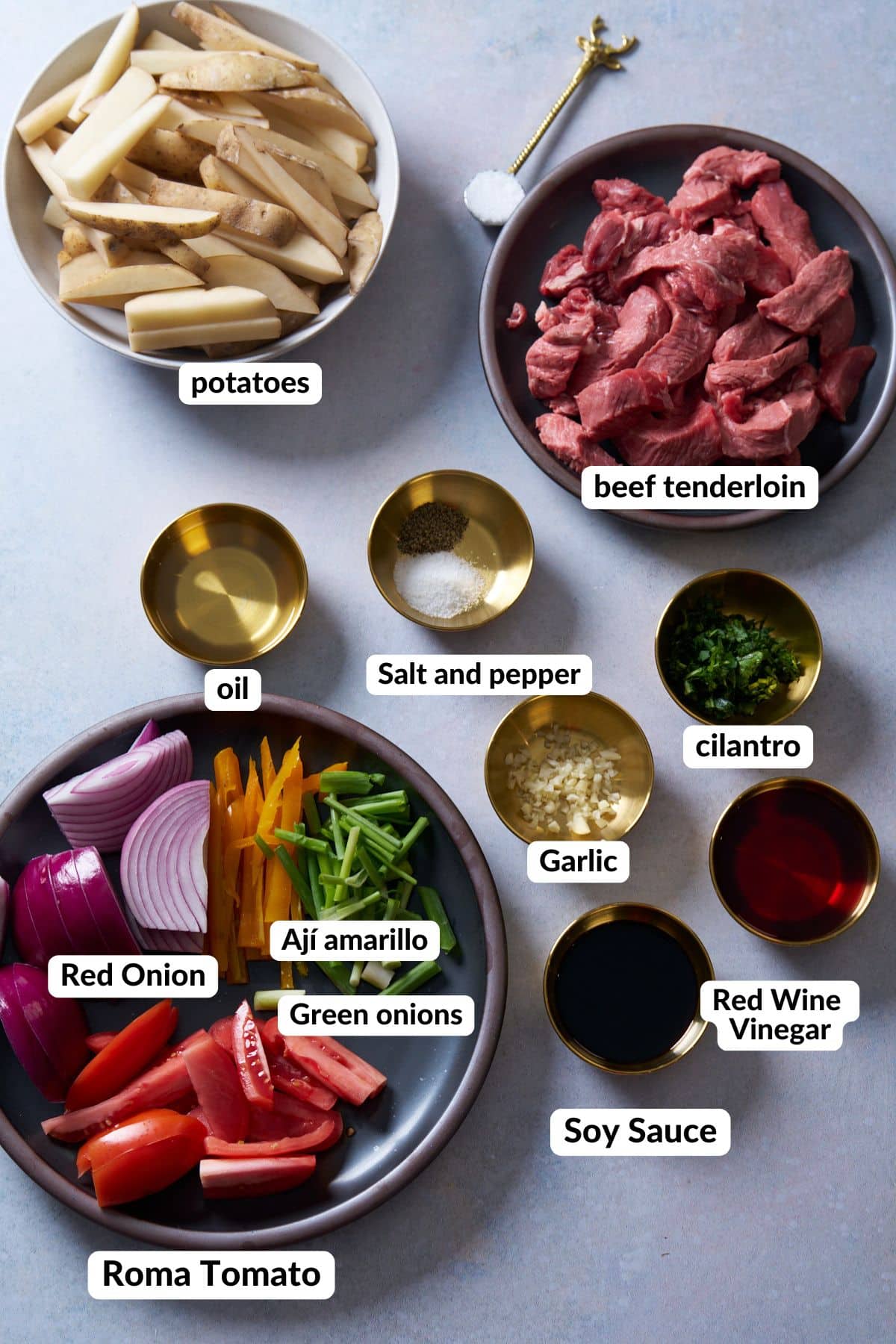
      • The Mongolian beef will also freeze really well. Thaw it in the fridge overnight before reheating.

      More Beef Recipes

      • Korean Flavored Sloppy Joes - a flavorful twist on beef sloppy joes.
      • Steak Kimchi Fried Rice - fried rice with kimchi and steak.
      mongolian beef in plate
      Print Recipe
      4.93 from 13 votes

      Easy Mongolian Beef

      Easy Mongolian beef is a rich and flavorful dish and is on the table in 20 minutes. Your favorite takeout made at home. Can also be made in the air fryer.
      Prep Time10 minutes mins
      Cook Time10 minutes mins
      Total Time20 minutes mins
      Course: Main Course
      Cuisine: Mongolian
      Keyword: air fryer Mongolian beef, easy mongolian beef, quick Mongolian beef
      Servings: 4 servings
      Calories: 303kcal
      Author: Tanya Harris

      Ingredients

      • 1 lb flank steak thinly sliced against the grain
      • 2 Tablespoon cornstarch
      • 2-4 Tablespoon canola oil
      • 1 yellow onion sliced
      • 2 green onions chopped, green and white parts separated
      • 4 garlic cloves chopped
      • 1- inch ginger chopped
      • ¼ cup low sodium soy sauce
      • ¼ cup water
      • 1 Tablespoon hoisin sauce
      • 3 Tablespoon brown sugar
      • Salt to taste

      Instructions

      • Cover the flank steak with cornstarch, making sure each piece is covered. Set aside.
      • Heat the canola oil in a large skillet over medium-high heat. Once the oil is hot, add the flank steak to the frying pan in a single layer, making sure that the pieces are not touching. Cook on 1-2 minutes per side until each side is browned. Cook in batches until all the flank steak is cooked. Set aside.
      • Add sliced yellow onion, whites of green onions, garlic, and ginger to the skillet and stir fry for about 3 minutes, until the onions are slightly softened but still have a little crunch. Add soy sauce, water, hoisin sauce, and brown sugar and stir. Add steak back to the pan along with the green parts of the onions. Remove from heat and serve.

      Air fryer Instructions:

      • This Mongolian Beef can also be made in an Air Fryer. If Air Frying, coat the flank steak in corn starch and place in a preheated air fryer of 400 degrees Fahrenheit. Cook for 15 minutes, shaking the basket halfway. Prepare the sauce on the stove with the onion, garlic, ginger, soy sauce, water, hoisin sauce, and brown sugar.
      • After multiple tests, we preferred the stovetop version but wanted to share the Air Fryer version for anyone wanting to exclude the frying component of this recipe.

      Notes

      • Freeze your steak before slicing it. It will make it easier and less likely to fall apart. Remember to cut against the grain.
      • Prep all of your ingredients before you start cooking. The dish comes together so quickly, so have everything to hand and ready to go.
      • If you have leftovers, they will keep in an airtight container in the fridge for 4 days. They can be reheated on the stove top or in the microwave.
      • The Mongolian beef will also freeze really well. Thaw it in the fridge overnight before reheating.

      Nutrition

      Calories: 303kcal | Carbohydrates: 20g | Protein: 26g | Fat: 13g | Saturated Fat: 3g | Cholesterol: 68mg | Sodium: 670mg | Potassium: 496mg | Fiber: 1g | Sugar: 11g | Vitamin A: 60IU | Vitamin C: 4mg | Calcium: 50mg | Iron: 2mg

      This post was first published on March 6, 2020. It has been updated with new photos and information.

      Fried Pork Chops (Crispy Southern Style)

      April 29, 2026 by Tanya Harris 8 Comments

      Two crispy fried pork chops served on a dark plate with fresh green beans and cherry tomatoes.

      When I'm craving crispy, perfectly golden fried pork chops, this is how I make them.

      Two crispy fried pork chops served on a dark plate with fresh green beans and cherry tomatoes.

      You’ll find the full recipe with ingredient amounts and instructions in the recipe card at the bottom of this post. Be sure to check out the blog post itself for extra tips and tricks!

      Fried Pork Chops At A Glance

      • What I'm Sharing: The technique and recipe for perfectly fried and delicious golden pork chops.
      • Prep Time: 15 minutes
      • Cook Time: 8 minutes
      • Total Time: 23 minutes
      • Serves: 4
      • Best For: Sunday dinner, weeknight comfort, and anyone who appreciates a perfectly golden-brown crust.
      Tanya holding a plate of fried pork chops

      I’ve always been a huge fan of pork chops, but a perfectly fried pork chop is the ultimate winner. Frying pork chops is a true skill because you want a crust that stays crispy while the meat remains juicy.

      I’ve spent plenty of time not just eating fried pork chops, but studying exactly how to fry them right. Now, whenever a craving hits, this is my go-to method.

      If you love pork chops as much as I do, you’ll also want to try my Juicy Pan-Seared Pork Chops or my Air Fryer Pork Chops.

      Happy cooking,

      Tanya

      A Quick Look at the Ingredients

      Ingredient amounts and full recipe instructions are on the printable recipe card at the bottom of the post.

      For the Pork Chops

      • Pork chops, about ½ inch thick - Thinner chops fry faster and stay tender. Bone-in or boneless both work, just keep the thickness consistent so they cook evenly. I use center-cut pork loin chops and trim any excess fat from the exterior.
      • Mustard - It helps the seasoning and flour grip the meat, and the flavor cooks off, so you won't taste mustard in the finished chop. I used Dijon, but yellow mustard works as well.
      • Dry Seasoning - I use All-Purpose Seasoning, but any well-balanced blend works. You can also use my Pork Chop Seasoning or Seasoned Salt.

      For the Coating

      • Eggs - Two large eggs, beaten, help build that double layer of crust.
      • All-purpose flour and cornstarch - The cornstarch is what gives you that extra crisp crust. Mix it with all-purpose flour for the best results.

      For Frying

      • Neutral oil. Vegetable, canola, or peanut oil all work - You want about ½ inch of oil in the skillet, enough to come halfway up the chops.

      How to Make Fried Pork Chops

      The method is simple, but the details matter. Follow each step and don't rush the oil temperature.

      Step 1: Pat the pork chops completely dry with paper towels. Rub them all over with yellow mustard and season both sides with 1 teaspoon of all-purpose seasoning.

      Patting raw pork chops dry with a paper towel to ensure a crispy crust
      pork chops covered in mustard

      Step 2: In a shallow bowl, whisk together the flour, cornstarch, and the remaining 2 teaspoons of all-purpose seasoning. In a second bowl, beat the egg until smooth.

      Step 3: Dredge each chop in the flour mixture, dip it into the egg, let the excess drip off, and then return it to the flour and coat evenly. Press the flour gently into the chop and shake off any excess.

      Battering station for pork chops with flour and egg wash.

      Step 4: Place the coated chops on a plate and let them sit for 10 minutes. This rest helps the coating set so it doesn't slide off in the oil.

      Step 5: Add oil to a large cast-iron skillet so it comes halfway up the sides of the chops, about ¼ inch deep. Heat it gradually over medium heat. The oil is ready when a pinch of flour dropped in sizzles steadily, or when it reaches 350°F.

      Step 6: Fry the chops for 3 to 4 minutes per side, until deep golden brown. Flip once. Don't crowd the pan; work in batches if needed, and adjust the heat to keep a steady sizzle.

      Lifting a crispy fried pork chop from a cast iron skillet with tongs.

      Step 7: Transfer to a wire rack and let rest for a few minutes before serving. The rack keeps the bottom crust from going soggy.

      Four crispy fried pork chops on a wire cooling rack.

      Serve and enjoy. Season with additional salt and pepper if desired.

      Tanya's Top Tips

      • Start with center-cut pork chops and trim off any excess fat cap. The fat curls up while the chop fries and lifts the breading right off, plus it renders into the oil and changes how everything cooks.
      • Use a cast-iron skillet. It holds heat steady and gives you the most even browning.
      • Get the oil hot enough before the chop hits it. Cold oil is what causes the breading to soak up grease rather than crisp. Bring it up gradually so it heats through evenly, then test with a pinch of flour. If it sizzles steadily, you're good.
      • Stick to 2 to 4 chops in one batch of oil. Any more than that and the oil starts getting dirty, and your later chops won't fry as cleanly as the first ones.
      • Don't crowd the pan. Adding too many chops at once drops the oil temperature fast, and that's when you get a greasy crust. Two chops at a time are plenty for a 10-inch skillet.
      • Rest the coated chops for 10 minutes before frying and rest the cooked chops on a wire rack instead of a paper towel. The rack lets steam escape so the crust stays crispy on all sides.

      Recommended Tools

      1. Lodge Cast Iron Skillet
        Lodge Cast Iron Skillet
        Buy Now
      2. Long Tweezer Tongs Professional Gold
        Long Tweezer Tongs Professional Gold
        Buy Now
      3. FryAway Cooking Oil Solidifier
        FryAway Cooking Oil Solidifier
        Buy Now

      What to Serve with these Fried Pork Chops

      These pork chops make a great dinner or breakfast option. I like to serve them with creamy mashed potatoes, a flavored rice like this garlic butter rice, and steamed vegetables. For breakfast, they're great with some creamy grits, or if you're using boneless chops, consider making a fried pork chop sandwich.

      I hope you love these fried pork chops as much as we do. If you're looking for more crispy, comforting recipes, try these out:

      Smothered Pork Chops - Tender pork chops in a rich onion gravy.

      Juicy Pan-Seared Pork Chops- A quick stovetop chop for busy weeknights.

      Two crispy fried pork chops served on a dark plate with fresh green beans and cherry tomatoes.
      Print Recipe
      5 from 3 votes

      Fried Pork Chops Recipe

      Crispy, golden fried pork chops with a juicy center. Dijon mustard helps the seasoned flour coating grip the meat for a crust that stays crunchy.
      Prep Time15 minutes mins
      Cook Time8 minutes mins
      Total Time23 minutes mins
      Course: Main Course
      Cuisine: American, Southern
      Keyword: fried pork chops
      Servings: 4 people
      Calories: 875kcal
      Author: Tanya Harris

      Equipment

      • cast iron skillet

      Ingredients

      • 4 pork chops about ½ inch thick (center cut, fat cap trimmed)
      • 1 tablespoon Dijon mustard
      • 1 tablespoon all-purpose seasoning divided
      • 1 cup all-purpose flour
      • 2 tablespoons cornstarch
      • 2 large eggs
      • 1 cup oil for frying about ¼ inch in pan

      Instructions

      • Pat pork chops dry and trim any excess fat cap. Rub all over with Dijon mustard and season both sides with 1 teaspoon of all-purpose seasoning.
      • In a shallow bowl, combine the flour, cornstarch, and remaining 2 teaspoons of all-purpose seasoning. In a second bowl, beat 2 large eggs until smooth.
      • Coat each chop in the flour mixture, dip into the egg letting the excess drip off, then return to the flour and coat evenly. Press lightly and shake off excess.
      • Place coated chops on a plate and let sit for 10 minutes.
      • Add about 1 cup of oil to a 10-inch cast iron skillet, enough to come up about ¼ inch. Heat over medium heat, bringing it up to temperature gradually. The oil is ready when a pinch of flour sizzles steadily or it hits about 350°F.
      • Fry pork chops for 3 to 4 minutes per side, until golden brown. Flip once and don't overcrowd the pan. Adjust heat as needed to maintain a steady sizzle.
      • Transfer to a clean wire rack and rest a few minutes before serving.

      Video

      Notes

      • Resting the coated chops for 10 minutes is what helps the breading stay on during frying.
      • Use a wire rack instead of paper towels for resting cooked chops so the bottom crust stays crisp.
      • For thicker chops, add 1 to 2 minutes per side.
      • Pork chops are safely cooked when the internal temperature reaches 145°F. For best results, use a quick-read thermometer to check the internal temperature.

      Nutrition

      Calories: 875kcal | Carbohydrates: 30g | Protein: 35g | Fat: 68g | Saturated Fat: 8g | Polyunsaturated Fat: 18g | Monounsaturated Fat: 40g | Trans Fat: 0.3g | Cholesterol: 172mg | Sodium: 139mg | Potassium: 616mg | Fiber: 3g | Sugar: 0.4g | Vitamin A: 190IU | Vitamin C: 0.1mg | Calcium: 88mg | Iron: 4mg

      How to Store Fried Pork Chops

      Storage: Store leftover pork chops in an airtight container in the refrigerator for up to 3 days. The crust will soften some, but the flavor holds up well.

      Freezing: Freeze cooked, cooled chops in a single layer, then transfer to a freezer bag. They keep for up to 2 months.

      Reheating: For the crispiest results, reheat in a 375°F oven or air fryer for 5 to 7 minutes. Skip the microwave if you can; it makes the crust go limp.

      Strawberry Baked Oatmeal

      April 27, 2026 by Tanya Harris 6 Comments

      Strawberry baked oatmeal in a casserole dish

      I love making Strawberry Baked Oatmeal for breakfast. It is easy to make ahead, keeps well in the fridge, and makes busy mornings so much easier.

      Strawberry baked oatmeal in a casserole dish

      You’ll find the full recipe with ingredient amounts and instructions in the recipe card at the bottom of this post. Be sure to check out the blog post itself for extra tips and tricks!

      One of my favorite breakfast meals growing up was those little packets of dry strawberries-and-cream oatmeal. I loved those things more than the real oatmeal Grandma would make on the stove. It was probably because of all the sugar in each packet. Yay sugar! It probably wasn't that good for me. I probably didn't care.
      Now, I care lol, and I find baking the oatmeal ahead of time results in oatmeal you can make for a crowd, or prep ahead for breakfast. This recipe is great because it involves fresh fruit and ingredients you likely already have in the kitchen.

      This baked oatmeal is easy to adjust for everyone in the house. Just add a little milk for a softer, creamier bowl or enjoy it as is for a heartier texture. It is a simple, delicious breakfast that works for different tastes with very little effort.

      A Quick Look at The Ingredients

      Ingredient amounts and full recipe instructions are on the printable recipe card at the bottom of the post.

      • Oats: Old-fashioned rolled oats make up the base of this baked oatmeal and give it the best texture. I would skip quick-cooking oats, as they can make the baked oatmeal too soft.
      • Fruit: Fresh strawberries add a sweet, juicy flavor in every bite.
      • Sweeteners and spices: Brown sugar and granulated sugar add the perfect amount of sweetness, while cinnamon and nutmeg bring in that cozy strawberries-and-cream flavor.
      • Baking staples: Baking powder helps the oatmeal bake up nicely.
      • Liquids: Milk and eggs help create the custardy texture that holds everything together. I use dairy milk here, but another milk you like should work just fine.
      • Flavor boosters: Melted butter, vanilla, and a little salt round out everything and add richness, depth, and balance.
      ingredients for strawberry baked oatmeal on table

      How to Make Strawberry and Cream Baked Oatmeal

      Step 1: Prepare the baking dish: Lightly grease a 7x13 casserole dish with butter or nonstick cooking spray. An 8x8 baking dish can also be used, but the oatmeal will be a little thicker.

      Step 2: Mix the dry ingredients. In a medium bowl, stir together the oats, brown sugar, cinnamon, nutmeg, baking powder, and salt.


      Step 3: Whisk the wet ingredients. In a separate bowl, whisk together the milk, eggs, melted butter, and vanilla. Stir in the granulated sugar until combined.

      dry oatmeal mixture with a spoon in it.
      Milk and eggs mixed in a bowl with a whisk in it

      Step 4: Combine everything. Pour the wet ingredients into the dry ingredients, then stir until everything is well combined. Fold in the chopped strawberries.

      Step 5: Add to the baking dish. Pour the oatmeal mixture into a prepared baking dish and spread it into an even layer.

      Wet ingredients of strawberry baked oatmeal and casserole dish before baking

      Step 6: Bake and serve. Bake in the preheated oven for 20-25 minutes, or until the oatmeal is set and lightly golden on top. Let it cool slightly before serving.
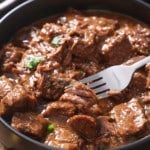
      Strawberry baked oatmeal and baking dish with spoon sticking out

      Looking for more breakfast recipes? Try these out:

      • Million Dollar Bacon
      • Pumpkin Pie Oatmeal (Pressure Cooker Recipe)
      • Egg Bites (Pressure Cooker Recipe)
      Strawberry baked oatmeal in a casserole dish
      Print Recipe
      No ratings yet

      Strawberry Baked Oatmeal Recipe

      Strawberry and Cream Oatmeal is delicious and the perfect make-ahead breakfast meal. Perfect for weekdays and weekends. Healthy, fruity, and creamy oatmeal is the perfect breakfast. 
      Prep Time10 minutes mins
      Cook Time25 minutes mins
      Total Time35 minutes mins
      Course: Breakfast
      Cuisine: American
      Keyword: strawberry cream oatmeal
      Servings: 6 people
      Calories: 293kcal
      Author: Tanya Harris

      Ingredients

      • 2 cups old fashioned rolled oats
      • ⅓ cup light brown sugar
      • ¼ cup white granulated sugar
      • 1 teaspoon cinnamon
      • ¼ teaspoon nutmeg
      • 1 teaspoon baking powder
      • ¼ teaspoon salt
      • 2 cups milk
      • 2 large eggs
      • 1.5 Tablespoons butter melted
      • ¼ teaspoon vanilla
      • 1.5 cups chopped strawberries about 10 medium sized strawberries

      Instructions

      • Preheat the oven to 375F and lightly grease a 7x13 casserole dish with butter or nonstick cooking spray.
      • In a medium bowl, combine the oats, brown sugar, granulated sugar, cinnamon, nutmeg, baking powder, and salt.
      • In a separate bowl, whisk together the milk, eggs, melted butter, and vanilla.
      • Pour the wet ingredients into the dry ingredients and stir until combined. Fold in the chopped strawberries.
      • Pour the oatmeal mixture into the prepared baking dish and spread it into an even layer.
      • Bake for 20 to 25 minutes, or until the oatmeal is set and lightly golden on top.
      • Let cool for a few minutes, then serve warm.

      Notes

      • I used a 7x13, but an 8x8 baking dish can also be used; the oatmeal will be a little thicker and may need a few extra minutes to bake.
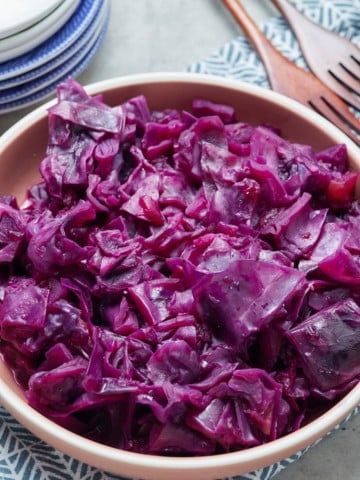
      • For a softer, creamier bowl, add a splash of milk when serving.
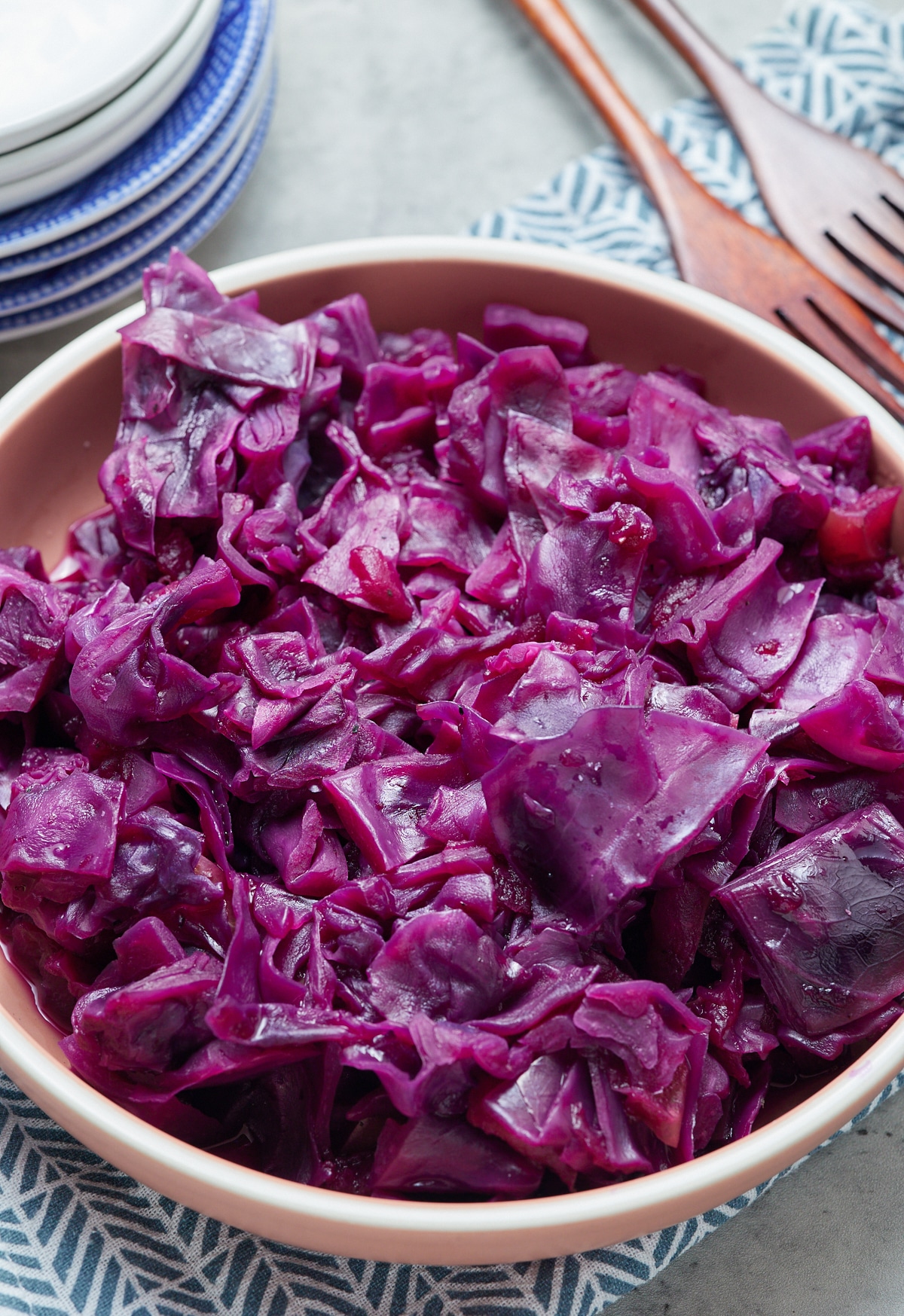
      • Store leftovers in an airtight container in the refrigerator for up to 4 days. Reheat individual portions in the microwave before serving.

      Nutrition

      Calories: 293kcal | Carbohydrates: 46g | Protein: 9g | Fat: 9g | Saturated Fat: 4g | Polyunsaturated Fat: 1g | Monounsaturated Fat: 2g | Trans Fat: 0.1g | Cholesterol: 79mg | Sodium: 180mg | Potassium: 385mg | Fiber: 4g | Sugar: 26g | Vitamin A: 315IU | Vitamin C: 21mg | Calcium: 173mg | Iron: 2mg

      How to Store Strawberry and Cream Baked Oatmeal

      Let the baked oatmeal cool completely, then cover the dish or transfer leftovers to an airtight container. Store it in the refrigerator for up to 4 days. When you are ready to eat, reheat individual portions in the microwave and add a splash of milk if you want a softer, creamier texture.

      You can also freeze baked oatmeal for longer storage. Wrap individual portions tightly or place them in freezer-safe containers and freeze for up to 2 months. Thaw overnight in the refrigerator before reheating.

      Strawberry baked oatmeal in a bowl with a spoon sticking out

      Variations

      This baked oatmeal recipe is easy to make your own with a few simple swaps.

      • Swap the fruit: Try blueberries, raspberries, chopped apples, or peaches instead of strawberries.
      • Change the milk: Dairy milk works great, but almond milk, oat milk, or another favorite milk can be used.
      • Add texture: Stir in chopped pecans, walnuts, or sliced almonds for a little crunch.
      • Make it extra cozy: Add a little more cinnamon or a pinch of cardamom for a warmer flavor.
      • Add a topping: Serve it with a drizzle of maple syrup, a spoonful of yogurt, or an extra splash of milk.

      Tanya’s Top Tips

      • Watch the bake time if using an 8x8 dish, since the oatmeal may need a few extra minutes to cook through.
      • Use old-fashioned rolled oats for the best texture. Quick oats can make the baked oatmeal too soft.
      • Do not skip greasing the dish, or the oatmeal will not lift out easily after baking.
      • Use ripe, sweet strawberries for the best flavor.
      • Let it cool for a few minutes before serving so it has time to set.
      • Add milk when serving if you like your oatmeal a little softer and creamier.

      This recipe was first published on April 11, 2016. It has been updated with additional information and photos.

      Easy Garlic Butter Rice

      April 22, 2026 by Tanya Harris 6 Comments

      garlic butter rice with butter, head of garlic in background

      This garlic butter rice is the perfect way to add flavor to plain rice.

      garlic butter rice in bowl wtith spoon sticking out

      You’ll find the full recipe with ingredient amounts and instructions in the recipe card at the bottom of this post. Be sure to check out the blog post itself for extra tips and tricks!

      Tanya holding a bowl of garlic butter rice

      Rice is one of those things I keep on heavy rotation in my kitchen. Whether it's plain white rice or a flavored version like my yellow rice or cilantro lime rice.

      This garlic rice comes out perfect with my stovetop method. I like to sweat the garlic in butter before adding the rice, resulting in a mellow, sweet garlic flavor running through every grain rather than a sharp, raw garlic bite. We love this rice.

      I think you'll love this one too.

      Love, Tanya

      Garlic Butter Rice At A Glance

      • Prep Time: 5 minutes
      • Cook Time: 23 minutes
      • Rest Time: 5 minutes
      • Total Time: 33 minutes
      • Serves: 4 as a side
      • Best For: Weeknight dinners, family meals, holiday side dish

      A Quick Look at The Ingredients

      Ingredient amounts and full recipe instructions are on the printable recipe card at the bottom of the post.

      • Long grain white rice: It cooks up fluffy and separate. Jasmine rice is a great swap if that's what you have, just check the package for the liquid ratio. You could also use brown rice, but you’ll need to increase the cook time and may need to adjust the liquid based on the package directions.
      • Unsalted butter: I use unsalted so I can control the salt myself. Feel free to use salted butter if that's your preference.
      • Fresh garlic: I use fresh garlic and mince it for this recipe.
      • Low-sodium chicken broth: gives you the most control over the final seasoning. Vegetable broth works if you want to keep this meatless.
      • Salt: A small amount goes in with the garlic to season it from the start, then more goes in with the broth.
      • Parsley: Fresh parsley to garnish.
      ingredients for garlic butter rice on table


      How to Make Garlic Butter Rice

      Step 1: In a medium saucepan over medium-low heat, melt the butter until it's fully liquid and just starting to foam. You don't want it browning, just melted and ready.

      Step 2: Add the minced garlic and a small pinch of salt. Let the garlic cook gently for about 5 minutes, stirring occasionally. You're looking for soft, fragrant garlic, not browned.

      Step 3: Add the rice straight into the garlic butter and stir for about 10 seconds.

      garlic sweating in butter in pot
      rice being cooked in garlic and butter

      Step 4: Pour in the chicken broth and add the salt. Stir, then turn the heat up to medium-high and bring it to a boil.

      Step 5: Once boiling, reduce the heat to low, cover with a tight-fitting lid, and simmer for 18 minutes. Don't lift the lid. The rice needs the trapped steam to cook properly.

      broth being poured into sauce pan along with the rice
      chicken broth boiling in pot

      Step 6: Take the pot off the heat and let it sit, still covered, for 5 more minutes. This rest time is what gets you fluffy, separate grains.

      Step 7: Fluff with a fork, top with chopped fresh parsley, and serve.

      cooked garlic butter rice after being fluffed with fork

      Variations

      • Vegetarian: Use vegetable broth instead of chicken broth.
      • Cheesy garlic butter rice: Stir in 2 to 3 tablespoons of grated parmesan after fluffing for a richer, cheesier side.
      • Spicy version: Add a pinch of red pepper flakes when the garlic is cooking.

      Serving Suggestions

      Garlic butter rice pairs well with just about any protein. A few of my favorites:

      • Serve it with pan-seared pork chops, lamb chops, or juicy broiled chicken breast for an easy weeknight plate.
      • Pair it with oven-baked shrimp or marinated air fryer salmon when you want something quick.
      • Spoon a saucy main like brown stew chicken or smothered chicken right over the top.
      garlic butter rice with butter, head of garlic in background

      Make Ahead and Storage

      Storage: Let the rice cool, then store it in an airtight container in the fridge for up to 4 days.

      Freezing: Spread the cooled rice in a single layer on a sheet pan to freeze, then transfer to a freezer bag. It keeps for 2 months.

      Reheating: Add a splash of broth or water, then microwave or heat in a covered pan over low heat. The extra liquid keeps it from drying out.

      Tanya's Top Tips

      • Don't rush the garlic infusion. This is the most important step. Low and slow on the garlic is what gives this rice its flavor.
      • Keep the lid on while it simmers. Lifting the lid lets the steam escape, leaving your rice unevenly cooked.
      • Rinse the rice. I always rinse my rice, but you can skip it if you prefer, especially if your rice instructions say not to.

      I hope you love this recipe as much as we do. If you make this recipe, please leave a star rating and let me know how it turned out in the comments below.

      garlic butter rice with butter, head of garlic in background
      Print Recipe
      5 from 2 votes

      Garlic Butter Rice Recipe

      Buttery, fragrant garlic butter rice is an easy one-pot side dish made with long grain white rice simmered in slow-infused garlic butter and chicken broth. 
      Prep Time5 minutes mins
      Cook Time23 minutes mins
      Resting Time5 minutes mins
      Total Time33 minutes mins
      Course: Side Dish
      Cuisine: American
      Keyword: garlic butter rice
      Servings: 4 people
      Calories: 239kcal
      Author: Tanya Harris

      Ingredients

      • 1 cup long grain white rice
      • 2 tablespoon unsalted butter
      • 3 cloves garlic minced (about 1 tablespoon)
      • 1¾ cups low sodium chicken broth
      • ½ teaspoon salt plus a pinch for the garlic
      • 2 teaspoons fresh parsley chopped for garnish

      Instructions

      • In a medium saucepan over medium-low heat, melt the butter until it’s fully liquid and just starting to foam.
      • Add the minced garlic and a pinch of salt. Cook on low for 5 minutes, stirring occasionally, until the garlic is soft and fragrant but not browned.
      • Add the rice to the pan and stir for about 10 seconds, coating every grain in the garlic butter.
      • Pour in the chicken broth and add the ½ teaspoon salt. Stir, then increase the heat to medium-high and bring to a boil.
      • Once boiling, reduce heat to low, cover with a tight-fitting lid, and simmer for 18 minutes, until the liquid is fully absorbed.
      • Remove from heat and let the rice rest, still covered, for 5 minutes.
      • Fluff the rice with a fork, top with fresh parsley, and serve warm.

      Notes

      • If you rinse your rice first, make sure to drain it well before adding it to the garlic butter so excess water doesn’t throw off the liquid ratio.
      • Keep the heat low while cooking the garlic. You want it soft and fragrant, not browned, so the rice gets a mellow garlic flavor instead of a bitter taste.

      Nutrition

      Calories: 239kcal | Carbohydrates: 39g | Protein: 6g | Fat: 7g | Saturated Fat: 4g | Polyunsaturated Fat: 0.4g | Monounsaturated Fat: 2g | Trans Fat: 0.2g | Cholesterol: 15mg | Sodium: 325mg | Potassium: 153mg | Fiber: 1g | Sugar: 0.2g | Vitamin A: 179IU | Vitamin C: 1mg | Calcium: 23mg | Iron: 1mg

      New Orleans BBQ Shrimp Recipe

      April 20, 2026 by Tanya Harris 6 Comments

      New Orleans-style BBQ shrimp in a skillet with a spoon and bread surrounding it

      This New Orleans BBQ shrimp is a must-make if you want to impress your friends with a shrimp dish. It's not actually barbequed; it's jumbo shrimp that are simmered in a bold, buttery Cajun sauce.

      New Orleans-style BBQ shrimp in a skillet with a spoon and bread surrounding it

      You’ll find the full recipe with ingredient amounts and instructions in the recipe card at the bottom of this post. Be sure to check out the blog post itself for extra tips and tricks!

      Tanya holding a bowl of BBQ shrimp and looking at the camera smiling

      BBQ shrimp is not your typical barbecue. Tender shrimp coated in a savory, buttery broth loaded with garlic, Worcestershire sauce, and Cajun seasoning. None of that sticky-sweet stuff.

      You’ll find it on menus all over New Orleans, and every time I have it, it comes with French bread to dip straight into that broth while you eat. It's the best!

      If you love Louisiana flavors, you'll also want to try my Cajun Jambalaya or Southern Style Shrimp and Grits.

      Love, Tanya

      New Orleans BBQ Shrimp at a Glance

      • Best For: Weeknight dinners, date night
      • Prep Time: 10 minutes
      • Cook Time: 12 minutes
      • Total Time: About 22 minutes
      • Serves: 4


      A Quick Look at the Ingredients

      Ingredient amounts and full recipe instructions are on the printable recipe card at the bottom of the post.

      • Jumbo shrimp (peeled and deveined, tail-on recommended) – Tail-on shrimp look great for presentation and hold up well in the sauce. Use the largest shrimp you can find. Raw shrimp, not pre-cooked shrimp, is best for this dish. If it's frozen, thaw it first.
      • Unsalted butter – Use real butter here, not margarine. I use 1 stick of butter in my recipe, but some recipes use much, much more. Feel free to add more butter if you like.
      • Garlic – Freshly minced if you can.
      • Worcestershire sauce – Adds depth and that signature savory note that makes New Orleans BBQ shrimp what it is.
      • Fresh lemon juice – Brightens the sauce and balances the richness of the butter.
      • Cajun or Creole seasoning – My Homemade Cajun Seasoning works well in this dish, but any store-bought blend will work. Salt content varies by brand, so season to taste.
      • Dried rosemary and oregano – Adds a herby note that is very traditional in this dish.
      • Chicken broth – adds a little more body and savory flavor, and plenty of sauce for dipping.
      • Green onions – Sliced, for garnish.


      How to Make New Orleans BBQ Shrimp

      Step 1: Build the sauce base. Melt the butter in a large skillet over medium heat. Add the minced garlic and cook for about 1 minute until fragrant. Do not let it brown.

      Step 2: Season and simmer. Stir in the Worcestershire sauce, lemon juice, Cajun seasoning, rosemary, and oregano. Pour in the chicken broth and let the sauce simmer for 2 minutes, stirring occasionally, until it reduces slightly. Taste and season with salt and pepper.

      Garlic and butter melting in skillet
      Sauce for barbecue shrimp and skillet

      Step 3: Cook the shrimp. Add the shrimp to the skillet in a single layer. Cook for 2 to 3 minutes per side until pink and opaque. As soon as they curl into a C-shape, they are done. Do not overcook them.

      Shrimp cooking in skillet and sauce for barbecue shrimp.
      Bbq shrimp in a skillet on the stovetop.

      Step 4: Serve immediately. Remove the skillet from the heat, garnish with sliced green onions, and spoon into shallow bowls with plenty of that sauce. Serve with crusty French bread right away.

      close up photo of BBQ shrimp in skillet

      Variations

      • Add beer. Some New Orleans recipes call for a splash of beer in the sauce. Add about ¼ cup of a light lager when you add the broth for a slightly deeper flavor.
      • Keep the tails on. The traditional version is made with shell-on, head-on shrimp. If you can find shrimp with the heads on, use them. The heads add a lot of flavor to the sauce, and yes, you eat them the messy way.
      • Add heat. This dish is not traditionally spicy, but if you want a kick, add a few dashes of hot sauce to the sauce while it simmers.
      • Swap the broth. If you have shrimp stock on hand, use it in place of the chicken broth for a more concentrated seafood flavor. I have a Shrimp Stock recipe if you want to make your own.

      Serving Suggestions

      This dish is made to be served in shallow bowls with crusty French bread for dipping. That sauce is the whole point, and you want something to soak it all up.

      You can also serve it over creamy grits, like my Southern Style Shrimp and Grits, spooning the shrimp and sauce over a bowl of creamy grits. It works beautifully as an appetizer for a larger group as well. For a full Southern spread, pair it with my Instant Pot Cajun Dirty Rice.

      Orleans-style BBQ shrimp in a bowl surrounded by bread

      Make Ahead and Storage

      Storage: Store leftover shrimp in an airtight container in the refrigerator for 3-4 days. The sauce may solidify as it cools because of the butter. That is normal.

      Reheating: Reheat gently in a skillet over low heat with a splash of broth or water to loosen the sauce. Avoid high heat, or the shrimp will turn rubbery.

      Freezing: I do not recommend freezing this dish. Shrimp can become tough and watery after freezing and thawing, and the butter sauce does not hold up well.

      Tanya's Top Tips

      • Do not overcook the shrimp. They cook fast. Pull them as soon as they turn pink and curl into a C-shape. An overcooked shrimp is rubbery, and there is no coming back from that.
      • Taste your Cajun seasoning before adding salt. Cajun and Creole blends vary a lot in salt content. Season your sauce to taste rather than just dumping in extra salt.

      FAQs

      Why is it called BBQ shrimp?

      The name comes from the deep, reddish-brown color the butter and Worcestershire sauce take on as it simmers. It looks like barbecue.
      The dish was invented in 1953 at Pascal's Manale, an Italian-Creole restaurant in Uptown New Orleans that's still open today. Mr. B's Bistro and Emeril later put their own spin on it, but Pascal's is where it started.

      I hope you love this New Orleans BBQ Shrimp as much as we do. If you're looking for more shrimp and seafood recipes, try these out:

      • Crispy Air Fryer Fried Shrimp – Crunchy, golden, and so easy in the air fryer.
      • Creamy Shrimp Bisque – A rich, velvety soup perfect for cold nights.
      • Air Fryer Shrimp Po'Boy Sandwiches – New Orleans vibes in sandwich form.
      New Orleans-style BBQ shrimp in a skillet with a spoon and bread surrounding it
      Print Recipe
      5 from 3 votes

      New Orleans BBQ Shrimp Recipe

      Tender jumbo shrimp simmered in a rich, garlicky Worcestershire butter sauce. One skillet, 25 minutes, and a lot of crusty bread required.
      Prep Time10 minutes mins
      Cook Time12 minutes mins
      Total Time22 minutes mins
      Course: Appetizer, Main Course
      Cuisine: American
      Keyword: New Orleans BBQ Shrimp
      Servings: 4 people
      Calories: 294kcal
      Author: Tanya Harris

      Ingredients

      • 1 lb jumbo shrimp peeled and deveined (tail-on recommended)
      • 8 tablespoons unsalted butter
      • 4 garlic cloves minced
      • 2 tablespoons fresh lemon juice
      • 1 tablespoon Worcestershire sauce
      • 1 tablespoon Cajun or Creole seasoning
      • ½ teaspoon dried rosemary crushed
      • ½ teaspoon dried oregano
      • ½ cup chicken broth
      • Salt and pepper to taste
      • 1 tablespoon green onions sliced (garnish)

      Instructions

      • Melt butter in a large skillet over medium heat. Add garlic and cook for 1 minute until fragrant.
      • Stir in lemon juice, Worcestershire sauce, Cajun seasoning, rosemary, and oregano. Stir in broth and simmer for 2 minutes until slightly reduced. Taste and season with salt and pepper.
      • Add shrimp in a single layer. Cook 2 to 3 minutes per side until pink, opaque, and curled into a C-shape.
      • Remove from heat. Garnish with green onions and serve immediately in shallow bowls with crusty French bread.

      Notes

      Cajun and Creole blends vary in salt. Taste the sauce before adding extra salt.
      Do not overcook the shrimp. They are done as soon as they curl and turn opaque.
      Serve immediately with French bread to soak up the sauce.
      To reheat leftovers, warm gently in a skillet over low heat with a splash of broth.

      Nutrition

      Calories: 294kcal | Carbohydrates: 4g | Protein: 16g | Fat: 24g | Saturated Fat: 15g | Polyunsaturated Fat: 1g | Monounsaturated Fat: 6g | Trans Fat: 1g | Cholesterol: 204mg | Sodium: 817mg | Potassium: 204mg | Fiber: 0.4g | Sugar: 1g | Vitamin A: 929IU | Vitamin C: 6mg | Calcium: 86mg | Iron: 1mg

      Homemade Fruit Punch Recipe

      April 17, 2026 by Tanya Harris 8 Comments


      Making delicious fruit punch means you need the right fruit juice combo, and this is the one that my whole family loves.

      fruit punch in glass on table outside

      You’ll find the full recipe with ingredient amounts and instructions in the recipe card at the bottom of this post. Be sure to check out the blog post itself for extra tips and tricks!

      Tanya Harris holding a glass of fruit punch

      Anytime I need a non-alcoholic, fruity drink, this fruit punch is what I make. It's some of my favorite fruit juices, all combined into one.

      The real stamp of approval came from my youngest. She has never been a fan of store-bought fruit punch, so I wasn’t expecting much. She took one sip and told me it was the best fruit punch she’d ever had. That was it for me.

      If you love a refreshing non-alcoholic drink for a crowd, you might also enjoy my Green Sherbet Punch or my Slow Cooker Hot Holiday Punch.

      Fruit Punch at a Glance

      • Prep Time: 5 minutes
      • Chill Time: 1 hour
      • Total Time: 1 hour 5 minutes
      • Serves: 6 to 8
      • Best For: Parties, gatherings, make-ahead drinks

      A Quick Look at the Ingredients

      • Frozen lemonade concentrate – Thawed. This is the backbone of the punch and gives it that tart, citrusy punch (no pun intended). You could also use limeade concentrate in its place.
      • Cranberry juice, orange juice, and pineapple juice – This is my tart, acidic, and sweet juice combo. Feel free to pick other juices you may prefer, but these are the trio I love. 
      • Ginger ale or club soda – Stirred in right before serving for a little fizz. You can use one or the other, or a mix of both. Club soda keeps it less sweet; ginger ale adds a subtle spiced flavor.
      • Water – I add a little bit of water to lighten the juice up. I say taste your punch before you add it. 

      How to make Fruit Punch

      Step 1: In a large pitcher, combine the thawed lemonade concentrate, cranberry juice, orange juice, pineapple juice, and water. Stir well to combine.

      orange juice being poured into fruit punch

      Step 2: Refrigerate the punch until chilled, at least 1 hour. You can also drink it as soon as it's made, but it's best when chilled.

      Step 3: Just before serving, stir in the ginger ale or club soda.

      Step 4: Serve over ice. Garnish with orange slices or fresh pineapple chunks if you’d like.

      glasses of fruit punch in front of pitcher of fruit punch

      Variations

      Make it alcoholic: Add white rum or vodka to the punch before chilling. Start with 1 to 1.5 cups and adjust to taste. My Jamaican Rum Punch is a great reference if you want a rum-forward version.

      Less tart: Stir in more water or increase the amount of pineapple juice, which is the sweetest juice in the mix.

      Make Ahead and Storage

      Storage: Store the punch in a covered pitcher or airtight container in the refrigerator for up to 3 days. The punch won't be as fizzy, but it'll still be delicious.

      Tanya’s Top Tips

      • Don’t add the ginger ale or club soda until right before serving, or you’ll lose all the carbonation. However, if you've made a batch and want to store it, it'll still taste fine; it just won't be as carbonated.
      • For a party, double or triple the recipe and mix directly in a large bowl or punch bowl.

      glass of fruit punch on table

      I hope you love this fruit punch recipe as much as we do. If you’re looking for more drink recipes, try these out:

      • Green Sherbet Punch – A fun, colorful punch that’s perfect for parties.
      • Slow Cooker Hot Holiday Punch – A warm, spiced punch for the colder months.
      • Homemade Cranberry Lemonade – Tart, refreshing, and made from scratch.
      • Classic Lemonade – A simple, crowd-pleasing classic.
      • Jamaican Sorrel Drink – A vibrant, floral drink made with dried sorrel.
      fruit punch in glass on table outside
      Print Recipe
      5 from 3 votes

      Homemade Fruit Punch Recipe

      This homemade fruit punch is refreshing and easy to make with juices you likely already have in your fridge.
      Prep Time5 minutes mins
      Chill Time1 hour hr
      Total Time1 hour hr 5 minutes mins
      Course: Drinks
      Cuisine: American
      Keyword: fruit punch, fruit punch recipe
      Servings: 8 people
      Calories: 76kcal
      Author: Tanya Harris

      Ingredients

      • 12 oz can frozen lemonade concentrate thawed
      • 2 cups cranberry juice
      • 1½ cups orange juice
      • 1 cup pineapple juice
      • 1 cup water
      • 1 cup ginger ale or club soda or a mix of both
      • Ice for serving
      • Orange slices and fresh pineapple chunks for garnish (optional)

      Instructions

      • In a large pitcher, combine the thawed lemonade concentrate, cranberry juice, orange juice, and pineapple juice. Stir well.
      • Refrigerate until chilled, at least 1 hour.
      • Just before serving, stir in the ginger ale or club soda.
      • Serve over ice. Garnish with fruit if desired.

      Video

      Notes

      • This punch is best when stored for up to 3 days.
      • You can use 100% cranberry juice for a less sweet, more tart punch, or cranberry juice cocktail if you prefer a sweeter drink.

      Nutrition

      Calories: 76kcal | Carbohydrates: 19g | Protein: 1g | Fat: 0.2g | Saturated Fat: 0.02g | Polyunsaturated Fat: 0.1g | Monounsaturated Fat: 0.04g | Sodium: 6mg | Potassium: 180mg | Fiber: 0.2g | Sugar: 17g | Vitamin A: 123IU | Vitamin C: 32mg | Calcium: 16mg | Iron: 0.4mg

      Broccoli Rice Casserole (Made From Scratch)

      April 15, 2026 by Tanya Harris 5 Comments

      broccoli rice casserole in dish with spoon in it

      I like to make my broccoli rice casserole from scratch, starting with a rich, cheesy, flavorful sauce that comes together in one pot.

      broccoli rice casserole in dish with spoon in it

      You’ll find the full recipe with ingredient amounts and instructions in the recipe card at the bottom of this post. Be sure to check out the blog post itself for extra tips and tricks!

      Broccoli Rice Casserole At a Glance

      Creamy, cheesy broccoli and rice casserole made completely from scratch, no canned soup.

      Prep Time: 15–20 minutes
      Cook Time: 30–35 minutes
      Total Time: 45–55 minutes
      Serves: 6–8
      Best For: Holiday dinners, potlucks, family meals

      tanya holding a plate of broccoli rice casserole

      When it comes to comfort food, you can't beat a rice casserole. Hearty and warming, and I love that it's a one-pot meal to cut down on the clean-up time!

      I like to make my cheese sauce from scratch, and mushrooms! Use it in place of a can of cream of mushroom soup you find in most recipes.

      If you are in the mood for more comfort food, be sure to check out my Creamy baked mac and cheese or my sweet potato casserole.

      Love, Tanya

      A Quick Look at the Ingredients

      Ingredient amounts and full recipe instructions are on the printable recipe card at the bottom of the post.

      • Broccoli - I use fresh broccoli florets for this recipe. Frozen broccoli florets work as well; just make sure to defrost them first and pat them dry to remove any excess water.
      • Butter - Used to sauté the onions and mushrooms and build flavor for the sauce.
      • Onions and Mushrooms - The aromatics in this casserole. I use yellow onions and baby bella (cremini) mushrooms.
      • For my sauce - A simple homemade sauce made with all-purpose flour, chicken broth, and evaporated milk instead of canned soup.
      • Seasonings - Mustard powder, salt, black pepper, and garlic powder give the sauce plenty of flavor and keep it from tasting bland.
      • Cheddar cheese and cooked rice - Freshly grated shredded cheddar cheese melts into the sauce and on top of the casserole, and cooked rice makes this a hearty, filling dish.
      ingredients for broccoli rice casserole on counter

      How to make Broccoli Rice Casserole

      Step 1: Preheat your oven to 400°F. Blanch the broccoli: Bring 4 quarts of salted water to a boil. Add the broccoli and cook for about 4 minutes. Remove the broccoli from the water and set aside.

      Step 2: Melt the butter in a large ovenproof skillet over medium heat. Add the onions and mushrooms and sauté for about 5 minutes.

      Sprinkle the flour over the onions and mushrooms, then stir. Cook for about 2 minutes.

      onions and mushrooms in a skillet with flour sprinkled over and stirred

      Step 3: Slowly stir in the chicken broth, making sure to scrape up all the browned bits from the bottom of the skillet. Then slowly whisk in the evaporated milk, mustard powder, salt, black pepper, and garlic powder. Bring the mixture to a simmer and cook for about 5 minutes, until thickened, stirring often.

      cream if mushroom sauce in skillet
      thickened creamy mushroom sauce and skillet on spoon

      Step 4: Remove skillet from heat and slowly stir in 2 cups of the grated cheese until the cheese has melted and the mixture is smooth and creamy. Then stir in the broccoli and rice.

      cheese being mixed into cream sauce
      broccoli and rice and sauce in skillet

      Step 5: Sprinkle the remaining cheese over the mixture. Place in the preheated oven and bake for 15 minutes, until the cheese on top has melted. Remove and enjoy 🙂

      rice, broccoli, chese added to cream sauce in skillet
      baked broccoli and cheese casserole right out of oven

      Can you make a rice casserole ahead of time?

      Yes! This is a great make-ahead dish. You can prep it all the day before and keep it covered in the fridge until you are ready to bake it. Any leftovers can be kept for three to four days and reheated in the oven.

      Can you freeze it?

      This casserole freezes really well, and you can cook it right from frozen. Let it cool, then transfer it to freezer-safe containers; it will keep well for up to 3 months.

      Place the frozen mixture into a casserole dish and bake at 400F for 30 minutes. Give it a good stir and cook for an additional 30 to 40 minutes.

      What's the best rice to use?

      I like to use a long-grain white rice like basmati or jasmine. You can use brown rice if you prefer, just make sure it's fully cooked before adding it to the casserole.

      spoon holding broccoli rice casserole

      Tanyas Top Tips

      • If subbing frozen broccoli for fresh, make sure to defrost the broccoli and drain it before adding it to the casserole. 
      • You can use a casserole dish if you don’t have an ovenproof skillet. Just transfer the cheese mixture to a bowl, add broccoli and cheese, and transfer the mixture to a 2qt casserole dish.
      • For the best melt and flavor, use freshly grated cheddar cheese instead of pre-shredded. Pre-shredded cheese is often coated with anti-caking agents that keep it from melting as smoothly into the sauce.
      • Make it a full meal by stirring in about 2 cups of bite-sized chicken (such as rotisserie, poached, or leftover roast chicken) along with the rice and broccoli before baking.

      I hope you love this broccoli rice casserole recipe as much as we do! For more rice recipes, check these out:

      • Homemade Rice a Roni - A cozy, from-scratch version of the classic boxed rice and pasta side, packed with flavor and pantry staples.
      • Kale Rice - Fluffy rice tossed with tender kale for an easy, veggie-loaded side dish that goes with just about any main.
      • Oven Baked Rice - Perfectly fluffy, hands-off rice baked in the oven so you can set it and forget it while you prep the rest of dinner.
      • Dirty Rice - A bold and savory Cajun-style rice dish made with aromatics and meat for a hearty, one-pan side or main.
      broccoli rice casserole in dish with spoon in it
      Print Recipe
      5 from 1 vote

      Broccoli Rice Casserole

      This from scratch broccoli rice casserole is pure comfort food, creamy and cheesy and packed with broccoli and rice for a satisfying one pot dinner.
      Prep Time15 minutes mins
      Cook Time30 minutes mins
      Total Time45 minutes mins
      Course: Main Course
      Cuisine: American
      Keyword: broccoli and rice casserole, how to make broccoli rice casserole from scratch
      Servings: 8 servings
      Calories: 362kcal
      Author: Tanya Harris

      Ingredients

      • 4 cups fresh broccoli florets chopped
      • 3 Tablespoon unsalted butter
      • ¾ cup chopped onion
      • 2 cups chopped portobello mushrooms
      • 3 Tablespoon all-purpose flour
      • ½ cup chicken broth
      • 1 12 oz can evaporated milk
      • 1 teaspoon mustard powder
      • 1 teaspoon salt or to taste
      • ½ teaspoon black pepper or to taste
      • ½ teaspoon garlic powder
      • 3 cups shredded cheddar cheese separated
      • 2 cups cooked rice

      Instructions

      • Preheat the oven to 400 degrees Fahrenheit.
      • Blanch broccoli - bring 4 quarts of salted water to a boil. Once boiling, place broccoli in the water and boil for about 4 minutes. Remove broccoli from water and set aside.
      • Melt butter over medium heat in a large ovenproof skillet. Add onions and mushrooms and sauté for about 5 minutes.
      • Sprinkle flour over the onions and mushrooms and stir. Cook for about 2 minutes.
      • Slowly stir in the chicken broth, making sure to get up all the brown bits in the bottom of the skillet. Slowly stir in the evaporated milk, mustard powder, salt, black pepper, and garlic powder. Bring mixture to a simmer and allow to simmer for about 5 minutes, stirring often.
      • Remove skillet from heat and slowly whisk in 2 cups of the grated cheese, until the cheese has melted and the mixture is smooth and creamy. Stir in the broccoli and rice. Sprinkle the remaining cheese over the mixture.
      • Place in the preheated oven and bake for 15 minutes, until the cheese on top has melted. Remove and enjoy 🙂

      Notes

      • If subbing frozen broccoli for fresh, make sure to defrost the broccoli and drain it before adding it to the casserole.
      • You can use a casserole dish if you don’t have an ovenproof skillet. Just transfer cheese mixture to a bowl, add broccoli and cheese, and transfer mixture to a 2qt casserole dish.

      Nutrition

      Calories: 362kcal | Carbohydrates: 24g | Protein: 17g | Fat: 22g | Saturated Fat: 14g | Cholesterol: 69mg | Sodium: 675mg | Potassium: 451mg | Fiber: 2g | Sugar: 7g | Vitamin A: 951IU | Vitamin C: 44mg | Calcium: 456mg | Iron: 1mg

      This post was originally published on August 7th, 2020. It has been updated with new photos.

      Peruvian Green Sauce (Aji Verde)

      April 14, 2026 by Tanya Harris 7 Comments

      peruvian green sauce in bowl

      This Peruvian green sauce, also known as aji verde, is the kind of condiment you'll want to put on absolutely everything.

      peruvian green sauce in bowl
      Tanya holding chicken and green sauce

      This Peruvian green sauce, also known as aji verde, is the kind of condiment you'll want to put on absolutely everything.

      I first fell in love with it at a local Peruvian restaurant my coworkers and I used to frequent for lunch. Fun fact: when I went to Peru, I couldn't find it there. The aji verde you know from Peruvian restaurants in the US is actually a stateside creation. The traditional version uses aji amarillo peppers and huacatay (black mint). The jalapeño and cilantro swap happened here.

      It goes on everything. Peruvian chicken, pork chops, fish, steak, rice and beans. I think you'll love it too.

      Love, Tanya

      Ingredients

      Ingredient amounts and full recipe instructions are on the printable recipe card at the bottom of the post.

      • Cilantro — Use mostly leaves, but small stems are fine.
      • Jalapeños — These vary a lot in heat. Start with seeds removed if you're unsure, then adjust next time.
      • Garlic - I use whole cloves and add them to the blender.
      • Olive oil - for the marinade.
      • Cotija cheese — This adds a salty, tangy richness that mayonnaise alone can't replicate. If you can't find cotija, feta, or Parmesan, either one works.
      • Lime juice — Use fresh. Bottled won't give you the same brightness.
      • Duke's mayo — My go-to. Use your favorite.

      How to Make Peruvian Green Sauce

      Add all your ingredients to a blender and blend until smooth. That's it. Seriously.

      ingredients for green sauce in jar
      blended green sauce in jar

      The only real decision you need to make is how spicy you want it.

      Spice level:

      • Spicy: Leave the seeds and membranes in the jalapeños
      • Mild: Remove seeds and membranes before blending
      • Extra mild: Use just one jalapeño
      spoon picking up green sauce

      How long does Green Sauce last?

      In the fridge, it can last for up to one week.

      I hope you enjoy this green sauce as much as we do.

      Suggested Recipes to eat this with?

      • Peruvian Chicken - Juicy chicken that pairs perfectly with a drizzle of this bright green sauce.
      • Air Fryer Whole Chicken (Peruvian Style) - same traditional flavor, made in the air fryer.
      • Yellow rice - perfect for soaking up every drop of this bright, delicious green sauce.
      peruvian green sauce in bowl
      Print Recipe
      5 from 1 vote

      Peruvian Green Sauce (Aji Verde)

      Delicious bright and bold peruvian Green Sauce that is so easy to make and taste amazing. Serve it with chicken, rice and beans, pork, and so much more.
      Prep Time5 minutes mins
      Cook Time0 minutes mins
      Total Time5 minutes mins
      Course: Sauce
      Cuisine: Peruvian
      Keyword: Peruvian Green Sauce
      Servings: 6 people
      Calories: 190kcal
      Author: Tanya Harris

      Equipment

      • Blender

      Ingredients

      • 2 fresh jalapeños
      • 1 cup cilantro roughly chopped
      • ½ cup mayonnaise I use Duke’s
      • 2 Tablespoon cotija cheese
      • 5 cloves garlic peeled
      • 2 Tablespoon olive oil
      • 2 Tablespoon lime juice from fresh limes
      • ¼ teaspoon salt

      Instructions

      • Place ingredients in blender. Blend until smooth.

      Notes

      For spicier sauce, keep seeds and membranes of jalapeños. For a mild sauce, remove seeds and membranes.

      Nutrition

      Calories: 190kcal | Carbohydrates: 2g | Protein: 1g | Fat: 20g | Saturated Fat: 4g | Polyunsaturated Fat: 9g | Monounsaturated Fat: 7g | Trans Fat: 0.03g | Cholesterol: 13mg | Sodium: 282mg | Potassium: 49mg | Fiber: 0.3g | Sugar: 0.4g | Vitamin A: 269IU | Vitamin C: 9mg | Calcium: 37mg | Iron: 0.2mg

      This post was originally published on June 8, 2019. It has been updated with new information and photos.

      Peruvian Chicken Recipe (Pollo a la Brasa)

      April 13, 2026 by Tanya Harris 3 Comments

      Peruvian chicken pieces cut up on a plate

      This Peruvian chicken recipe, also known as pollo a la brasa, is marinated in a bold blend of garlic, cumin, soy sauce, and lime, then grilled or oven-roasted until the skin is golden and crispy. Serve it with aji verde sauce for the full experience.

      Peruvian chicken pieces cut up on a plate

      You’ll find the full recipe with ingredient amounts and instructions in the recipe card at the bottom of this post. Be sure to check out the blog post itself for extra tips and tricks!

      Tanya holding a big plate of Peruvian chicken

      I first had pollo a la brasa, also known as Peruvian chicken, at a Peruvian restaurant in North Carolina, and I’ve been making it ever since.

      After visiting Lima, Peru, and taking a cooking class there, and hunting for the best Peruvian chicken, I came home and decided to recreate it again, this time on the grill. It’s so good! The most important thing is the marinade, which comes together easily. I also like to spatchcock my chicken for this recipe, allowing it to cook more quickly. I've also included instructions for baking this chicken in the oven. I got you covered.

      Love, Tanya

      Peruvian Chicken At a Glance

      • Prep Time: 20 minutes
      • Marinate Time: 2 to 24 hours (overnight recommended)
      • Cook Time: 45 to 60 minutes
      • Total Time: About 1 hour 10 minutes (plus marinating time)
      • Serves: 6
      • Best For: Weekend cooking, dinner parties, meal prep

      A Quick Look at The Ingredients

      Ingredient amounts and full recipe instructions are on the printable recipe card at the bottom of the post.

      • Whole chicken: A 4 to 5-pound whole chicken works best. Spatchcocking it (removing the backbone so it lies flat) gives you crispier skin and more even cooking.
      • Extra virgin olive oil: The fat base of the marinade that helps it cling to the chicken.
      • Lime juice: I like to use fresh lime juice in the marinade.
      • Garlic: Six cloves. I throw them all into the blender, as I'll be blending them anyway.
      • Soy sauce: A signature ingredient in pollo a la brasa. Chinese immigration to Peru in the 19th and 20th centuries brought soy sauce into the local cooking tradition, and it has been part of the dish ever since. It adds a deep, savory backbone to the marinade.
      • Cumin: The dominant spice in this recipe. Use a generous tablespoon.
      • Paprika: Adds color and a mild warmth.
      • Dried oregano: A classic Peruvian herb in roasted chicken dishes.
      • Brown sugar: A small amount helps the skin caramelize beautifully on the grill or under the broiler.
      • Black pepper and kosher salt: Season the marinade and the chicken well.
      Ingredients for Peruvian chicken on the table.

      How to Make Peruvian Chicken

      Step 1: Make the Marinade. Add the olive oil, lime juice, garlic, soy sauce, cumin, paprika, oregano, brown sugar, salt, and pepper to a small blender or food processor, and blend until smooth. I use my stick blender for this. The marinade will be thick and fragrant.

      Stick blender blending marinade for Peruvian chicken.
      Blended marinade for Peruvian chicken.

      Step 2: Spatchcock and Season the Chicken. Pat the chicken completely dry with paper towels. This step matters a lot for skin crispiness. Rub the marinade generously under the skin of the breast and thighs, then coat the entire exterior and underside. Place the chicken in a large zip-top bag or a dish covered tightly with plastic wrap.

      Step 3: Marinate. Refrigerate for at least 2 hours, up to 24 hours. Overnight gives you the deepest flavor.

      Raw chicken marinating in Peruvian marinade

      Step 4: Cook Your Chicken. Choose your method below. Remove the chicken from the fridge about 30 minutes before cooking, so it reaches room temperature.

      Grill Method (Peruvian Chicken on the Grill)

      • Preheat your grill to 375°F (190°C) and set it up for indirect heat.
      • Place the chicken, skin-side up, over indirect heat. Close the lid.
      • Cook for 45 to 60 minutes, maintaining a steady temperature throughout.
      • Check the internal temperature in the thickest part of the thigh. Remove the chicken from the grill once it reaches 175°F (79°C).
      • Transfer to a cutting board and let it rest for 15 minutes before carving.

      Oven Method (Peruvian Chicken in the Oven)

      • Preheat your oven to 425°F (220°C).
      • Set a wire rack over a rimmed baking sheet. Place the chicken skin-side up on the rack.
      • Roast for 45 to 55 minutes.
      • If the skin is not dark enough at the end, switch the oven to broil on high for the last 1 to 2 minutes. Watch it closely.
      • Remove when the internal temperature in the thickest part of the thigh reads 175°F (79°C).
      • Rest for 15 minutes before carving.
      Peruvian chicken on the grill grilling

      Step 5: Rest and Carve. Transfer the cooked chicken to a cutting board and let it rest for at least 15 minutes before cutting. This allows the juices to redistribute and keeps the meat moist. Then cut it into pieces and serve with your preferred sauce.

      Peruvian chicken pieces cut up on plates, surrounded by jalapeno, cilantro, limes, and aji verde sauce.

      For Serving

      Peruvian Green Sauce (Aji Verde): The classic pairing. Creamy, herby, and spicy, it is the sauce this chicken was made for.

      Aji amarillo sauce: If you can find aji amarillo paste at a Latin grocery or online, the yellow sauce made from it is incredible with this chicken. Bright, fruity, and mildly spicy.

      French fries: In Peruvian restaurants, pollo a la brasa almost always comes with fries. My Crispy Oven-Baked Fries or Air Fryer French Fries are both great options. You could also serve it with yellow rice and beans.

      What's up with Peruvian chicken on a plate

      Variations

      • Chicken thighs or quarters: If you prefer dark meat only or want a faster cook, bone-in skin-on chicken thighs or quarters work really well with this marinade. Reduce oven time to about 35 to 40 minutes at 425°F (220°C).
      • Spicier version: Add a tablespoon of aji amarillo paste or aji panca paste to the marinade. Both are worth tracking down at a Latin grocery store or online. They add a fruity, mildly spicy depth that is really distinct.
      • Air fryer version: I have a whole post dedicated to this method. Check out my Air Fryer Whole Chicken (Peruvian Style).
      • Gluten free: Swap the soy sauce for tamari or coconut aminos.

      What to Do With Leftover Peruvian Chicken

      One of my favorite uses is chicken salad. Pull the meat off the bone and use it in my Creamy Rotisserie Chicken Salad Recipe. The seasoned Peruvian chicken adds a whole new flavor dimension to a simple chicken salad. Also great chopped over rice bowls or tossed into a quick soup.

      Make Ahead and Storage

      • Make ahead: You can marinate the chicken up to 24 hours in advance. The longer it marinates, the better the flavor.
      • Storage: Store leftover cooked chicken in an airtight container in the refrigerator for up to 4 days.
      • Freezing: Cooked chicken can be frozen for up to 3 months. Let it cool completely, then store it in a freezer-safe bag or container.
      • Reheating: Reheat in a 350°F (175°C) oven for 10 to 15 minutes, or in an air fryer at 350°F (175°C) for 5 to 7 minutes, to restore some crispiness to the skin.
      Roasted Peruvian chicken on a baking sheet

      Tanya's Top Tips

      • Pat the chicken completely dry before rubbing on the marinade. Moisture is the enemy of crispy skin.
      • Use a meat thermometer. Pull the chicken when the thighs reach about 175°F (79°C), and let carryover cooking finish during the 15-minute rest.
      • Get the marinade under the skin, not just on top. Use your fingers to loosen the skin over the breast and thighs, and rub it directly onto the meat.
      • Save the backbone when you spatchcock. It makes excellent chicken stock. When grilling, I throw the backbone on the grill to roast it while the chicken cooks.

      FAQs

      Can I use boneless chicken?

      The bone-in version is strongly recommended here. The bones contribute to flavor during the long cook, and the skin gives you that signature crispy exterior. Boneless chicken also cannot hold up to a long marinade without the texture breaking down.

      Do I have to spatchcock the chicken?

      No, but I recommend it. A whole, unspatchcocked chicken will take longer to cook. Spatchcocking reduces the cook time.

      I hope you love this Peruvian chicken recipe as much as we do. If you are looking for more bold, flavorful chicken dinners, try these:

      • Spatchcocked Garlic Parmesan Chicken: Another great use of the spatchcock technique.
      • Copycat Chipotle Chicken Recipe: If you love a bold, marinated chicken, this one is for you.
      • Classic Roasted Chicken: no-fuss whole chicken with crispy golden skin and juicy, flavorful meat.
      Peruvian chicken pieces cut up on a plate
      Print Recipe
      5 from 1 vote

      Peruvian Chicken Recipe (Pollo a la Brasa)

      This Peruvian chicken recipe is marinated overnight in a bold blend of garlic, cumin, soy sauce, and lime, then grilled or oven-roasted until the skin is deeply golden and crispy. Serve it with aji verde sauce for the full experience.
      Prep Time20 minutes mins
      Cook Time45 minutes mins
      Marinating Time8 hours hrs
      Total Time9 hours hrs 5 minutes mins
      Course: Main Course
      Cuisine: Peruvian
      Keyword: peruvian chicken
      Servings: 6 people
      Calories: 357kcal
      Author: Tanya Harris

      Equipment

      • stick blender

      Ingredients

      • 1 whole chicken 4 to 5 lbs, spatchcocked
      • 3 tablespoons extra virgin olive oil
      • 2 tablespoons fresh lime juice
      • 2 tablespoons soy sauce
      • 6 garlic cloves
      • 1 tablespoon cumin
      • 2 teaspoons paprika
      • 1 teaspoon dried oregano
      • 2 teaspoons brown sugar
      • ½ tablespoon kosher salt
      • 1 teaspoon black pepper

      Instructions

      • Add the olive oil, lime juice, garlic, soy sauce, cumin, paprika, oregano, brown sugar, salt, and pepper to a small blender or food processor and blend until smooth. The marinade will be thick and fragrant.
      • Pat the spatchcocked chicken completely dry with paper towels. Rub the marinade under the skin of the breast and thighs, then coat the entire exterior.
      • Place in a zip-top bag or covered dish and refrigerate for at least 2 hours, up to 24 hours.

      Grill Method (Indirect Heat):

      • Remove the chicken from the refrigerator about 30 minutes before cooking so it comes closer to room temperature.
      • Preheat the grill to 375°F (190°C) and set it up for indirect heat.
      • Place the chicken skin-side up over the indirect heat. Close the lid.
      • Cook for 45 to 60 minutes, maintaining a steady temperature throughout.
      • Check the internal temperature in the thickest part of the thigh. Remove the chicken from the grill once it reaches 175°F (79°C).
      • Transfer to a cutting board and let rest for 15 minutes before carving.

      Oven Method:

      • Remove the chicken from the refrigerator about 30 minutes before cooking so it comes closer to room temperature.
      • Preheat the oven to 425°F (220°C). Set a wire rack over a rimmed baking sheet.
      • Place the chicken skin-side up on the rack. Roast for 45 to 55 minutes.
      • If the skin is not dark enough at the end, switch the oven to broil on high for the last 1 to 2 minutes. Watch it closely.
      • Check the internal temperature in the thickest part of the thigh and remove the chicken once it reaches 175°F (79°C).
      • Transfer to a cutting board and let rest for 15 minutes before carving.

      Notes

      • Overnight marinating (12 to 24 hours) gives the deepest flavor.
      • Pat the chicken very dry before applying the marinade, and cook over indirect heat for even browning.
      • Temperature: For this recipe, I like to cook dark meat a bit higher. Use a meat thermometer and remove the chicken when the thighs reach 175°F (79°C).
      • Spice it up: For a spicier version, add 1 tablespoon aji amarillo paste or aji panca paste to the marinade.
      • Storage: Store leftovers in an airtight container in the refrigerator for up to 4 days.

      Nutrition

      Calories: 357kcal | Carbohydrates: 4g | Protein: 25g | Fat: 26g | Saturated Fat: 6g | Polyunsaturated Fat: 5g | Monounsaturated Fat: 13g | Trans Fat: 0.1g | Cholesterol: 95mg | Sodium: 1009mg | Potassium: 314mg | Fiber: 1g | Sugar: 2g | Vitamin A: 529IU | Vitamin C: 5mg | Calcium: 40mg | Iron: 2mg

      Dutch Baby Pancake Recipe

      April 10, 2026 by Tanya Harris 4 Comments

      Dutch baby pancake in skillet with berries and powdered sugar on top

      This Dutch baby pancake recipe is the easiest, most impressive breakfast you will ever make. A simple blended batter of eggs, flour, whole milk, and butter bakes up puffy and golden in a cast-iron skillet with zero flipping required.

      Dutch baby pancake in skillet with berries and powdered sugar on top
      tanya holding a slice of dutch baby pancake

      I've been making this Dutch baby for years, and it still gets a reaction every single time. My daughter especially loves watching it puff up through the oven window. Honestly, so do I.

      What I love most is that there are no chemical leaveners, no baking powder, no baking soda. The rise is entirely due to air incorporated during blending. When that aerated batter hits a screaming hot cast-iron skillet in a 425-degree oven, steam and heat push it into a dramatic, golden, puffed pancake. Oh, how I love baking science!

      If you love easy breakfast recipes that feel a little special, you will also want to check out my Sheet Pan Pancakes, my Banana Oatmeal Pancakes, or my Air Fryer French Toast.

      Love, Tanya

      Dutch Baby Pancake at a Glance

      • Prep Time: 15 minutes
      • Cook Time: 17 to 22 minutes
      • Total Time: About 40 minutes
      • Serves: 4
      • Best For: Weekend breakfast, brunch, special occasions

      A Quick Look at the Ingredients

      Ingredient amounts and full recipe instructions are on the printable recipe card at the bottom of the post.

      • Eggs – You need large eggs at room temperature. Room temperature eggs blend better and give the pancake more lift. Pull them out of the fridge while the oven preheats.
      • All-purpose flour – Standard all-purpose flour works great here. No need to sift.
      • Whole milk – Whole milk gives the batter the richest texture. It also needs to be at room temperature, just like the eggs. You can sub with 2% milk in a pinch.
      • Granulated sugar – Just a small amount for a touch of sweetness. This is not a super-sweet pancake.
      • Vanilla extract – Rounds out the flavor.
      • Salt – A small amount to balance everything out.
      • Unsalted butter – This is what the skillet gets coated with before the batter goes in. It gives the edges that gorgeous golden color and keeps the pancake from sticking.
      • Toppings for serving – Powdered sugar, maple syrup, fresh fruit, preserves, or my Homemade Honey Butter are all great options.

      How to Make a Dutch Baby Pancake

      Step 1: Preheat the oven. Set your oven to 425°F (220°C) and place a 10-inch cast-iron skillet on the middle rack as the oven heats up.

      Step 2: Make the batter. Add the eggs, flour, milk, sugar, vanilla, and salt to a blender (or use a stick blender). Blend for about 45 to 50 seconds until the batter is completely smooth and slightly airy. This is the step that makes the pancake puff.

      Batter for Dutch baby pancake in a glass jar

      Step 3: Melt the butter. Once the oven is preheated, add the butter to the hot skillet and return it to the oven for a couple of minutes until the butter is fully melted. Keep a close eye on it so it does not burn.

      Step 4: Add the batter. Carefully remove the hot skillet from the oven and pour the batter directly into the center of the buttered pan. Immediately return it to the oven.

      cast iron skillet with melted butter
      Better for Dutch baby pancake and skillet

      Step 5: Bake. Bake for 17 to 22 minutes until the edges are puffed and golden brown. Do not open the oven door while it is baking. Opening the door lets out heat and can cause the pancake to collapse before it sets.

      Dutch baby pancake as soon as it came out of the oven

      Step 6: Remove from the oven. Carefully remove the skillet from the oven and place it on a heat-safe surface. The Dutch baby will be very puffy and golden around the edges.

      Step 7: Serve immediately. Cut into wedges and top with your favorites. The pancake will begin to deflate as it cools, so get it to the table fast.

      Close-up photo of Dutch baby pancake from above.

      Variations

      • Sweet Dutch Baby: Keep the recipe as written and top with powdered sugar, fresh berries, and maple syrup.
      • Lemon Dutch Baby: Add a teaspoon of fresh lemon zest to the batter before blending. Serve with a squeeze of lemon juice and a dusting of powdered sugar.
      • Cinnamon Sugar Dutch Baby: Add a quarter teaspoon of cinnamon to the batter. Once out of the oven, immediately sprinkle with cinnamon sugar.
      • Apple Dutch Baby: Top with a bit of sauteed apples. I love these Southern fried apples as a topping. Add them to the middle of the Dutch baby after you remove it from the oven.
      • Savory Dutch Baby: Skip the sugar and vanilla. After baking, top with fresh herbs, sour cream, smoked salmon, or sautéed mushrooms and cheese.

      Serving Suggestions

      This Dutch baby is a meal on its own, but it goes well with a side of crispy bacon or sausage. For toppings, I love it with a dusting of powdered sugar and a drizzle of maple syrup. Fresh strawberries, blueberries, or raspberries are great on top. If you want something extra indulgent, try a dollop of my Homemade Honey Butter or my Cinnamon Butter on top.

      Slice of Dutch baby pancake on a plate.

      Storage

      • Refrigerator: Store leftovers in the fridge, in an airtight container, for up to 3 days. The texture will not be the same as fresh, but it is still good.
      • Reheating: Warm leftovers in a 300°F oven for about 5 to 7 minutes.

      Tanya's Top Tips

      • Use room temperature eggs and milk. This is the most important tip. Cold ingredients will reduce the puff. Pull them out of the fridge while the oven preheats.
      • Let the blender do the work. Blend the batter for a full 45 to 50 seconds. That time in the blender is what incorporates air into the batter and drives the rise in the oven.
      • Do not open the oven door. Watch through the oven window if you want to see the puff happen, but keep that door closed until the timer goes off.
      • Have your toppings ready. The Dutch baby starts deflating as soon as it hits the cooler air of your kitchen. Get it to the table fast.
      • Serve it straight from the skillet. Bring the whole pan to the table and let people serve themselves. It makes the whole experience more fun.
      Dutch baby pancake in skillet with garnishes surrounding it

      FAQs

      Is a Dutch baby the same as a German pancake?

      They are essentially the same thing. The name Dutch baby is said to come from a mispronunciation of Deutsch, the German word for German, at a Seattle cafe in the early 1900s. The names are used interchangeably today.

      Can I make a Dutch baby without a cast-iron skillet?

      Yes. A cast-iron skillet gives the best results because it holds heat so well, but any oven-safe 10-inch pan works. Avoid glass or ceramic baking dishes, as they do not heat evenly. A metal pie dish or a 9x13 baking dish for a doubled batch also works.

      Can I double this recipe?

      Yes! To double the recipe, pour the batter into a 9x13 inch baking dish instead of a skillet. The bake time will be similar, but keep an eye on it.

      Can I make this Dutch baby ahead of time?

      Can I make this Dutch baby ahead of time?
      It’s best right from the oven, but you can blend the batter up to 24 hours ahead and chill it. Let it sit out while the oven preheats, whisk, then bake. Leftovers keep in the fridge for up to 3 days and reheat in a 300°F oven for 5 to 7 minutes.

      I hope you love this Dutch baby pancake as much as we do. If you're looking for more breakfast recipes, try these out:

      • Mini Dutch Baby Pancakes – Individual-sized Dutch babies that are perfect for serving a crowd without any slicing.
      • Sheet Pan Pancakes – All the flavor of pancakes with none of the standing at the stove flipping.
      • Banana Oatmeal Pancakes – A wholesome, hearty pancake that comes together quickly on a weekday morning.
      • Sweet Potato Pancakes – Fluffy, subtly sweet pancakes with a hint of warm spice.
      • Air Fryer French Toast – Thick, golden French toast made easy in the air fryer.
      Dutch baby pancake in skillet with berries and powdered sugar on top
      Print Recipe
      5 from 2 votes

      Dutch Baby Pancake Recipe

      This Dutch baby pancake bakes up puffy and golden in a cast iron skillet using a simple blended batter of eggs, flour, whole milk, and butter. No flipping, no leaveners, and it is ready in about 40 minutes.
      Prep Time15 minutes mins
      Cook Time17 minutes mins
      Total Time32 minutes mins
      Course: Breakfast, entree
      Cuisine: American
      Keyword: dutch baby pancake
      Servings: 4 people
      Calories: 237kcal
      Author: Tanya Harris

      Equipment

      • stick blender

      Ingredients

      • 3 large eggs at room temperature
      • ½ cup all-purpose flour about 72 grams
      • ½ cup whole milk at room temperature
      • 1 tablespoon granulated sugar 15 grams
      • 1 teaspoon vanilla extract
      • ⅛ teaspoon salt
      • 4 tablespoons unsalted butter

      Instructions

      • Preheat the oven to 425°F (220°C). Place a 10-inch cast-iron skillet on the middle rack while the oven heats up.
      • Add the eggs, flour, milk, sugar, vanilla, and salt to a blender. Blend for 45 to 50 seconds until completely smooth.
      • Once the oven is preheated, add the butter to the hot skillet and return it to the oven. Watch it closely until the butter is fully melted, about 1 to 2 minutes. Do not let it burn.
      • Carefully remove the skillet from the oven. Pour the batter directly into the center of the buttered skillet. Immediately return it to the oven.
      • Bake for 17 to 22 minutes until the edges are golden brown and puffed. Do not open the oven door during baking.
      • Cut into wedges and serve immediately with your choice of toppings. It will deflate as it cools, so serve it right away.

      Video

      Notes

      • Room temperature eggs and milk are key. Cold ingredients reduce the puff.
      • A cast-iron skillet yields the best results, but any oven-safe 10-inch pan will work. Avoid glass or ceramic.
      • To double the recipe, use a 9x13-inch baking dish.
      • Store leftovers in an airtight container in the fridge for up to 3 days. Reheat in a 300°F (150°C) oven for 5 to 7 minutes.
      • Top with your favorite toppings such as powdered sugar, berries, or keep it savory with toppings like cheese, mushrooms, and herbs.

      Nutrition

      Calories: 237kcal | Carbohydrates: 17g | Protein: 7g | Fat: 16g | Saturated Fat: 9g | Polyunsaturated Fat: 1g | Monounsaturated Fat: 4g | Trans Fat: 0.5g | Cholesterol: 157mg | Sodium: 133mg | Potassium: 113mg | Fiber: 0.4g | Sugar: 5g | Vitamin A: 577IU | Calcium: 62mg | Iron: 1mg

      Ghanaian Jollof Rice Recipe

      April 8, 2026 by Tanya Harris 4 Comments

      jollof rice in pot surrounded by tomatoes

      This jollof rice recipe has become a family favorite, and once you taste it, you will understand why. This traditional West African red rice is cooked in a rich, deeply seasoned tomato base that infuses every grain with bold, savory flavor.

      jollof rice in pot surrounded by tomatoes

      You’ll find the full recipe with ingredient amounts and instructions in the recipe card at the bottom of this post. Be sure to check out the blog post itself for extra tips and tricks!

      tanya holding jollof rice in kitchen

      I make a lot of rice dishes, so it was only a matter of time before jollof rice made its way into my regular rotation. My husband travels to Ghana frequently, and this recipe is a combination of recipes from the home cooks and a chef he met there.

      Jollof rice has a few steps, and the key is not to rush them. You'll need a blender to break down your tomatoes, onions, and peppers, and you need to cook that mixture down really well before the rice ever touches the pot. Once you get the hang of it, this recipe is not intimidating at all. If you love rice dishes, you might also enjoy my Jamaican Rice and Peas and my One-Pot Jerk Chicken and Rice.

      Jollof Rice At a Glance

      • Prep Time: 10 minutes
      • Cook Time: 50 minutes
      • Total Time: 1 hour
      • Serves: 8
      • Best For: Weeknight dinners, meal prep, holiday gatherings

      What Is Jollof Rice?

      Jollof rice is a one-pot West African dish where rice cooks directly in a seasoned tomato-based stew, so every grain soaks up the flavor. It is a staple across West Africa, with Nigeria, Ghana, and Senegal each claiming its own version. The core is always the same: rice, a deeply cooked tomato base, and plenty of seasoning. This recipe is inspired by Ghanaian jollof, which skips the red bell pepper you may find in other recipes, and lets the tomato, aromatics, and spices do the heavy lifting.

      A Quick Look at the Ingredients

      Ingredient amounts and full recipe instructions are on the printable recipe card at the bottom of the post.

      • Roma tomatoes, scotch bonnet peppers, onion, garlic, and ginger: All of these go into the blender together to form the base. Roma tomatoes work well here because they are meatier and less watery than other varieties. For scotch bonnets, I actually use habaneros most of the time because they're much easier to find at a regular grocery store, and the heat level is similar. I like my jollof on the spicier side, so I usually add 2 peppers. If you want less heat, start with 1. For the seeds and membrane, I remove most of them, but I leave a little membrane in because that is where the heat and flavor really live. Adjust to your comfort level.
      • Parboiled rice: I use it because it holds up better during cooking, gives you more consistent results, and produces separated grains instead of a mushy pot. White long-grain rice also works well.
      • Tomato paste: I prefer regular tomato paste in this recipe, rather than double-concentrated. It gives you just the right amount of rich tomato flavor without overpowering the dish. If using double-concentrated, I suggest reducing the amount by ½.
      • Vegetable oil: Used to cook the tomato base down in the pot.
      • Chicken broth: Adds flavor to the rice as it cooks. Vegetable broth or fish stock also works here.
      • Salt, curry powder, and bay leaves: your seasoning trio. Curry powder adds warm flavors and depth. Some recipes use Maggi cubes for added flavor, but I skip this and opt for a flavorful chicken broth instead.
      ingredients for jollof rice

      How to Make Jollof Rice

      Step 1: Blend the base. Add the Roma tomatoes, habanero or scotch bonnet peppers (with most of the membrane removed), onion, garlic, and ginger to a blender. Blend until completely smooth.

      tomaoes, ginger, onions, etc in blender before blending
      jollof base ingredients in blender after bing blended

      Step 2: Cook the tomato base. Heat the vegetable oil in a large heavy-bottomed pot over medium heat. Pour in the blended mixture and cook, stirring occasionally, for about 15 minutes. You will notice a lot of popping and spattering as the water cooks out. Keep cooking until the mixture has thickened and most of the liquid has evaporated. This step is what builds the deep flavor base, so do not rush it.

      tomato puree in pot before blending
      tomato mixture in pot after cooking down in oil

      Step 3: Add the tomato paste and seasoning. Stir in the tomato paste and cook for about 10 seconds. Then add the salt, curry powder, and bay leaves, stirring to combine.

      Step 4: Add broth and rice. Pour in the chicken broth and stir. Bring to a simmer, then add the rinsed parboiled rice and stir to combine.

      all jollof ingredients in pot before steaming rice

      Step 5: Cook the rice. Reduce the heat to low, cover the pot tightly, and cook for 25 minutes until the rice is tender and the liquid is absorbed. Keep the heat on low here to prevent burning.

      Step 6: Rest and serve. Remove from the heat and let the rice sit, covered, for 10 minutes. Then fluff with a fork. Remove the bay leaves before serving.

      jollof rice before fluffing
      jollof rice after fluffing

      Variations

      • Less spicy: Use 1 habanero or scotch bonnet instead of 2, and remove all seeds and membranes.
      • White long-grain rice: Works well. However, for more consistent results and separated grains, stick with parboiled. 
      • Vegetarian: Swap chicken broth for vegetable broth.
      • Stir in cooked mixed vegetables, such as peas, corn, and chopped carrots.
      • Smoky bottom (party style): Once the rice is fully cooked, turn the heat up to medium-high for 3 to 5 minutes with the lid on. You will hear the rice crackling at the bottom of the pot. This creates a smoky, slightly crispy bottom layer that is a traditional and beloved part of jollof rice in West Africa.
      jollof rice on plate

      Serving Suggestions

      Jollof rice is a full side dish on its own and pairs well with just about any protein. Serve it alongside my Jamaican Jerk Chicken. I've also used this rice as a base in a chicken bowl. So good!

      Storage

      • Refrigerator: Store leftovers in an airtight container for up to 4 days.
      • Freezer: Jollof rice freezes well. Store in a freezer-safe container for up to 3 months. Thaw in the refrigerator overnight before reheating.
      • Reheating: Add a splash of water or broth and reheat on the stovetop over low heat, covered, until warmed through. You can also microwave it with a damp paper towel over the top to keep the rice from drying out.

      Tanya's Top Tips

      • Cook the tomato base until it is really thick, and most of the liquid has cooked out, before adding anything else. If the stew is still watery when you add the rice, your rice will not cook properly and will come out mushy.
      • If using white long-grain rice, rinse your rice before adding it to the pot. This removes excess starch and helps the grains stay separated. Most parboiled rice instructs not to rinse, but I still like to give all my rice a quick rinse. 
      • Let the rice rest covered for 10 minutes after cooking. This finishes the cooking process and allows the steam to redistribute through the pot.
      • Use a heavy-bottomed pot. A thin pot will distribute heat unevenly, and you are more likely to get a burnt bottom.

      I hope you love this jollof rice as much as we do. If you are looking for more rice recipes, try these out:

      • Jamaican Rice and Peas - A classic Jamaican side dish made with kidney beans and coconut milk.
      • One-Pot Jerk Chicken and Rice - Smoky jerk-seasoned chicken cooked right in the pot with rice.
      • Easy Yellow Rice Recipe - A simple, vibrant yellow rice that works as a side for so many meals.
      • Oven Baked Rice - A hands-off method for perfectly cooked rice every time.
      jollof rice in pot surrounded by tomatoes
      Print Recipe
      5 from 2 votes

      Ghanaian Jollof Rice Recipe

      This jollof rice is a one-pot West African rice dish cooked in a rich, well-seasoned tomato base. Deeply flavorful and perfectly spiced.
      Prep Time10 minutes mins
      Cook Time50 minutes mins
      Total Time1 hour hr
      Course: Side Dish
      Cuisine: African
      Keyword: jollof rice, jollof rice recipe
      Servings: 8 people
      Calories: 313kcal
      Author: Tanya Harris

      Ingredients

      • 5 Roma tomatoes chopped
      • 1 to 2 habanero or scotch bonnet peppers seeds and most of membrane removed
      • 1 medium onion chopped
      • 4 cloves garlic
      • 1- inch piece fresh ginger
      • ½ cup vegetable oil
      • 2 tablespoons tomato paste
      • 1 ½ teaspoons salt or to taste
      • 1 teaspoon curry powder
      • 2 bay leaves
      • 2 cups chicken broth or vegetable broth
      • 2 cups parboiled rice rinsed

      Instructions

      • Add the tomatoes, habanero peppers, onion, garlic, and ginger to a blender. Blend until smooth.
      • Heat the vegetable oil in a large heavy-bottomed pot over medium heat. Pour in the blended mixture and cook, stirring occasionally, for about 15 minutes until thickened and most of the liquid has evaporated. The mixture will pop and spatter as it cooks.
      • Stir in the tomato paste and cook for about 10 seconds. Add the salt, curry powder, and bay leaves, and stir.
      • Pour in the chicken broth and stir to combine. Bring to a simmer.
      • Add the rinsed rice and stir. Reduce the heat to low, cover tightly, and cook for 25 minutes until the rice is tender and the liquid is absorbed.
      • Remove from the heat and let sit, covered, for 10 minutes. Fluff with a fork and serve.

      Notes

      • Keep the heat on low at the end of cooking to prevent the bottom of the rice from burning.
      • The tomato base should be thick and most of the liquid should be cooked out before you add the rice.
      • Habanero peppers are a great substitute for scotch bonnet and are much easier to find at a regular grocery store.
      • For a smoky bottom (party-style jollof), turn the heat up to medium-high for 3 to 5 minutes with the lid on after the rice is fully cooked.
      • Store leftovers in an airtight container in the refrigerator for up to 4 days, or freeze for up to 3 months.

      Nutrition

      Calories: 313kcal | Carbohydrates: 42g | Protein: 5g | Fat: 14g | Saturated Fat: 2g | Polyunsaturated Fat: 8g | Monounsaturated Fat: 3g | Trans Fat: 0.1g | Cholesterol: 1mg | Sodium: 691mg | Potassium: 234mg | Fiber: 2g | Sugar: 2g | Vitamin A: 401IU | Vitamin C: 10mg | Calcium: 28mg | Iron: 1mg
      • 1
      • 2
      • 3
      • …
      • 19
      • Next Page »
      tanya holding bowl and mixing

      Welcome!

      Welcome to My Forking Life! Hi, I'm Tanya, an attorney, busy wife and mom, and lover of quick, easy, and delicious meals.

      More about me

      Popular Recipes

      • Jamaican Oxtails Recipe
      • Air fryer fried chicken on a white platter
        Air Fryer Fried Chicken
      • brown stew chicken in pan
        Brown Stew Chicken
      • Jamaican Instant Pot Rice and Beans

      Holiday Favorites

      • sweet potato pie on a plate
        Southern Sweet Potato Pie Recipe
      • spoon lifting gravy out of gravy dish
        Easy Recipe for Gravy without Drippings
      • Stirring the giblet gravy with a spoon.
        Grandma's Giblet Gravy Recipe
      • creamy baked macaroni and cheese, the best baked macaroni and cheese, creamy mac and cheese
        Creamy Baked Macaroni and Cheese
      as seen on...various online websites text listed

      Footer

      ↑ back to top
      • Privacy Policy
      • Contact
      • About Tanya

      As an Amazon Associate, I earn from qualifying purchases.

      Copyright © 2026 My Forking Life

      Rate This Recipe

      Your vote:


      Let us know what you thought of this recipe:

      This worked exactly as written, thanks!
      My family loved this!
      Thank you for sharing this recipe

      Or write in your own words:

      A rating is required
      A name is required
      An email is required